
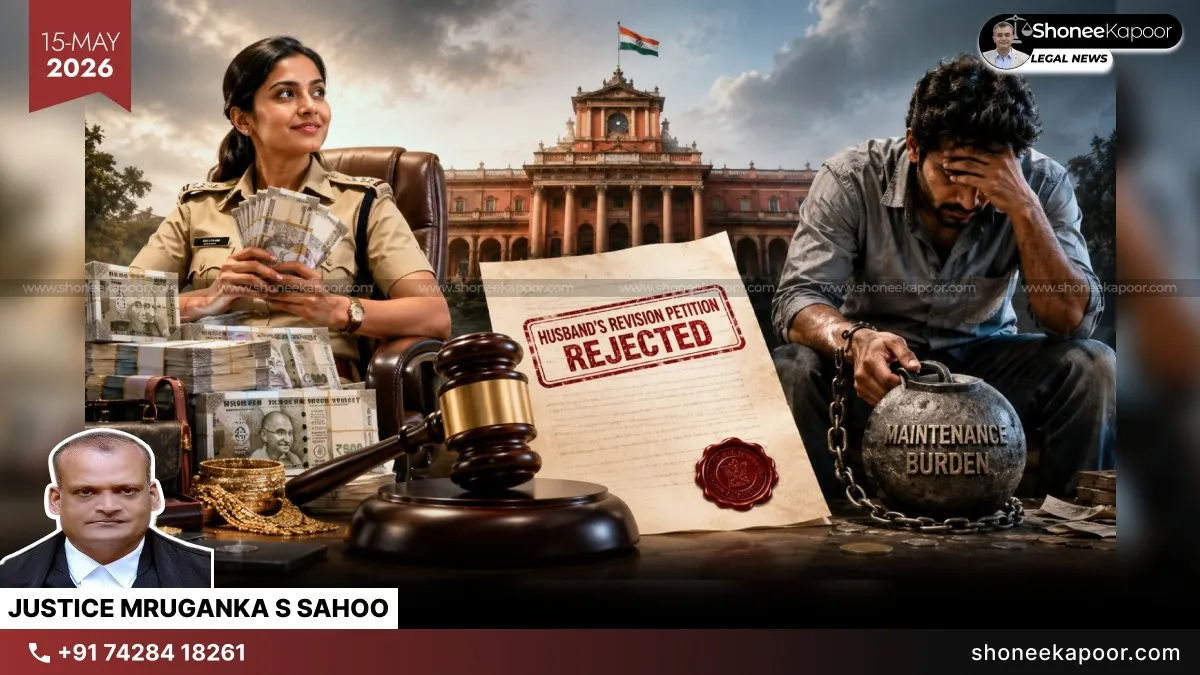
Can a husband lose his maintenance challenge even when the wife is financially independent?
The Orissa High Court says yes. The Court treated the husband’s MBA and engineering qualifications as proof of earning capacity despite his claim of financial hardship.
ORISSA: The Orissa High Court has refused to interfere with a Family Court order directing a husband to pay ₹6,000 monthly maintenance to his wife despite the fact that she is employed in a government job.
Justice Mruganka Sekhar Sahoo, while dismissing the husband’s revision petition, observed that an able-bodied and educated husband cannot avoid his legal obligation to maintain his wife merely by taking the plea of unemployment or financial hardship.
The dispute began after the wife filed a maintenance case under Section 125 CrPC seeking ₹50,000 per month. The Family Court at Bhubaneswar later awarded her ₹6,000 monthly maintenance from January 2020.
Challenging this order before the High Court, the husband argued that the wife was already working as an Assistant Revenue Inspector in the office of the Tahasildar, Cuttack, and was earning a regular salary, therefore she was financially capable of maintaining herself.
During the proceedings, the High Court noted that the husband was highly educated and professionally qualified. The records showed that he had completed Master in Engineering and MBA qualifications and had earlier worked in reputed companies like Wipro and Harman.
The Family Court had also recorded that he had previously worked as a Senior Project Engineer and was capable of earning. At the same time, the Court also took note of the husband’s grievance that despite the wife having a stable government job with salary of around ₹31,000 per month, maintenance was still being continued against him.
The High Court observed that the husband had allegedly failed to clear maintenance dues for several years and arrears had crossed more than ₹4.31 lakh. The Court also noticed that despite repeated opportunities, the husband did not properly cooperate in early disposal of the matter.
While examining the issue, Justice Sahoo relied heavily upon Supreme Court judgments dealing with maintenance law. The Court reproduced the observations from Rajnesh v. Neha and reiterated that merely because a wife is earning does not automatically disentitle her from claiming maintenance.
The Court quoted:
“In Shailja v. Khobbanna, the Court held that merely because the wife is capable of earning, it would not be a sufficient ground to reduce the maintenance awarded by the Family Court.”
The High Court also highlighted the legal principle repeatedly used by courts in maintenance cases and quoted:
“An able-bodied husband must be presumed to be capable of earning sufficient money to maintain his wife and children, and cannot contend that he is not in a position to earn sufficiently to maintain his family.”
Justice Sahoo further relied upon the Supreme Court judgment in Shamima Farooqui v. Shahid Khan and observed that the responsibility of maintenance continues so long as the husband is capable of earning.
The Court ultimately held that the Family Court had properly appreciated the evidence and there was no major error requiring interference in revision jurisdiction. Justice Sahoo observed that the maintenance amount of ₹6,000 per month is not a huge fortune that has been showered on the wife and it does not deserve reduction.
With these observations, the Orissa High Court dismissed the husband’s revision petition and upheld the maintenance order passed by the Family Court.
Explanatory Table: Laws And Sections Involved
| Law / Section | Purpose | How Applied In This Case |
| Section 125 CrPC | Provides maintenance to wife, children and parents unable to maintain themselves. | Wife sought maintenance under this provision. |
| Section 144 BNSS, 2023 | Replaces Section 125 CrPC under new criminal laws. | Court noted it is pari materia to Section 125 CrPC. |
| Section 19(4), Family Courts Act, 1984 | Gives High Court revisional power over Family Court orders. | Husband filed revision petition under this section. |
| Section 25, Hindu Marriage Act | Deals with permanent alimony and maintenance after divorce. | Family Court continued ₹6,000 maintenance after divorce decree. |
| Article 15(3), Constitution of India | Allows special legal protection for women and children. | Referred while discussing maintenance as social justice law. |
| Article 39, Constitution of India | Promotes social and economic justice. | Used to explain object behind maintenance provisions. |
| Article 142, Constitution of India | Gives Supreme Court power to do complete justice. | Mentioned in Rajnesh v. Neha guidelines discussion. |
| Section 24, Hindu Marriage Act | Provides interim maintenance during matrimonial cases. | Referred in Supreme Court precedents cited by Court. |
| Section 125(2) CrPC | Allows maintenance from date of order or application. | Maintenance granted from filing date of petition. |
| Section 125(3) CrPC | Provides enforcement mechanism for unpaid maintenance. | Court noted husband’s large maintenance arrears. |
Case Details
- Case Title: Bibhuprasad Sahoo v. Snigdha Samaranika Das
- Court: Orissa High Court at Cuttack
- Case Number: RPFAM No. 01 of 2025
- Bench: Hon’ble Mr. Justice Mruganka Sekhar Sahoo
- Date of Judgment: 04 May 2026
- Counsels:
- For Petitioner: Ms. Rita Singh, Advocate
- For Opposite Party: Mr. Debidutta Mohapatra, Advocate
Key Takeaways
- A salaried government-employed wife still getting maintenance from her husband shows how maintenance law has slowly shifted from survival support to entitlement culture.
- Husbands are increasingly judged on “earning capacity” instead of actual income, while a wife’s real salary and financial stability often get diluted in maintenance calculations.
- A husband’s degrees, past jobs, and qualifications are now enough to presume he can always pay maintenance, even during unemployment or financial collapse.
- Maintenance litigation is increasingly becoming punishment for husbands through arrears, delays, and endless financial pressure instead of balanced justice between two earning spouses.
- Financial responsibility is still treated as a permanent obligation of the husband, while the financial independence of an earning wife rarely receives equal legal weight.
This Could Change Your Case-Get FREE Legal Advice-Click Here!
Disclaimer: The views and opinions expressed in this article are those of the Indian courts and do not necessarily reflect the official policy or position of “ShoneeKapoor.com” or its affiliates. This article is intended for informational and educational purposes only. The content provided is not legal advice, and viewers should not act upon this information without seeking professional counsel. Viewer discretion is advised.
