
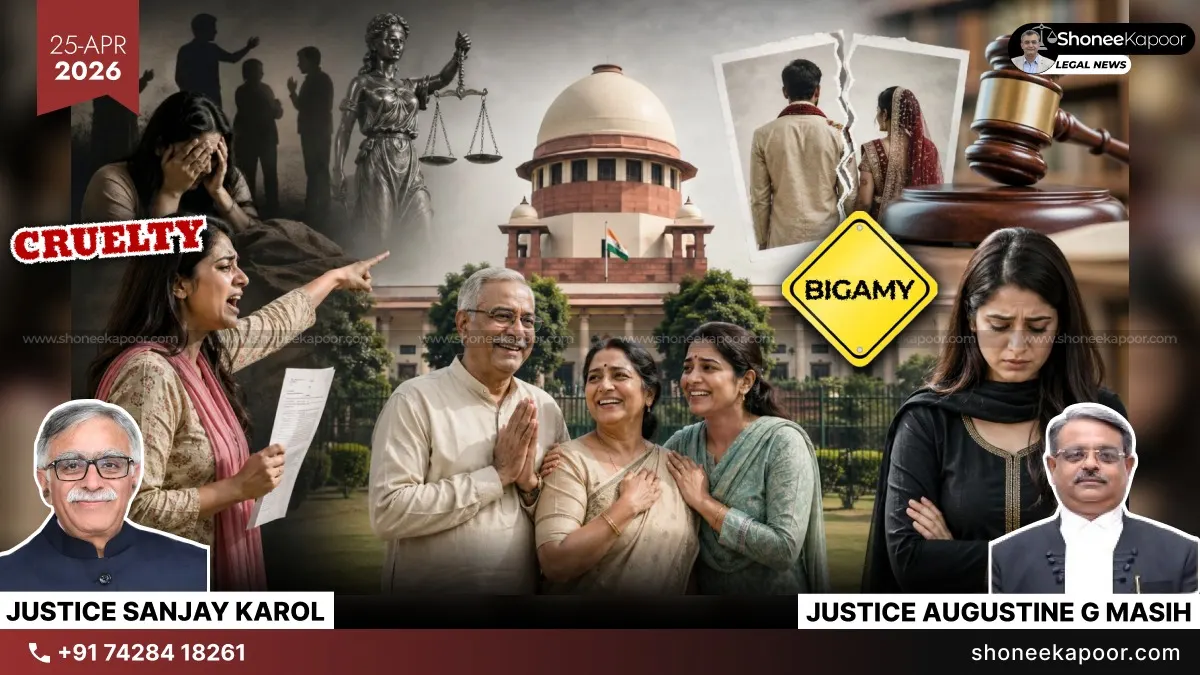
The Supreme Court held that common intention cannot be presumed from mere presence or awareness.
Why are innocent relatives still prosecuted without evidence of participation?
NEW DELHI: The Supreme Court of India has delivered a major judgment giving relief to the father-in-law, mother-in-law and sister-in-law in a criminal case filed under Sections 498A and 494 IPC. Justice Augustine George Masih and Justice Sanjay Karol passed the ruling in a case arising from Kerala, where a woman had accused her husband and his family members of dowry harassment, cruelty and concealment of the husband’s second marriage.
The complainant alleged that after her marriage in 2007, she was harassed for money and gold, physically assaulted, and later discovered that her husband had allegedly married another woman during the subsistence of the first marriage. Based on her complaint, an FIR was registered in 2016. A chargesheet was later filed against the husband and his family members.
The in-laws approached the Kerala High Court seeking quashing of the criminal case, but the High Court refused to interfere. They then moved the Supreme Court.
After hearing both sides, the Supreme Court examined whether there were clear and specific allegations against the husband’s relatives. The Court found that the main accusations of cruelty, assault and dowry demand were against the husband. Against the other family members, the allegations were general in nature and did not describe any direct act of harassment.
The Court relied on the famous State of Haryana v. Bhajan Lal judgment and repeated that inherent powers of courts can be used:
“To prevent the abuse of the process of any court or otherwise to secure the ends of justice.”
The Bench also relied on Dara Lakshmi Narayana v. State of Telangana and strongly cautioned against casually implicating relatives in matrimonial disputes. The Court quoted:
“A mere reference to the names of family members in a criminal case arising out of a matrimonial dispute, without specific allegations indicating their active involvement should be nipped in the bud.”
The judges noted that the father-in-law and mother-in-law were only accused of being present during some incidents and allegedly receiving money. However, no specific incident showed that they personally demanded dowry, threatened the complainant or assaulted her.
Similarly, the sister-in-law was accused only of receiving money for the purchase of a flat, but there was no material showing cruelty or coercion by her.
On the allegation of bigamy under Section 494 IPC, the Supreme Court relied on S. Nitheen v. State of Kerala and held that relatives cannot be prosecuted merely because they knew about the second marriage. There must be evidence of active participation or facilitation.
The Court clearly observed:
“Mere knowledge that an act is being or has been committed by another person does not, by itself, establish the requisite common intention.”
Since no concrete material existed against the in-laws, the Supreme Court set aside the Kerala High Court order and quashed the criminal proceedings against them. However, the case against the husband would continue separately.
Explanatory Table: Laws & Sections Involved
| Law / Section | Purpose | How Applied in This Case |
| Section 498A IPC | Punishes cruelty, harassment, dowry demands, mental or physical abuse by husband or his relatives. | Wife alleged cruelty and dowry harassment by husband and his family members. Supreme Court found specific allegations mainly against husband, not in-laws. |
| Section 494 IPC | Punishes bigamy when a person marries again during subsistence of first valid marriage. | Husband was accused of contracting second marriage. Court held no material showing in-laws actively participated in that marriage. |
| Section 34 IPC | Fixes joint liability when several persons act with common intention. | Used to implicate family members along with husband. Court held mere relationship or knowledge does not prove common intention. |
| Section 482 CrPC | Gives High Court power to quash false, abusive, or legally unsustainable criminal proceedings. | In-laws approached High Court and later Supreme Court seeking quashing. Supreme Court granted relief. |
| Section 156(1) CrPC | Allows police to investigate cognizable offences without prior Magistrate approval. | Mentioned while discussing principles from Bhajan Lal regarding police investigation powers. |
| Section 155(2) CrPC | Requires Magistrate permission before police investigate non-cognizable offences. | Mentioned in Bhajan Lal principles cited by Supreme Court. |
| Article 226 Constitution of India | Gives High Courts power to issue writs and protect legal rights. | Referred to while discussing extraordinary powers of courts to prevent abuse of legal process. |
Case Details
- Case Title: Sivaraman Nair and Others v. State of Kerala and Another
- Court: Supreme Court of India
- Case Type: Criminal Appeal arising out of SLP (Crl.) No. 9195 of 2025
- Neutral Citation: 2026 INSC 412
- Date of Judgment: 24 April 2026
- Originating FIR: FIR No. 1318 of 2016
- Bench: Justice Sanjay Karol & Justice Augustine George Masih
Key Takeaways
- Mere naming of family members in a 498A case is not enough; there must be clear, specific allegations showing their direct involvement.
- Vague and omnibus allegations are a common misuse tactic in matrimonial disputes and should not lead to criminal trial.
- Criminal liability cannot be extended to relatives just because they are part of the husband’s family or were allegedly present.
- In cases of alleged second marriage, relatives cannot be prosecuted unless there is proof of active participation or facilitation.
- Courts must actively prevent misuse of criminal law to harass innocent family members and ensure that only those with real involvement face trial.
This Could Change Your Case-Get FREE Legal Advice-Click Here!
Disclaimer: The views and opinions expressed in this article are those of the Indian courts and do not necessarily reflect the official policy or position of “ShoneeKapoor.com” or its affiliates. This article is intended for informational and educational purposes only. The content provided is not legal advice, and viewers should not act upon this information without seeking professional counsel. Viewer discretion is advised.
