
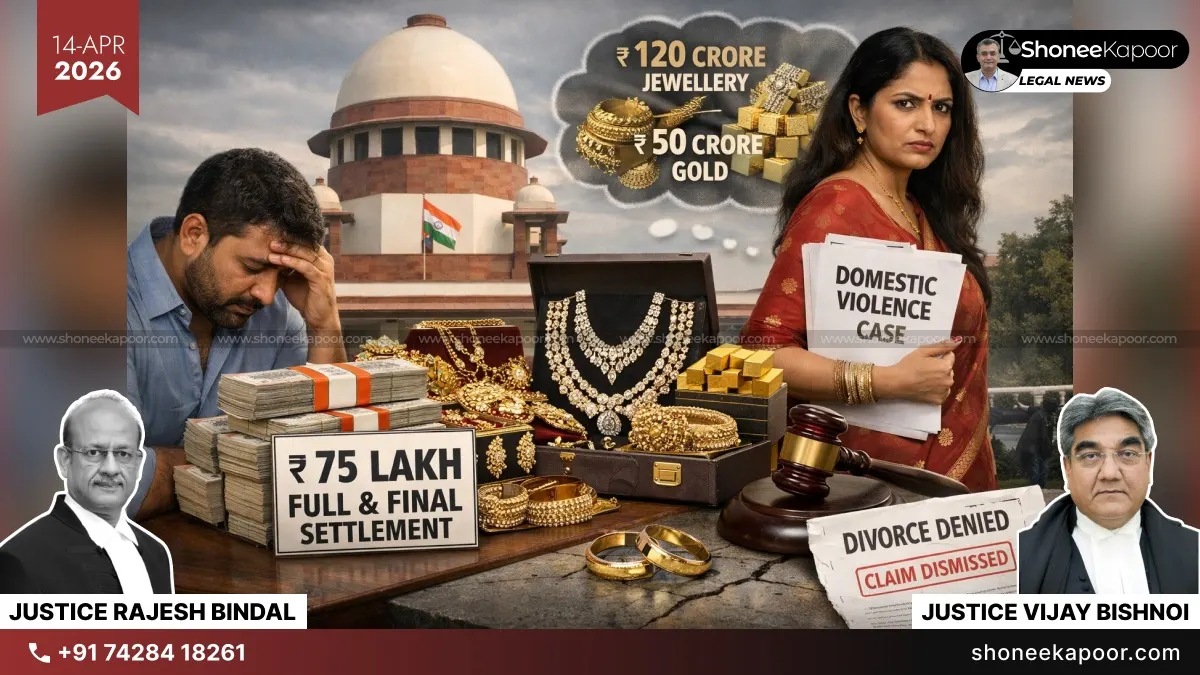
A court-approved settlement involving crores was fully acted upon—then suddenly challenged. What followed exposes how legal processes can be stretched beyond fairness, raising serious concerns about misuse.
NEW DELHI: The Supreme Court of India, in a judgment delivered by Hon’ble Mr. Justice Vijay Bishnoi and Hon’ble Mr. Justice Rajesh Bindal, highlighted how legal processes can be misused even after a full and final settlement between spouses.
The dispute began after matrimonial differences led to divorce proceedings, which were later referred to mediation. A detailed settlement was reached, and both parties agreed to dissolve the marriage by mutual consent, with financial terms settled.
The Court examined a situation where the husband had already paid substantial settlement money and complied with major terms, but the wife later withdrew from mutual divorce and initiated fresh proceedings under the Domestic Violence Act.
It was noted that the marriage had already broken down, with both parties living separately since 2022–23. Despite the settlement, the wife stepped back after receiving ₹75 lakh, jewellery, and other benefits, while the husband had withdrawn his earlier divorce case and and followed the settlement, which ended up putting him in a weaker legal position.
The Court clearly held that once parties enter into a mediated settlement, they cannot casually walk away from it unless there is clear proof of fraud, coercion, or non-compliance. In this case, the claims about additional jewellery worth ₹120 crore and gold worth ₹50 crore were not part of the settlement and were raised later, which weakened their credibility.
On the issue of domestic violence proceedings, the Court found that there were no specific allegations of actual violence and that the complaint appeared to be an afterthought. The Court stated:
“A criminal complaint regarding domestic violence, with mere reference to the names of the family members or the husband without any specific allegation that points towards their active involvement in commission of such an act of violence, shall be nipped in the bud.”
The Court further observed:
“The proceedings under the DV Act, as initiated by the Respondent-Wife, are liable to be quashed, the continuance of which would be an abuse of the process of law.”
It also took a strict view on parties backing out of settlements and held:
“Once the parties have entered into a settlement agreement… it is not open for the party to step back from the terms and conditions so arrived between them.”
The judgment reinforces that mediation settlements are binding in nature and cannot be treated as optional arrangements. Using criminal law after accepting settlement benefits was seen as misuse of the legal process.
Considering the overall facts, the Court found that the marriage had completely and irretrievably broken down and stated:
“There has been a complete and irretrievable breakdown of the matrimonial relationship… we see no point in continuation of any sorts of litigation.”
The Court ultimately dissolved the marriage using its constitutional powers, quashed the domestic violence proceedings, and directed completion of remaining financial obligations.
Explanatory Table: Laws & Sections Involved
| Law / Provision | Purpose | How Applied in This Case |
| Section 13(1)(i-a), 13(1)(ia) Hindu Marriage Act, 1955 | Divorce on grounds of cruelty/adultery | Husband initially filed divorce on these grounds |
| Section 13B(1) & (2) Hindu Marriage Act | Divorce by mutual consent | Parties agreed to mutual divorce through settlement |
| Section 24 HMA | Interim maintenance | Relevant in matrimonial disputes generally |
| Section 25 HMA | Permanent alimony | Settlement amount fixed as full and final alimony |
| Section 12 Domestic Violence Act, 2005 | Complaint for domestic violence | Wife filed DV case after settlement |
| Section 3 DV Act | Defines domestic violence (including economic abuse) | Wife claimed economic abuse to justify DV case |
| Section 528 BNSS, 2023 | Quashing of criminal proceedings | Husband sought quashing of DV complaint |
| Article 142(1) Constitution of India | Supreme Court power to do complete justice | Court granted divorce and ended all litigation |
| Section 125 CrPC (referenced via precedent) | Maintenance provision | Used in precedent cited by Court |
| Section 498A IPC (referenced via precedent) | Cruelty by husband | Discussed in similar case laws |
| Sections 3 & 4 Dowry Prohibition Act | Dowry-related offences | Referenced in precedent analysis |
| Section 138 NI Act (via precedent) | Cheque dishonour | Used to explain the settlement’s binding nature |
Case Details
- Case Title: Dhananjay Rathi vs Ruchika Rathi
- Court: Supreme Court of India
- Case Type: Criminal Appeal No. 1924 of 2026 (arising out of SLP (Crl.) No. 1878 of 2026)
- Date of Judgment: 13 April 2026
- Neutral Citation: 2026 INSC 360
- Bench: Hon’ble Mr. Justice Rajesh Bindal & Hon’ble Mr. Justice Vijay Bishnoi
- Counsels:
- For Appellant (Husband): Mr. Prabhjit Jauhar, Advocate
- For Respondent (Wife): Mr. Prashant Mendiratta, Advocate
Key Takeaways
- Accepting settlement money and then filing fresh criminal cases exposes how legal provisions can be misused against men.
- Courts have clarified that mediation settlements are binding and cannot be treated as optional once benefits are taken.
- Filing vague domestic violence complaints without specific allegations will not be allowed to continue.
- Withdrawing from mutual divorce after securing financial advantage can be seen as abuse of legal process.
- The judgment reinforces that men cannot be dragged into endless litigation after complying with settlement terms.
This Could Change Your Case-Get FREE Legal Advice-Click Here!
Disclaimer: The views and opinions expressed in this article are those of the Indian courts and do not necessarily reflect the official policy or position of “ShoneeKapoor.com” or its affiliates. This article is intended for informational and educational purposes only. The content provided is not legal advice, and viewers should not act upon this information without seeking professional counsel. Viewer discretion is advised.

Manipulation of the empathy elements embodied in women centric laws and judiciary have encouraged such degraded women to play with the lives of young boys to destroy their future life. This is planned and fabricated.