
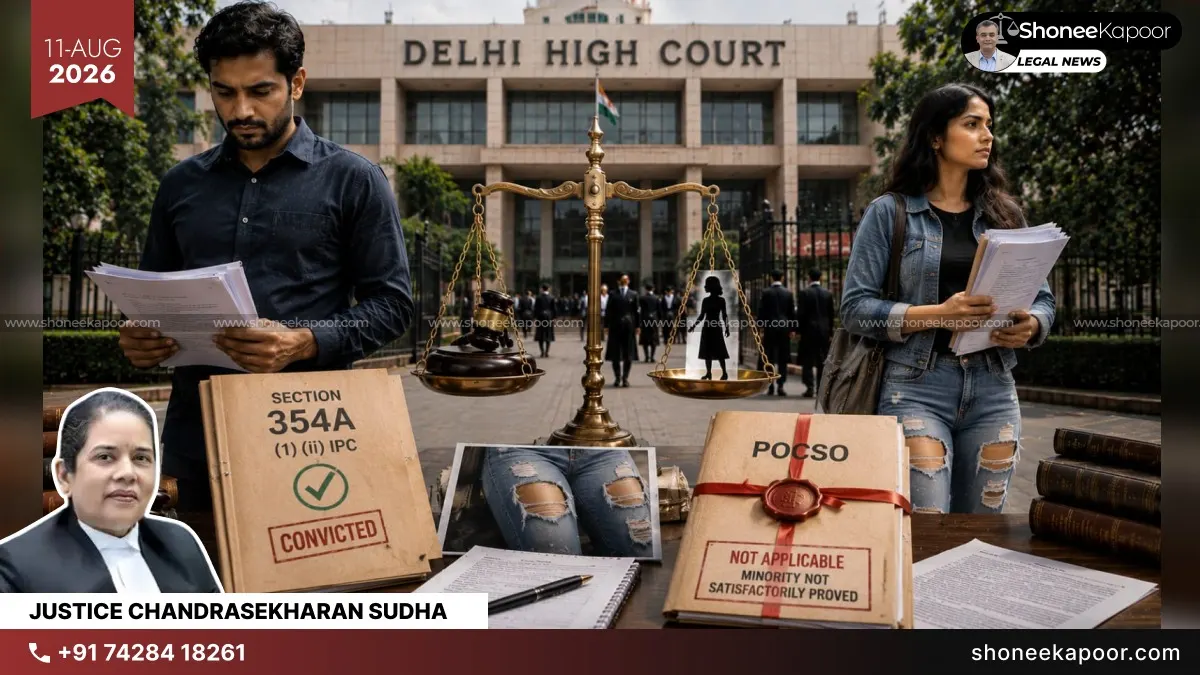
Can complaints by neighbourhood residents about a girl’s clothes and conduct create reasonable doubt in a sexual harassment case? The Delhi High Court has answered this while overturning an acquittal, but also drew an important line on POCSO, proof of age and the accused’s right to a fair trial.
NEW DELHI: The Delhi High Court has set aside the acquittal of a man and convicted him under Section 354A(1)(i) of the Indian Penal Code (IPC) for sexually harassing a girl in a 2013 incident. At the same time, the Court did not apply the POCSO Act because the prosecution could not satisfactorily establish that the prosecutrix was a minor. This distinction is important: even in a sensitive sexual-offence case, criminal liability must remain confined to offences actually proved by legally acceptable evidence.
Justice Chandrasekharan Sudha delivered the judgment on August 10, 2026, in an appeal filed by the State against Sajid Ali’s 2014 acquittal. The case arose from an incident dated July 17, 2013, in the Lal Kuan area of Delhi. According to the prosecution, Sajid had repeatedly made sexually coloured remarks towards the girl and had also touched her without consent. FIR No. 110/2013 was registered at Hauz Qazi Police Station.
The charge-sheet referred to Sections 354A and 354D IPC and Section 12 of the POCSO Act. The trial court, however, framed charges under Section 354A IPC and Section 10 POCSO Act. In August 2014, the trial court acquitted Sajid after finding discrepancies in the prosecution case, including issues concerning investigation and complaints submitted by neighbourhood residents against the girl and her mother.
An important aspect of the High Court judgment is that it did not simply accept every part of the prosecution case. The Court found that the prosecution had failed to satisfactorily establish the prosecutrix’s age or minority, and therefore held that the POCSO Act could not be invoked. This reinforces a basic criminal-law safeguard: the seriousness of an allegation cannot replace proof of the statutory ingredients of an offence.
However, after independently examining the girl’s evidence, the High Court found sufficient material for the offence of sexual harassment under Section 354A(1)(i) IPC. It rejected the trial court’s reasoning that failures in investigation concerning complaints filed against the girl and her mother created sufficient reason to discard the core prosecution case.
A major part of the judgment dealt with those neighbourhood complaints. More than 50 residents were stated to have complained about the girl and her mother. Among other allegations, the complaint objected to the fact that the two women lived without a male member in the family, criticised the girl’s clothing and alleged that her clothes adversely affected “innocent boys” of the locality. The High Court found no cognizable offence disclosed merely by such allegations.
The Court said:
“What a girl or woman chooses to wear is a matter of her personal choice. Neither her neighbours, nor society, nor the accused, nor counsel appearing in a court of law has any right to dictate her clothing. It is simply none of their concern. The suggestion that a woman wearing jeans may ‘corrupt young boys’ reflects a deeply troubling and unacceptable mindset. The answer does not lie in controlling the clothes of girls and women. Parents and society must instead teach their children to control their conduct, respect personal boundaries and treat every human with dignity, whether at home or outside.”
The High Court also criticised the attempt to portray the prosecutrix as a woman of questionable character and observed that even such a characterisation cannot take away a woman’s legal protection.
“Even a woman of easy virtue is entitled to privacy and no one can invade her privacy as and when he likes. So also, it is not open to any and every person to violate her person as and when he wishes. She is entitled to protect her person if there is an attempt to violate it against her wish. She is equally entitled to the protection of law.”
The Court particularly objected to the manner in which questions about the girl’s clothes were put during cross-examination. The girl had been questioned about whether she wore western and tight clothes and whether residents objected to her apparel. The High Court held that such questions were irrelevant to determining whether the alleged sexual conduct had occurred.
It observed:
“A woman’s choice of attire neither diminishes her dignity nor serves as justification or condonation for unlawful conduct directed against her. Questions founded upon regressive notions of how a woman ought to dress have no legitimate place in a court of law and cannot be permitted to become a device for character assassination or for blaming the prosecutrix.”
The defence had also referred to the religion of the prosecutrix and residents while questioning her clothing. During the appeal, defence counsel explained the point by saying, “Janab, har mohalle mein ek reeti riwaz hota hain jinko sabko manna padega”. The High Court rejected this reasoning and held that religion and local custom had no relevance to whether the ingredients of the criminal offence were proved.
The Court said:
“Her religion, the religion of the residents of the locality, and the clothes worn by her have no connection with that issue. Neither religion nor local custom can be used to justify unlawful conduct or to impose restrictions upon the personal choices of a woman. The attempt to bring the religion and attire of (the prosecutrix) into the case was entirely irrelevant and improper.”
The High Court also reminded trial courts that cross-examination is a valuable right of an accused, but that right is not unlimited. The Court expressly recognised that an accused’s right to a fair trial must be fully protected, while holding that irrelevant questioning cannot be used merely to shame or humiliate a witness.
It observed:
“Whenever cross-examination transgresses the bounds of relevance and propriety, or is employed as a means to intimidate, insult, harass or shame a witness, the Court must intervene promptly and decisively. The process of cross-examination cannot be reduced to an instrument of humiliation, nor can the dignity of a witness be sacrificed under the guise of testing her credibility.”
The Court further cautioned judicial officers to intervene when questioning becomes irrelevant, scandalous or insulting, particularly in cases involving children or victims of sexual offences.
“This duty assumes even greater importance where the witness is a child, a victim of a sexual offence or a person otherwise placed in a vulnerable position.”
Ultimately, the High Court held that the girl’s testimony regarding unwanted physical contact had not been discredited and that the ingredients of Section 354A(1)(i) IPC stood established. It therefore reversed the acquittal and convicted Sajid Ali under Section 354A(1)(i) IPC. Significantly, the Court did not revive the POCSO charge because the minority itself had not been satisfactorily proved.
The judgment also directed that those copies be circulated among Delhi’s judicial officers and sent to the Delhi Judicial Academy for appropriate training and sensitisation. Sajid Ali was directed to appear before the High Court on August 12, 2026 for hearing on sentence under Section 235(2) CrPC.
EXPLANATORY TABLE OF LAWS AND SECTION
| Law / Section | What It Means | Application In This Case |
| Section 354A(1)(i), IPC | Covers sexual harassment involving physical contact and advances containing unwelcome and explicit sexual overtures. | The High Court found this offence proved and convicted Sajid Ali under this provision. |
| Section 354D, IPC | Deals with stalking, including repeatedly following or contacting a woman despite clear disinterest. | It appeared in the charge-sheet, but the trial court had not framed a charge for this offence. The High Court ultimately convicted under Section 354A(1)(i). |
| Section 10, POCSO Act | Provides punishment for aggravated sexual assault on a child. | The trial court had framed a charge under this section, but the High Court held that the prosecution had not satisfactorily proved the prosecutrix’s minority, so POCSO could not be invoked. |
| Section 12, POCSO Act | Provides punishment for sexual harassment of a child. | This provision appeared in the prosecution’s charge-sheet allegations. |
| Section 378(3), CrPC | Deals with appeal against acquittal requiring leave of the High Court in specified cases. | The State challenged Sajid Ali’s acquittal before the Delhi High Court. |
| Section 207, CrPC | Requires supply of relevant police papers and documents to the accused. | The judgment records compliance before charges were framed. |
| Section 313(1)(b), CrPC | Allows the accused to personally explain incriminating circumstances appearing in prosecution evidence. | Sajid denied the allegations and claimed false implication. |
| Section 232, CrPC | Concerns acquittal where there is no evidence that the accused committed the offence. | The High Court noticed non-compliance by the trial court but found no demonstrated substantial prejudice to the accused. |
| Sections 154, 156 & 157, CrPC | Concern registration and investigation of cognizable offences and police powers to investigate. | Considered while examining whether neighbourhood complaints required investigation. |
| Sections 146–152, Evidence Act | Regulate cross-examination and the Court’s control over improper, indecent or insulting questions. | The High Court relied on these principles while criticising questions concerning the prosecutrix’s dress and character. |
| Sections 151 & 152, Evidence Act | Permit courts to prohibit indecent, scandalous, insulting or annoying questions in appropriate circumstances. | Used to emphasise the trial judge’s duty to stop humiliating questioning. |
| Section 155, Evidence Act | Deals with impeaching the credit of a witness. | The Court held that the clothing-related questioning was not genuinely aimed at testing credibility under this provision. |
| Section 235(2), CrPC | Requires hearing the convicted person on the question of sentence. | Sajid was directed to appear on August 12, 2026 for sentencing proceedings. |
CASE DETAILS
| Case Particular | Details |
| Case Title | State (NCT of Delhi) v. Sajid Ali |
| Court | High Court of Delhi at New Delhi |
| Case Number | CRL.A. 1065/2016 |
| CNR Number | DLHC012885792016 |
| Neutral Citation | 2026:DHC:6421 |
| Bench | Justice Chandrasekharan Sudha |
| Judgment Reserved | July 29, 2026 |
| Judgment Pronounced | August 10, 2026 |
| Trial Case | Sessions Case No. 165 of 2013, Additional Sessions Judge-01 (Central), Tis Hazari Courts, Delhi |
KEY TAKEAWAYS
- Acquittal is not always the end: A High Court can reverse it if the evidence was wrongly appreciated.
- POCSO cannot run on assumption: The prosecution failed to satisfactorily prove that the girl was a minor.
- Allegation is not evidence: Every ingredient of the offence must still be proved in court.
- Clothes cannot justify harassment: The Court rejected attempts to blame a woman’s attire or character.
- Men need due process, not public prejudice: Punish proven wrongdoing, but never turn accusation into automatic guilt.
This Could Change Your Case-Get FREE Legal Advice-Click Here!
Disclaimer: The views and opinions expressed in this article are those of the Indian courts and do not necessarily reflect the official policy or position of “ShoneeKapoor.com” or its affiliates. This article is intended for informational and educational purposes only. The content provided is not legal advice, and viewers should not act upon this information without seeking professional counsel. Viewer discretion is advised.
