
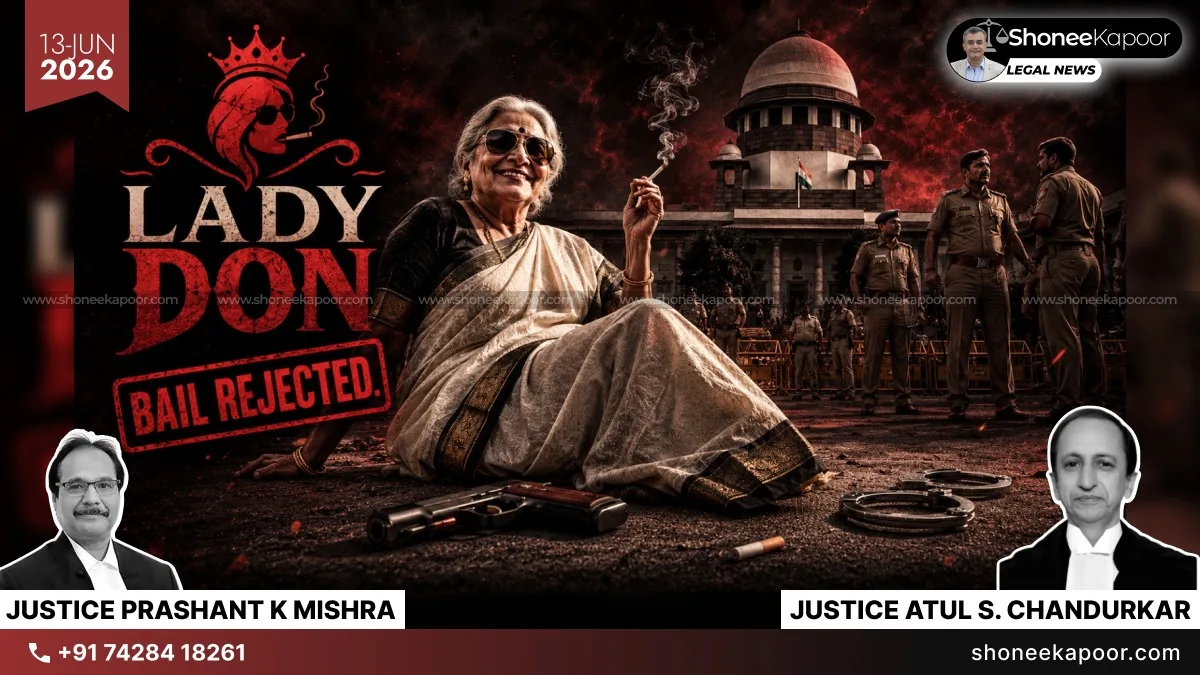
A 60-year-old woman sought bail citing age, illness, and delay in trial. Why did the Supreme Court still refuse relief and call her a “Lady Don”? Was this just about one narcotics case, or did her past record ultimately outweigh every other argument?
NEW DELHI: The Supreme Court has refused to grant bail to a 60-year-old woman accused in a narcotics case under the Narcotic Drugs and Psychotropic Substances (NDPS) Act, observing that her repeated involvement in similar offences weakened her claim for relief despite her age and medical condition.
A Bench of Justice Prashant Kumar Mishra and Justice Atul S. Chandurkar was hearing a Special Leave Petition filed by Akiloon Begum against the March 26, 2026 order of the Madhya Pradesh High Court. The High Court had rejected her fourth bail application in Crime No. 186/2025 registered at Dhanpuri Police Station in Shahdol district under Section 8/20 of the NDPS Act.
At the beginning of the hearing, the Bench questioned the conduct of the petitioner. Justice Mishra remarked:
“Why are you doing all this? You should lead a very decent life at this age.”
Appearing for the petitioner, Advocate C. Ankeeta Appanna argued that the trial was progressing slowly. According to the defence, only two witnesses had been examined in the past year even though the prosecution had listed 14 witnesses.
However, the Supreme Court took note of the woman’s criminal history.
Justice Mishra observed:
“You are not a first-time offender. You have a history.”
The petitioner’s counsel then highlighted her age and medical conditions, stating that she was suffering from diabetes and hypertension and required regular treatment. Despite these submissions, the Court remained unconvinced.
Justice Mishra observed:
“You have lost the credibility of being a lady… You are no longer a lady, you are a Lady Don.”
The defence responded by arguing that the existence of previous criminal cases should not automatically result in denial of bail. Counsel also pointed out that individuals already facing criminal proceedings could be implicated in additional cases.
It was submitted:
“The State machinery is such that if I go inside in one case, I can be easily planted in another case.”
Despite these arguments, the Supreme Court dismissed the petition and declined to grant bail.
According to the plea, Akiloon Begum has been in custody since May 28, 2025. She argued that the quantity of alleged contraband recovered from her was below the commercial quantity threshold. Therefore, the strict conditions under Section 37 of the NDPS Act should not apply to her case.
The petitioner further contended that the High Court had relied too heavily on her previous criminal record while ignoring settled legal principles that criminal antecedents alone cannot justify denial of bail. Reliance was placed on earlier judgments, including Puranmal Jat v. State of Rajasthan and Maulana Mohd. Amir Rashadi v. State of Uttar Pradesh.
The plea, filed through Advocate-on-Record Ashutosh Dubey, also stated that the charge sheet had already been filed and no custodial interrogation was required. It was argued that the trial was likely to take considerable time to conclude and that the petitioner, due to chronic health issues, required regular medication.
According to the prosecution, the petitioner was involved in the sale of narcotic substances. The police relied upon a memorandum statement allegedly made by her, in which she was said to have admitted selling narcotics in the past and restarting such activities a few months before her arrest.
The defence, however, questioned the reliability of this statement and argued that it was self-contradictory and could not be safely relied upon.
After considering the rival submissions, the Supreme Court found no reason to interfere with the High Court’s order. The Court refused to enlarge the petitioner on bail, effectively bringing her fourth attempt to secure regular bail to an end.
EXPLANATORY TABLE: LAWS AND SECTIONS MENTIONED
| LAW / SECTION | WHAT IT MEANS | HOW IT APPLIED IN THIS CASE |
| Section 8, NDPS Act, 1985 | Prohibits production, possession, sale, purchase, transport and use of narcotic drugs and psychotropic substances except as permitted by law. | The FIR alleged that the accused was involved in selling narcotic substances. |
| Section 20, NDPS Act, 1985 | Provides punishment for offences relating to cannabis, depending on the quantity involved. | The case was registered under Section 8/20 alleging illegal narcotics activity. |
| Section 37, NDPS Act, 1985 | Imposes strict conditions for grant of bail in offences involving commercial quantity of narcotics. | The petitioner argued that the recovered quantity was below commercial quantity, making Section 37 inapplicable. |
| Article 136, Constitution of India (SLP Jurisdiction) | Gives the Supreme Court discretionary power to hear appeals against judgments of lower courts. | The petitioner approached the Supreme Court through a Special Leave Petition challenging the High Court order. |
JUDGMENTS RELIED UPON BY THE PETITIONER
| JUDGMENT | PRINCIPLE RELIED UPON |
| Puranmal Jat v. State of Rajasthan | Criminal antecedents alone should not automatically result in denial of bail. |
| Maulana Mohd. Amir Rashadi v. State of Uttar Pradesh | Previous cases against an accused cannot be the sole basis for refusing bail; courts must assess the facts of the present case. |
CASE DETAILS
| PARTICULARS | DETAILS |
| Case Title | Akiloon Begum v. The State of Madhya Pradesh |
| Court | Supreme Court of India |
| Bench | Justice Prashant Kumar Mishra and Justice Atul S. Chandurkar |
| Hearing Date | June 12, 2026 |
| Type of Matter | Special Leave Petition (Criminal) arising from rejection of bail |
| Impugned Order | Order dated March 26, 2026 passed by the Madhya Pradesh High Court |
| Police Station | Dhanpuri Police Station |
| District | Shahdol, Madhya Pradesh |
| Crime Number | Crime No. 186/2025 |
| Custody Since | May 28, 2025 |
| Nature of Relief Sought | Regular Bail |
| Bail Attempt | Fourth Bail Application |
| Outcome | Bail Rejected; SLP Dismissed |
COUNSELS
| SIDE | COUNSEL |
| For the Petitioner | Advocate C. Ankeeta Appanna |
| Advocate-on-Record for Petitioner | Ashutosh Dubey |
KEY TAKEAWAYS
- Gender cannot become a shield when the allegations and criminal history tell a different story. Accountability must be gender-neutral.
- Society often extends automatic sympathy to women accused of crimes, while men are frequently presumed guilty from day one.
- The justice system must judge conduct, evidence, and antecedents—not age, gender, or stereotypes of who “looks like” an offender.
- If repeated allegations against men are used to brand them habitual offenders in public discourse, the same standards must apply to women as well.
- Equality means equal scrutiny. True justice begins when courts stop treating women as incapable of wrongdoing and men as guilty by default.
This Could Change Your Case-Get FREE Legal Advice-Click Here!
Disclaimer: The views and opinions expressed in this article are those of the Indian courts and do not necessarily reflect the official policy or position of “ShoneeKapoor.com” or its affiliates. This article is intended for informational and educational purposes only. The content provided is not legal advice, and viewers should not act upon this information without seeking professional counsel. Viewer discretion is advised.
