
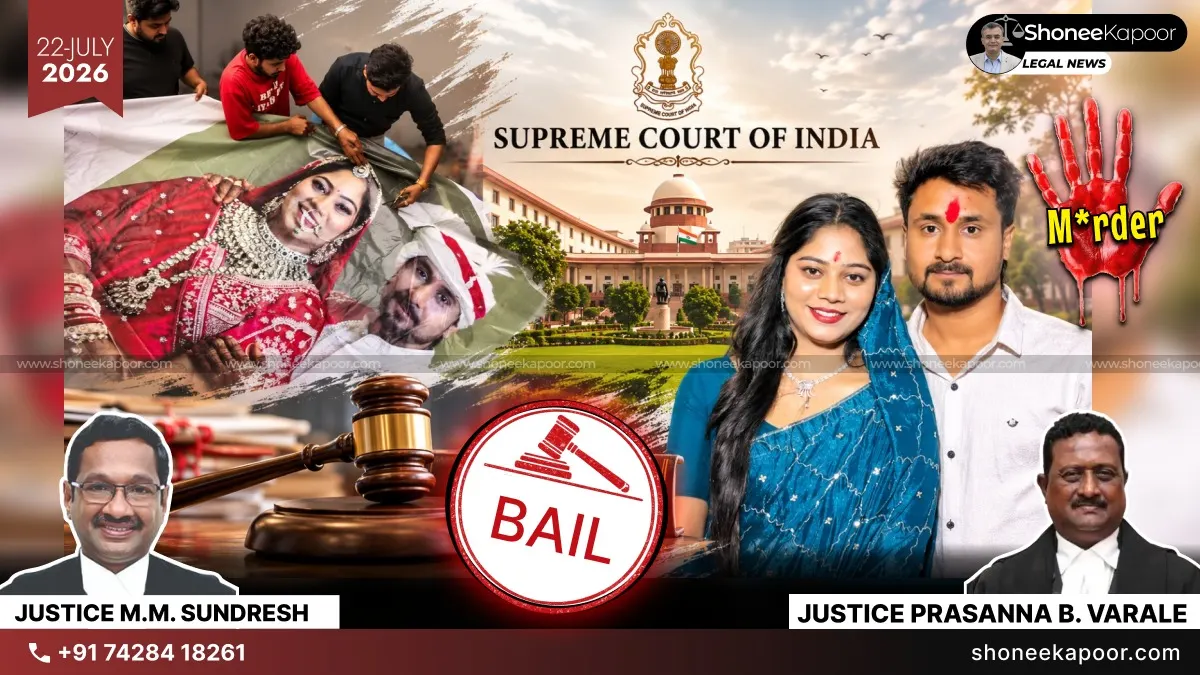
Can bail in a husband’s alleged pre-planned murder case continue merely because the arrest memo mentioned the wrong legal section? The Supreme Court has questioned Sonam Raghuvanshi’s conduct and asked why the objection regarding non-supply of arrest grounds was not raised at the first available opportunity.
NEW DELHI: The Supreme Court on July 21, 2026, suggested that Sonam Raghuvanshi, the main accused in the Meghalaya honeymoon murder case, should consider surrendering and facing trial. The Court also questioned the delay in challenging her arrest on the ground that proper reasons for arrest were not supplied to her.
A Bench comprising Justice M.M. Sundresh and Justice P.B. Varale was hearing a petition filed by the State of Meghalaya against the bail granted to Sonam by the High Court.
During the hearing, Justice Sundresh questioned Sonam’s lawyer about her conduct, the prosecution’s basic case and the stage at which she first raised the objection concerning the grounds of arrest.
“Your conduct itself—how do you explain? The case of the prosecution is that you along with the deceased went to that place. That is the foundational fact. So, we will not go into the other issues. Number two, regarding the grounds of arrest, did you raise it at the earliest point of time?” Justice Sundresh asked.
The Bench also questioned whether the clerical mistake in the arrest memo was serious enough to justify bail at the present stage of the criminal proceedings.
“How does the reasoning given by the High Court that Section 403 is Section 103, how does it matter at this stage of the case?” Justice Sundresh remarked.
The Supreme Court indicated that it could either decide the State’s petition on its merits or direct Sonam to surrender while important prosecution witnesses were examined by the trial court.
“Either we will consider and pass an order on merits or we will pass an order making you surrender. We are putting it to you because we don’t want to catch you by surprise and at the same time you should also understand our mind. You just get instructions and come back to us,” Justice Sundresh said.
The judge indicated that surrendering might be the more suitable option for Sonam at this stage.
“I think the second option is better for you. If you want to argue further, we will hear you and then decide one way or the other.”
The Court further observed that, in case Sonam surrendered, it could direct the trial court to first record the statements of independent public witnesses. Her request for bail could then be considered again after the evidence of those witnesses was recorded.
“If the second option is taken, we will issue directions to the trial court to examine the public witnesses and then we will take up the bail application,” the Bench said.
Solicitor General Tushar Mehta, appearing for the Meghalaya government, argued that Sonam was fully aware of the allegations and reasons behind her arrest. He clarified that the State was challenging the original grant of bail and not merely seeking cancellation of bail because of any later conduct.
According to the prosecution, Sonam allegedly conspired with her alleged lover and three hired attackers to murder her husband, Raja Raghuvanshi, during their honeymoon in Meghalaya.
The prosecution claims that Raja was taken to an isolated hilly location, killed and then thrown into a gorge. These allegations are yet to be finally proved during trial.
The Solicitor General submitted that Sonam surrendered only after the other accused persons had been arrested. He argued that she had not disputed this sequence of events in her previous applications or court pleadings.
Mehta stated that the reference to “Section 403” of the Bharatiya Nyaya Sanhita in the arrest memo, instead of Section 103, was only a typographical mistake. According to him, such an error could not automatically mean that the grounds of arrest were never communicated.
He referred to Article 22(1) of the Constitution and relied upon the Madhu Limaye judgment. He argued that the legal requirement of communicating the grounds of arrest is meant to prevent arbitrary arrest and ensure that an accused person understands the allegations.
The State also pointed out that Sonam did not raise any objection regarding non-supply of arrest grounds before the Magistrate or in her earlier bail applications. The objection was raised only at a later stage.
“At the stage of the third application, somebody may have advised that this can be a ground of non-communication of grounds of arrest. Your Lordships may have to examine at what stage you raise that ground. You raise that ground at the first available opportunity,” Mehta submitted.
The Supreme Court clarified that it did not intend to examine the complete prosecution story or decide the truth of the murder allegations at this stage. The matter was listed for further hearing on Thursday.
The High Court had granted bail to Sonam because several arrest-related documents referred to the non-existent “Section 403(1)” of the BNS instead of Section 103(1). The High Court viewed the repeated error as a sign that the arrest documents had been prepared without proper application of mind.
LAST HEARING IN SUPREME COURT – JULY 3, 2026
The Supreme Court had previously indicated that it might consider referring an important legal issue to a larger Bench. The issue is whether written grounds of arrest must always be supplied to an accused person at the time of arrest, especially when earlier judicial decisions appear to differ.
During previous hearings, Solicitor General Tushar Mehta submitted that written grounds of arrest had, in fact, been supplied to Sonam. However, Section 103 of the BNS was mistakenly typed as Section 403, even though Section 403 does not exist under the BNS.
The State argued that the lower courts granted bail only because this clerical mistake was treated as complete non-supply of the grounds of arrest.
The Supreme Court had earlier stressed that merely writing down legal provisions may not be sufficient. The basic nature of the allegation must also be explained to the arrested person.
“It’s not about simply mentioning sections…you have to give general background that you are involved in the murder of your husband…”.
On July 3, 2026, a Bench headed by Justice M.M. Sundresh refused to stay the bail granted to Sonam. The Court had expressed initial reservations about the High Court’s reasoning because the bail appeared to have been upheld mainly on the basis of the incorrect section mentioned in the arrest memo.
However, since Sonam had already been released, the Supreme Court declined to immediately suspend the bail order. It nevertheless agreed to hear Meghalaya’s petition challenging the decision.
On June 29, 2026, the High Court upheld the trial court’s bail order. It held that the repeated reference to “Section 403(1) BNS” instead of Section 103(1) could not simply be ignored as an ordinary typing mistake because it appeared in several important documents.
The High Court observed:
“The foundational basis for building up a case against the accused/respondent being found lacking, all other attempts to rectify the subsequent actions or process will have to fail.”
The case began after Sonam and Raja Raghuvanshi, who were married on May 12, 2025, went missing on May 23, 2025, during their honeymoon in Meghalaya. They were reportedly last seen leaving a homestay in Nongriat.
Their rented scooter was later found abandoned near Sohrarim. On June 2, 2025, around ten days after their disappearance, Raja’s body was recovered from a deep gorge near Weisawdong Falls in the East Khasi Hills.
Sonam remained missing until June 8, 2025, when she was found near a dhaba on the Varanasi-Ghazipur main road.
Meghalaya Police later named Sonam and 21-year-old Raj Kushwaha among the main suspects in Raja’s murder. The police have filed a chargesheet running into more than 700 pages, alleging that Sonam and Kushwaha had planned the murder in advance.
EXPLANATORY TABLE OF LAWS AND SECTIONS
| LAW OR PROVISION | WHAT IT PROVIDES | RELEVANCE TO THIS CASE |
| Article 22(1), Constitution of India | Every arrested person must be informed, as soon as possible, of the grounds of arrest. The person must also be allowed to consult and be defended by a lawyer of their choice. | Sonam’s bail argument was based on the claim that the grounds of her arrest were not properly communicated because the arrest documents repeatedly mentioned an incorrect and non-existent section. |
| Section 103(1), Bharatiya Nyaya Sanhita, 2023 | Provides punishment for murder. Murder is ordinarily punishable with death or imprisonment for life, along with fine. | This is the substantive murder provision that should allegedly have been mentioned in Sonam’s arrest documents. |
| “Section 403(1), BNS” | No such section exists in the Bharatiya Nyaya Sanhita in the form mentioned in the arrest documents. | The arrest memo and other documents allegedly mentioned Section 403(1) instead of Section 103(1). The High Court treated the repeated mistake as evidence of non-application of mind and ineffective communication of the grounds of arrest. |
| Section 3(6), Bharatiya Nyaya Sanhita, 2023 | Deals with criminal acts committed by several persons in furtherance of a common intention. Each participant may be held responsible as though the act had been committed individually. | Relevant because the prosecution alleges that Sonam acted with Raj Kushwaha and other persons under a common plan to murder Raja Raghuvanshi. |
| Section 238(a), Bharatiya Nyaya Sanhita, 2023 | Punishes causing the disappearance of evidence or giving false information to protect an offender where the underlying offence is punishable with death. | Potentially relevant to the allegation that the victim’s body was thrown into a gorge and efforts were made to conceal the crime. |
| Section 309(6), Bharatiya Nyaya Sanhita, 2023 | Falls within the BNS provision dealing with robbery and aggravated forms of robbery-related conduct. Its precise applicability depends on the allegations and charges framed in the trial record. | Publicly reported case timelines state that this provision was among the sections under which charges were framed. Its factual basis should be taken only from the formal charge order or chargesheet. |
| Arms Act, 1959 | Regulates the acquisition, possession, manufacture, use and carrying of arms and ammunition. It also prescribes punishment for unauthorised possession or use. | A supplementary chargesheet reportedly invoked Arms Act offences against certain accused. The exact Arms Act sections are not identified in the supplied report. |
| Article 136, Constitution of India | Gives the Supreme Court discretionary power to grant special leave to appeal against judgments or orders passed by courts and tribunals. | The State of Meghalaya approached the Supreme Court through an SLP challenging the bail order upheld by the Meghalaya High Court. |
| Special Leave Petition — Criminal | A procedural route through which a party requests the Supreme Court to examine a criminal order passed by a lower court or High Court. Grant of special leave is discretionary. | The State is asking the Supreme Court to interfere with the order granting bail to Sonam. |
| Grounds of Arrest Requirement | The arrested person must receive meaningful information about why they are being arrested. Merely listing section numbers may not always be sufficient if the basic allegations are not communicated. | The Supreme Court observed that the real allegation or basic background must be disclosed, not merely a set of penal provisions. |
| Bail | Temporary release of an accused from custody subject to conditions while investigation or trial continues. Bail is not an acquittal and does not decide guilt or innocence. | Sonam was released on bail because the courts below found defects in the communication of the grounds of arrest. |
| Cancellation or Setting Aside of Bail | A superior court may interfere where bail was granted on legally unsustainable grounds, relevant material was ignored, or the order was arbitrary or perverse. | Meghalaya argues that the bail itself was wrongly granted merely because Section 103 was typed as Section 403. |
| Surrender Pending Witness Examination | A court may direct or invite an accused to surrender and may arrange an expedited examination of material witnesses before reconsidering bail. | The Supreme Court suggested that Sonam surrender while public witnesses are examined, after which bail could be considered again. |
| Typographical Error in Judicial or Arrest Records | A minor clerical mistake does not automatically invalidate proceedings. Its effect depends on whether it caused prejudice, concealed the real allegations or showed serious non-application of mind. | The State calls “403” instead of “103” a harmless typing error. The High Court viewed its repetition across important documents as a serious defect. |
| Madhu Limaye Principle | The decision is relied upon for the principle that communicating grounds of arrest protects personal liberty, prevents arbitrary detention and enables the arrested person to seek legal remedies. | The Solicitor General relied on the case to argue that Sonam knew the substance of the allegations and was not prejudiced by the incorrect section number. |
CASE DETAILS
| PARTICULAR | DETAILS |
| Case Title | State of Meghalaya v. Sonam Raghuvanshi @ Bitti @ Bittu |
| Case Number | SLP (Crl.) No. 11944 of 2026 |
| Court | Supreme Court of India |
| Nature of Case | Special Leave Petition filed by the State of Meghalaya challenging the grant of bail to Sonam Raghuvanshi |
| Petitioner | State of Meghalaya |
| Respondent | Sonam Raghuvanshi @ Bitti @ Bittu |
| Bench on July 21, 2026 | Justice M.M. Sundresh and Justice P.B. Varale |
| Counsel for State of Meghalaya | Solicitor General of India Tushar Mehta |
| Advocate-on-Record for State | Avijit Mani Tripathi |
| Advocate-on-Record for Respondent | Abhay Singh |
| Person Allegedly Murdered | Raja Raghuvanshi, husband of Sonam Raghuvanshi |
| Main Accused Named in Reports | Sonam Raghuvanshi |
| Other Principal Accused Named | Raj Kushwaha, described by the prosecution as Sonam’s alleged lover |
| Impugned High Court Order | Meghalaya High Court order dated June 29, 2026, upholding the trial court’s order granting bail |
| Trial Court Bail Order | Bail was reportedly granted by the District and Sessions Court, East Khasi Hills, in April 2026 |
| Supreme Court Hearing Covered | July 21, 2026 |
| Next Hearing Mentioned | Thursday following the July 21 hearing |
| Chargesheet | More than 700 pages, according to the prosecution and media reports |
| Central Legal Issue | Whether repeatedly mentioning a non-existent penal section in arrest documents amounted to failure to properly communicate the grounds of arrest |
| Supreme Court’s Suggested Course | Sonam could surrender while the trial court records the evidence of important public witnesses, after which her bail plea could be reconsidered |
| Present Status | The Supreme Court had not finally decided the State’s challenge in the hearing covered by the report |
KEY TAKEAWAYS
- A typing mistake in an arrest memo should not overshadow the alleged planned murder of a husband.
- The Supreme Court questioned why the objection about arrest grounds was not raised at the first available opportunity.
- Constitutional safeguards must protect liberty, but they must not become technical escape routes in grave crimes.
- Bail is not acquittal, and the allegations against Sonam and the other accused still require a full trial.
- Men deserve equal justice after death; Raja must not become a forgotten statistic while procedure dominates the case.
This Could Change Your Case-Get FREE Legal Advice-Click Here!
Disclaimer: The views and opinions expressed in this article are those of the Indian courts and do not necessarily reflect the official policy or position of “ShoneeKapoor.com” or its affiliates. This article is intended for informational and educational purposes only. The content provided is not legal advice, and viewers should not act upon this information without seeking professional counsel. Viewer discretion is advised.
