
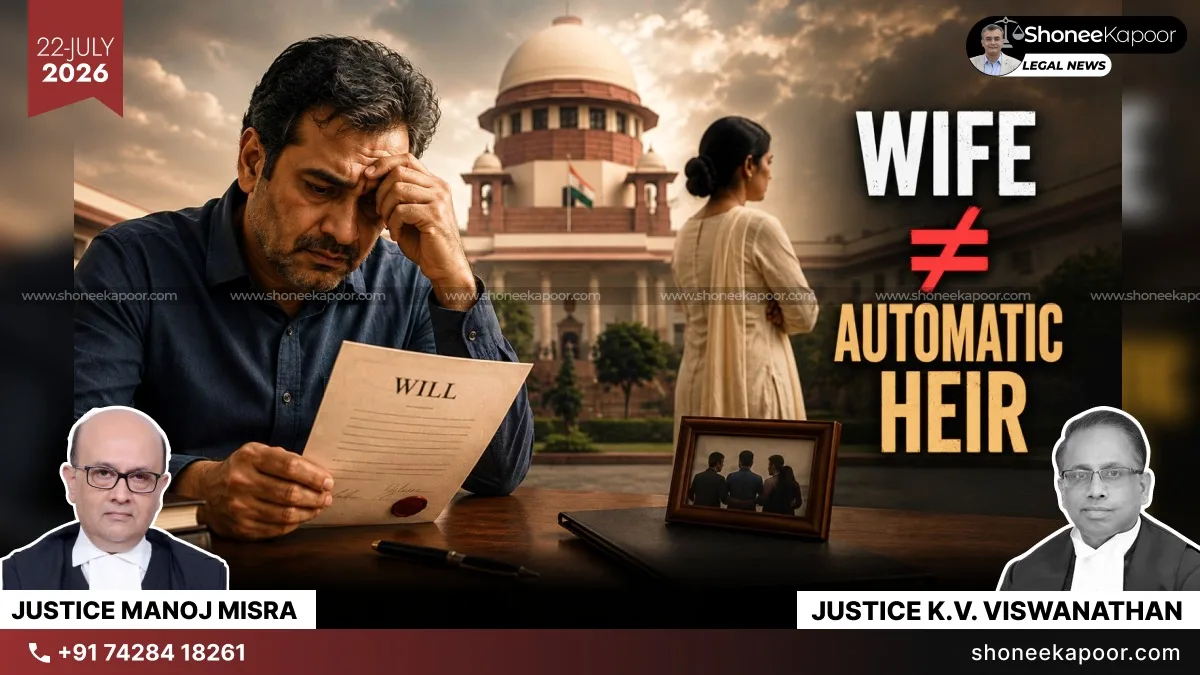
Can a husband leave his wife out of his Will and give his property to distant relatives? The Supreme Court has clarified that such a decision is not automatically illegal—but certain unusual facts may put the Will under serious doubt.
NEW DELHI:The Supreme Court has held that excluding a wife from a Will does not automatically make the document suspicious or invalid. However, when a husband excludes a wife who cared for him throughout their marriage and gives his entire property to strangers or distant relatives, the court must examine the Will more carefully.
The ruling was delivered by a Bench of Justice Manoj Misra and Justice K.V. Viswanathan in Sardari Lal v. Bishan Dass and Others, Civil Appeal No. 10990 of 2016.
The dispute concerned the property of Chhajju Ram, an illiterate agriculturist from Himachal Pradesh. He died without children in 1992. His wife, Bhambo Devi, claimed that she was his only legal heir and that her husband had died without making a valid Will.
However, Bishan Dass and other defendants relied upon a registered Will dated November 6, 1974. According to them, Chhajju Ram had transferred his movable and immovable properties to them because they had taken care of him and his wife. The widow alleged that the Will was forged and had been created through fraud or undue influence.
The Trial Court rejected the Will and ruled in favour of the widow. The First Appellate Court upheld that decision. However, the Himachal Pradesh High Court later accepted the Will and dismissed the widow’s claim. The matter then reached the Supreme Court.
The Supreme Court stated,
“The circumstance of disinheriting a wife may or may not be considered suspicious.”
The Court explained that every Will must be examined according to its own facts. A person has the freedom to decide how his self-acquired property will be distributed after his death. Therefore, merely excluding a wife or another legal heir does not automatically prove fraud, coercion or manipulation.
In the present case, the Court found that the beneficiaries were not the natural heirs or close relatives of the deceased. Evidence also showed that the husband and wife had cordial relations and that the wife had taken care of him until his death. This made the complete exclusion of the wife an unusual circumstance requiring a convincing explanation.
The Will claimed that the wife already had sufficient cash and jewellery. It also stated that the beneficiaries had provided food, clothing and other support to the couple. However, the courts found that these claims were not properly proved.
The evidence indicated that the couple lived separately from the beneficiaries. One beneficiary was away because of his employment, while another was only a young student when the Will was allegedly executed. The claim that the beneficiaries were the testator’s nephews was also not established.
The Supreme Court clarified that a person making a Will is not legally required to provide reasons for every bequest. However, when reasons are written in the Will, a court can examine whether those reasons are genuine or were inserted only to make a doubtful Will appear reasonable.
Another major concern was that Chhajju Ram was illiterate and could only place his thumb impression on documents. This placed a heavier responsibility on the persons relying upon the Will to prove that its contents had been properly explained to him and that he understood the consequences of excluding his wife.
The Court also noticed unexplained cuttings on the reverse side of the registered Will. The name “Laxmi Kant Bassi” had been struck out and replaced with “Chhajju”. The changes did not carry the initials or signature of the Sub-Registrar. There was also no clear evidence showing when or by whom these alterations were made.
The Court said that registration alone could not remove these doubts. Although registration may support the genuineness of a Will, it is not final proof that the document was voluntarily executed or that the testator fully understood its contents.
The Supreme Court found that the incorrect statements in the Will, the testator’s illiteracy, the complete exclusion of his only Class I heir, the choice of beneficiaries who were not close relatives, and the unexplained alterations created serious suspicious circumstances.
The persons relying upon the Will failed to remove those suspicions and satisfy the judicial conscience of the court. The Supreme Court therefore restored the decisions of the Trial Court and the First Appellate Court, which had rejected the Will and recognised the widow’s claim.
The Court also held that the Himachal Pradesh High Court had exceeded its limited jurisdiction under Section 100 of the Code of Civil Procedure by interfering with the well-reasoned factual findings of the First Appellate Court. The appeal was allowed and no order was passed regarding costs.
The judgment does not create a general rule that a husband must leave his property to his wife. It protects testamentary freedom and recognises that a man can ordinarily distribute his self-acquired property according to his own wishes. At the same time, the Will must be genuine, voluntary and properly proved.
Therefore, a husband can legally exclude his wife from his Will. But when the decision appears highly unnatural and is supported by incorrect or doubtful statements, the beneficiaries must provide strong evidence proving that the husband knowingly and freely made that choice.
EXPLANATORY TABLE OF LAWS AND SECTION INVOLVED
| Law and Provision | What It Means | How It Applied in This Case |
| Section 63, Indian Succession Act, 1925 | Lays down the legal requirements for executing an unprivileged Will. The testator must sign or affix his mark, and the Will must be attested by at least two witnesses. | The respondents argued that the Will had been legally executed because an attesting witness was examined. The Supreme Court held that technical compliance is only the first step. Suspicious circumstances must also be satisfactorily explained. |
| Section 68, Indian Evidence Act, 1872 | Requires at least one attesting witness to be called to prove a document that the law requires to be attested, provided such a witness is alive and capable of giving evidence. | One attesting witness was examined to prove the Will. However, the Court held that examining an attesting witness alone did not remove the doubts surrounding the Will. |
| Section 58, Indian Evidence Act, 1872 | Facts admitted by the parties generally do not need to be independently proved. | The defendants had admitted that Chhajju Ram owned the property, died without children and that his wife would inherit if the Will failed. Therefore, those admitted facts did not require further proof from the plaintiff. |
| Order VIII Rule 5, Code of Civil Procedure, 1908 | Allegations of fact that are not specifically denied may be treated as admitted, subject to the court’s discretion. | The Supreme Court considered the admissions contained in the defendants’ written statement while rejecting the argument that the plaintiff’s failure to enter the witness box was fatal. |
| Section 100, Code of Civil Procedure, 1908 | A second appeal before a High Court can be entertained only when a substantial question of law arises. It is not meant for routine reconsideration of factual findings. | The Supreme Court held that the High Court exceeded its jurisdiction by disturbing concurrent factual findings of the Trial Court and First Appellate Court concerning suspicious circumstances surrounding the Will. |
| Section 2(5), Registration Act, 1908 | Defines the terms “endorsement” and “endorsed” in relation to entries made by a registering officer on a document. | Relevant because the reverse side of the Will contained alterations and endorsements whose authenticity and manner of preparation were questioned. |
| Section 32, Registration Act, 1908 | Specifies who may present a document for registration, including the person executing it, a representative, an assign or a duly authorised agent. | The Court examined the statutory registration process while considering the evidentiary value of the Will’s registration. |
| Section 34(3), Registration Act, 1908 | Requires the registering officer to inquire whether the document was executed by the persons appearing before him and to verify their identity and authority. | The Court considered whether the registration endorsements reliably established that the testator personally and knowingly executed the Will. |
| Section 35, Registration Act, 1908 | Provides the procedure when execution is admitted or denied before the registering officer. | It was relevant to the argument that registration supported the due execution of the Will. The Court clarified that registration does not automatically prove a Will’s genuineness. |
| Section 52, Registration Act, 1908 | Deals with the duties of the registering officer when a document is presented, including recording the date, time and place of presentation and issuing a receipt. | The provision was discussed as part of the statutory registration procedure applicable to the disputed Will. |
| Section 58, Registration Act, 1908 | Requires specified particulars and endorsements to be recorded on a document admitted for registration. | The unexplained cuttings and replacement of a name on the reverse side of the Will raised doubts about whether the endorsements were properly made. |
| Section 59, Registration Act, 1908 | Requires the registering officer to affix the date and signature to the endorsements made on the document. | The alterations on the Will did not carry proper initials or authentication by the Sub-Registrar, which strengthened the suspicion surrounding the document. |
| Section 60(1), Registration Act, 1908 | Requires the registering officer to endorse a certificate containing the word “registered,” along with the relevant registration particulars. | The Court examined the registration certificate while deciding whether registration could remove doubts about execution. |
| Section 60(2), Registration Act, 1908 | States that a registration certificate is admissible to prove that the document was duly registered and that the statutory formalities mentioned in the certificate occurred. | The Court clarified that this presumption concerns registration formalities; it does not conclusively prove that a Will was voluntarily executed with full knowledge and understanding. |
CASE DETAILS
| Particular | Details |
| Case Title | Sardari Lal v. Bishan Dass & Others |
| Court | Supreme Court of India |
| Jurisdiction | Civil Appellate Jurisdiction |
| Case Number | Civil Appeal No. 10990 of 2016 |
| Neutral Citation | 2026 INSC 669 |
| Judgment Date | July 6, 2026 |
| Bench | Justice Manoj Misra and Justice K.V. Viswanathan |
| Judgment Authored By | Justice Manoj Misra |
| Counsel for Appellant | Ms. Radhika Gautam |
| Counsel for Respondents | Shri Rajesh Gupta |
| Impugned Judgment | Himachal Pradesh High Court judgment dated July 18, 2016, in Regular Second Appeal No. 475 of 2003 |
KEY TAKEAWAYS
- A wife is not automatically entitled to her husband’s self-acquired property through a Will.
- A husband can legally exclude his wife and leave his property to anyone he chooses.
- The Will must be genuine, voluntary and proved according to law.
- Registration alone does not make a doubtful Will valid. Suspicious alterations and false claims can destroy it.
- Courts must verify the evidence, but a man’s final decision over his own property should not be treated as wrongdoing merely because his wife gets nothing.
This Could Change Your Case-Get FREE Legal Advice-Click Here!
Disclaimer: The views and opinions expressed in this article are those of the Indian courts and do not necessarily reflect the official policy or position of “ShoneeKapoor.com” or its affiliates. This article is intended for informational and educational purposes only. The content provided is not legal advice, and viewers should not act upon this information without seeking professional counsel. Viewer discretion is advised.
