
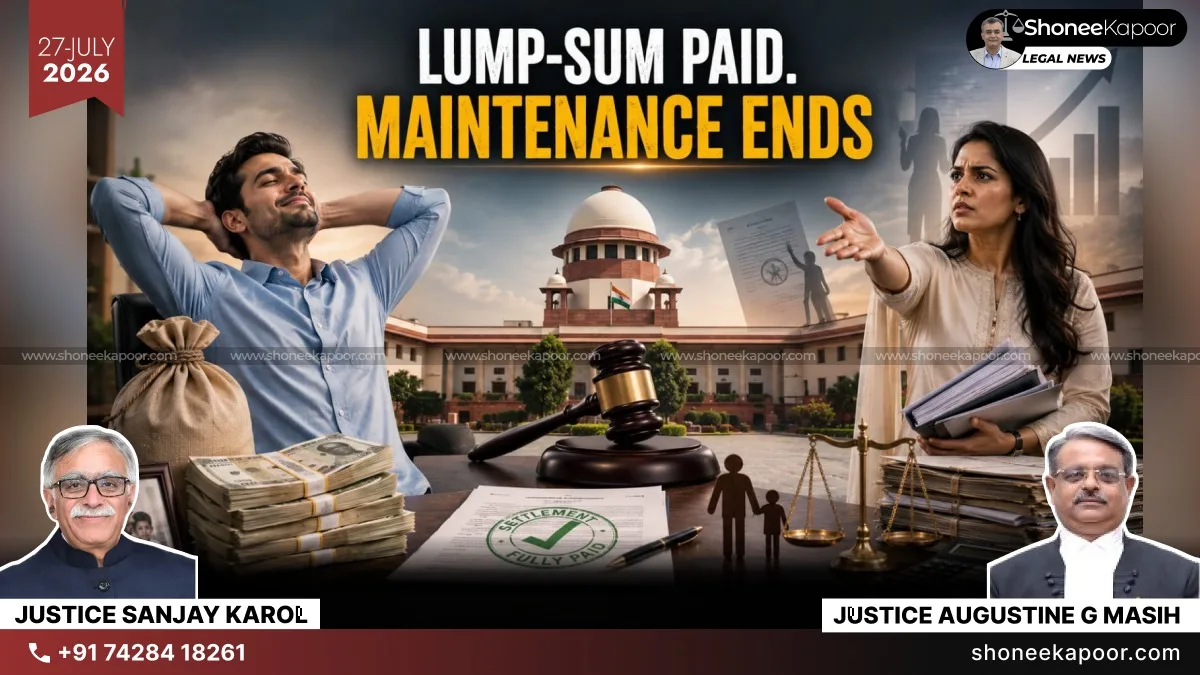
Can a wife continue demanding 20% of her former husband’s annual income after he has already paid the agreed ₹2.20 crore maintenance settlement?
The Supreme Court explained why a concluded divorce settlement cannot be reopened or rewritten through execution proceedings.
NEW DELHI: The Supreme Court of India has held that an income-linked maintenance clause ends once the husband pays the full lump-sum amount agreed in a mutual divorce settlement.
A Bench of Justice Sanjay Karol and Justice Augustine George Masih dismissed the appeal filed by a divorced wife seeking 20% of her former husband’s annual income, even after he had paid the complete ₹2.20 crore maintenance settlement.
The couple obtained divorce by mutual consent under Section 13B of the Hindu Marriage Act, 1955, on August 29, 2015.
Under Clause 8 of the settlement, the husband agreed to pay ₹2.20 crore towards the maintenance of their son. Clause 9 provided for payment of 20% of his annual income, while Clause 10 stated that after payment of ₹1 crore, the husband “need not pay any further amount towards maintenance”.
The husband paid the entire agreed amount. His final instalment was paid on July 28, 2017. However, nearly five years later, the wife filed an execution petition seeking 20% of his annual income with interest.
The Family Court dismissed her petition. The Karnataka High Court upheld the decision and said the Family Court’s interpretation was “just and proper and in consonance with the clear terms of the compromise petition”.
The wife then approached the Supreme Court. She argued that Clause 9 created a separate and continuing liability until the son completed post-graduation or attained the age of 23 years.
She also requested the Court to create an additional educational corpus of around ₹6 crore to ₹6.5 crore under Article 142 of the Constitution.
The husband argued that Clauses 8, 9 and 10 formed one complete settlement. According to him, Clause 9 was only a temporary arrangement until the lump-sum amount was paid.
The Supreme Court framed the main question as:
“Whether Clause 9 of the Settlement Petition dated 29.08.2015 constitutes an independent and continuing obligation surviving the payments made under Clauses 8 and 10 thereof, or stood satisfied and ceased to operate upon such payments; and consequently, whether the concurrent findings of the Family Court and the High Court warrant interference under Article 136 of the Constitution of India?”
The Court explained that an executing court cannot rewrite a decree. It can only enforce the settlement according to its actual terms.
The Supreme Court observed:
“Upon payment of the sum of Rs. 1,00,00,000/- out of the amount agreed under Clause 8, the Respondent-husband ‘need not pay any further amount towards maintenance’. The expression is comprehensive and unqualified. It is neither confined to maintenance of any particular description nor does it carve out the income-linked maintenance provided under Clause 9.”
The Court held that Clause 9 was not an independent lifetime liability.
It further observed:
“Clause 8 fixes the total quantum of maintenance. Clause 9 provides an interim income-linked mechanism to secure maintenance of the son during the period over which the lump sum under Clause 8 was being paid in installments. Clause 10 identifies the point of discharge, namely, once Rs. 1,00,00,000/- stood paid, the interim mechanism came to an end and only the balance under Clause 8 remained payable.”
The Bench held that all three clauses had to be read together. Clause 8 fixed the total amount, Clause 9 operated temporarily, and Clause 10 ended further maintenance liability after the specified payment.
The Court also considered that the wife had remained silent for nearly five years after accepting the complete settlement amount. She had not reserved any further claim while executing the related documents.
The Supreme Court refused to create an additional ₹6 crore to ₹6.5 crore corpus, holding that Article 142 cannot be used to rewrite a fully performed divorce settlement.
During the proceedings, the husband voluntarily deposited another ₹1 crore for his son’s higher education abroad. The Court clarified that this payment was voluntary and did not mean that Clause 9 was still active.
The Supreme Court finally held:
“Clause 9 of the Settlement Petition dated 29.08.2015, being an interim and transitional obligation, stood satisfied and ceased to operate upon the payments made in terms of Clauses 8 and 10 thereof, qua which the concurrent findings of the Family Court and the High Court warrant no interference under Article 136 of the Constitution of India.”
The appeal was dismissed.
The judgment makes it clear that a divorce settlement must bring financial finality. Once a husband has fully paid the agreed amount, an execution petition cannot be used years later to revive an already discharged clause and create endless financial liability.
EXPLANATORY TABLE OF LAWS AND SECTION
| LAW/SECTION | WHAT IT MEANS | RELEVANCE IN THIS CASE |
| Section 13B, Hindu Marriage Act, 1955 | Allows spouses to obtain divorce by mutual consent when statutory requirements are fulfilled. | The parties jointly filed M.C. No. 3644 of 2013 and obtained divorce according to their settlement. |
| Section 28A, Hindu Marriage Act, 1955 | Provides for enforcement of decrees and orders passed under the Hindu Marriage Act in the same manner as civil court decrees. | The wife relied on this provision while seeking execution of Clause 9. |
| Section 36, Code of Civil Procedure, 1908 | Applies the rules relating to execution of decrees to the execution of orders. | The wife filed the execution petition under Section 36 read with Order XXI Rule 10 CPC. |
| Order XXI Rule 10, Code of Civil Procedure, 1908 | Provides the procedure for applying for execution of a decree. | The wife used it to seek recovery of 20% of the husband’s annual income with interest. |
| Section 19(1), Family Courts Act, 1984 | Provides an appeal to the High Court against certain judgments and orders of a Family Court. | The wife appealed against the dismissal of her execution petition. |
| Article 136, Constitution of India | Gives the Supreme Court discretionary power to grant special leave against judgments or orders of courts and tribunals. | The wife challenged the concurrent findings of the Family Court and Karnataka High Court. |
| Article 142, Constitution of India | Allows the Supreme Court to pass orders necessary to do complete justice in a pending matter. | The wife sought creation of an additional ₹6 crore to ₹6.5 crore corpus for the son. |
| Article 136, Limitation Act, 1963 | Provides a limitation period of 12 years for execution of many decrees and orders. | The wife argued that her 2022 execution petition was filed within limitation. |
| Consent decree | A court decree based on settlement terms voluntarily agreed between the parties. | The divorce decree incorporated the Settlement Petition dated August 29, 2015. |
| Execution proceedings | Proceedings used to enforce an existing decree, not to determine new rights. | The wife attempted to enforce Clause 9 through an execution petition. |
| Harmonious construction | A rule requiring all clauses of a document to be read together so that each clause has meaning. | Clauses 8, 9 and 10 appeared to deal with different forms of maintenance. |
| Waiver, acquiescence and estoppel | Principles that may prevent a person from asserting a claim inconsistent with earlier conduct or prolonged acceptance. | The husband relied on the wife’s silence, release deeds and acknowledgments. |
| Laches | Unreasonable delay in asserting a right, which may affect discretionary relief. | The wife waited nearly five years after the final payment before filing execution. |
CASE DETAILS
| Particular | Details |
| Case Title | A v. B |
| Neutral Citation | 2026 INSC 731 |
| Court | Supreme Court of India |
| Case Number | Civil Appeal No. 9232 of 2026, arising out of SLP (C) No. 19770 of 2025 |
| SLP Number | Special Leave Petition (Civil) No. 19770 of 2025 |
| Bench | Justice Sanjay Karol and Justice Augustine George Masih |
| Judgment Authored By | Justice Augustine George Masih |
KEY TAKEAWAYS
- A settlement cannot become a lifetime ATM-Once the husband paid the agreed ₹2.20 crore, the income-linked maintenance clause came to an end.
- Execution proceedings cannot manufacture fresh liability- A court can enforce the decree, but it cannot rewrite it to create new financial demands.
- Nearly five years of silence mattered-After accepting the full settlement without reserving any claim, the wife later tried to revive a clause that had already ceased.
- Article 142 cannot rewrite a settled divorce deal: The Court rejected the additional ₹6–6.5 crore demand.
- Finality must protect husbands too: A man who fully honours the settlement cannot face endless fresh claims.
This Could Change Your Case-Get FREE Legal Advice-Click Here!
Disclaimer: The views and opinions expressed in this article are those of the Indian courts and do not necessarily reflect the official policy or position of “ShoneeKapoor.com” or its affiliates. This article is intended for informational and educational purposes only. The content provided is not legal advice, and viewers should not act upon this information without seeking professional counsel. Viewer discretion is advised.
