
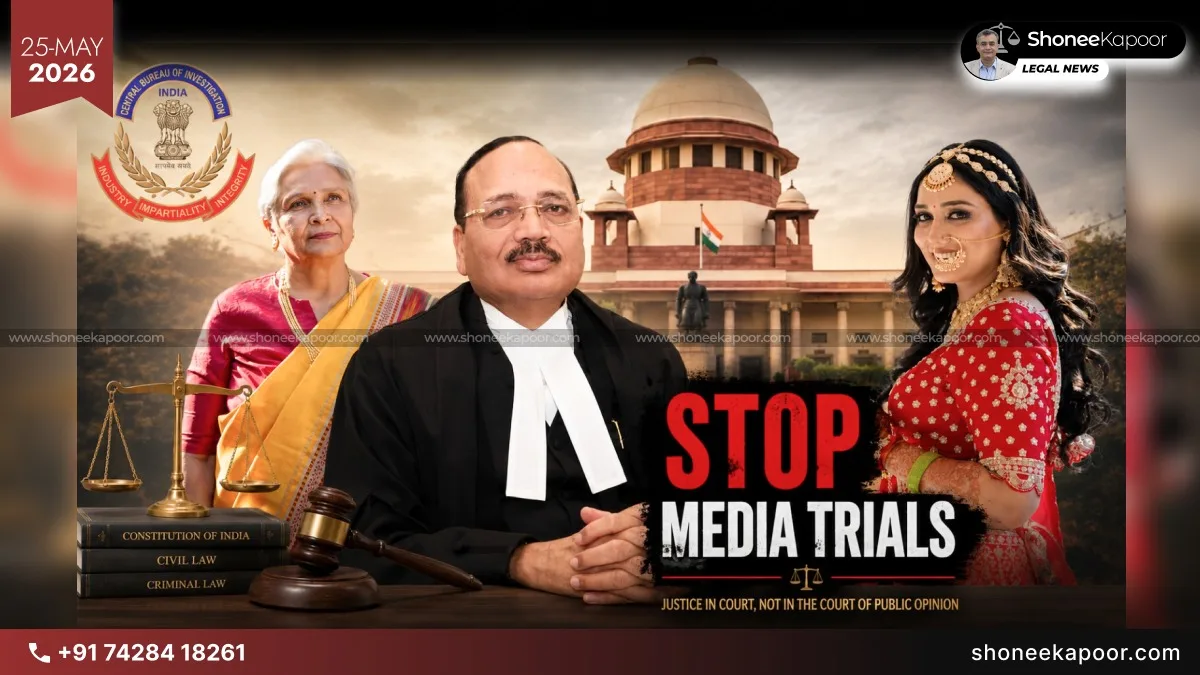
Was media pressure influencing the investigation before the facts were fully examined? Supreme Court has now asked people and media to avoid speculation as the CBI takes over the Twisha Sharma death investigation.
NEW DELHI: The Supreme Court Today (May 25th) indicated that the Central Bureau of Investigation (CBI) will take over the investigation into the death of Twisha Sharma in Madhya Pradesh.
Solicitor General of India Tushar Mehta informed the Court that the CBI would take charge of the case and that all administrative formalities would be completed immediately.
During the hearing, the Supreme Court also requested the media to avoid publishing statements from both sides while the investigation is still ongoing.
“We are slightly at pain because of some of the actions. We will request our media friends to not go for the statements of the victims family or the other family. Let the things move as per law and procedure,” the Chief Justice of India said.
The matter was heard by a bench comprising Chief Justice of India Surya Kant, Justice Joymalya Bagchi and Justice Vipul Pancholi in the suo motu case titled In Re: Alleged Institutional Bias and Procedural Discrepancies in the Unnatural Death of Young Woman at Matrimonial Home.
The Court observed that it had taken suo motu cognisance after narratives started emerging in public that there could be “institutional bias” in the investigation because Twisha Sharma’s husband is a practising advocate and her mother-in-law is a former District Judge.
The Supreme Court, in its order, asked the media not to publish statements of potential witnesses or accused persons because such reporting may affect issues that are still under investigation. The Court also appealed to the public to avoid speculation and place trust in the investigation being conducted by the country’s premier agency.
The bench further advised the victim’s family to record their statements before the investigating agency instead of addressing the press repeatedly.
Solicitor General Tushar Mehta submitted before the Court that “one of the potential accused”, the mother-in-law of Twisha, was appearing on multiple news channels and allegedly making statements against the deceased, which then led to counter statements and aggressive media coverage from the other side as well. He also informed the Court that the mother-in-law was allegedly not cooperating with the investigation.
Senior Advocate Siddharth Dave, appearing for the accused, raised concerns regarding media reporting and stated that the entire Section 164 CrPC statement had reportedly been published in newspapers.
Senior Advocate Siddharth Luthra argued that there was a delay of three days in registration of the FIR and also alleged failure in preservation of evidence. He further stated that the mother-in-law was allegedly producing her own Call Data Records, which according to him was not legally permissible.
The Solicitor General also informed the bench that a second post-mortem examination was conducted on Sunday by an AIIMS Bhopal medical team following directions issued by the Madhya Pradesh High Court.
The Supreme Court had registered the suo motu matter on Saturday based on “media reports and other attending circumstances.”
Twisha Sharma’s husband Samarth Singh, who is a practising advocate, and his mother Giribala Singh, a former District Judge, are facing allegations of dowry harassment and abetment to suicide.
Samarth Singh surrendered before the trial court after withdrawing his anticipatory bail plea from the Madhya Pradesh High Court. He has been sent to seven days police custody. Meanwhile, Madhya Pradesh Police have also approached the High Court seeking cancellation of anticipatory bail granted to Giribala Singh.
As per reports, Twisha Sharma, aged 33 and a former Miss Pune winner living in Noida, was found dead at her husband’s residence in Bhopal’s Katara Hills on May 12. The couple reportedly met through a dating application around five months ago.
Twisha’s family accused the in-laws of continuous harassment and domestic violence and sought a second post-mortem examination to determine the exact cause of death. The Madhya Pradesh High Court later allowed the plea for a second autopsy.
Explanatory Table Of Laws & Legal Sections Involved
| LAW / SECTION | MEANING IN SIMPLE TERMS | RELEVANCE IN THIS CASE |
| Section 498A IPC / BNS Equivalent | Cruelty by husband or relatives towards a married woman | Allegations of harassment and cruelty against husband and in-laws |
| Dowry Death Provisions (304B IPC / BNS Equivalent) | Death of a married woman linked to dowry harassment within marriage | Media reports and allegations relate to suspected dowry-linked death |
| Abetment to Suicide – Section 306 IPC / BNS Equivalent | Punishing a person accused of provoking or forcing another person to commit suicide | Main allegation against husband and in-laws |
| Section 164 CrPC | Judicial recording of witness or victim statements before a Magistrate | Senior Advocate Siddharth Dave objected to alleged media publication of such statements |
| Anticipatory Bail – Section 438 CrPC / BNSS | Pre-arrest bail granted by court | Husband withdrew anticipatory bail plea; police sought cancellation of mother-in-law’s bail |
| Police Custody Remand | Custody granted to police for interrogation during investigation | Husband remanded to 7-day police custody |
| Suo Motu Jurisdiction | Court taking up a matter on its own without formal petition | Supreme Court initiated proceedings based on media reports and surrounding circumstances |
| Second Autopsy / Post-Mortem | Fresh medical examination of body to verify cause of death | Ordered due to allegations regarding investigation and evidence concerns |
| CBI Investigation | Transfer of probe to central agency for independent investigation | Supreme Court accepted proposal for CBI takeover |
| Preservation of Evidence | Legal duty to secure evidence properly during investigation | Concerns raised regarding delay in FIR and handling of evidence |
| Call Data Records (CDR) | Mobile phone communication records used during investigation | Questions raised over accused allegedly producing personal CDRs independently |
Case Details
| PARTICULARS | DETAILS |
| Case Title | In Re: Alleged Institutional Bias and Procedural Discrepancies in the Unnatural Death of Young Woman at Matrimonial Home |
| Case Number | SMW (Crl.) No. 4/2026 |
| Court | Supreme Court of India |
| Bench | Chief Justice Surya Kant, Justice Joymalya Bagchi, Justice Vipul Pancholi |
| Nature of Case | Suo Motu Criminal Writ Proceedings |
| Investigation Agency | Central Bureau of Investigation (CBI) |
| Key Accused Named In Reports | Samarth Singh and Giribala Singh |
| Main Allegations | Dowry harassment and abetment to suicide |
| Date Of Incident | May 12, 2026 |
| Place Of Incident | Katara Hills, Bhopal, Madhya Pradesh |
Counsels Appearing
| COUNSEL | APPEARED FOR |
| Tushar Mehta, Solicitor General of India | State / Investigation Side |
| Senior Advocate Siddharth Dave | Accused Side |
| Senior Advocate Siddharth Luthra | Party Raising Procedural Concerns |
Key Takeaways
- The Supreme Court itself cautioned media against running statements from either side because public narratives were influencing the investigation before facts were fully established.
- The husband faced arrest, police custody, passport restrictions, and nationwide public scrutiny even before final forensic findings or trial conclusions.
- The Court acknowledged concerns regarding “institutional bias” and procedural discrepancies, showing that investigation fairness itself had become a serious issue.
- Publication of Section 164 CrPC statements and continuous television debates raised major concerns about violation of due process and presumption of innocence.
- The case once again exposes how in high-profile matrimonial allegations, men are often socially declared guilty first while legal safeguards arrive much later.
This Could Change Your Case-Get FREE Legal Advice-Click Here!
Disclaimer: The views and opinions expressed in this article are those of the Indian courts and do not necessarily reflect the official policy or position of “ShoneeKapoor.com” or its affiliates. This article is intended for informational and educational purposes only. The content provided is not legal advice, and viewers should not act upon this information without seeking professional counsel. Viewer discretion is advised.
