
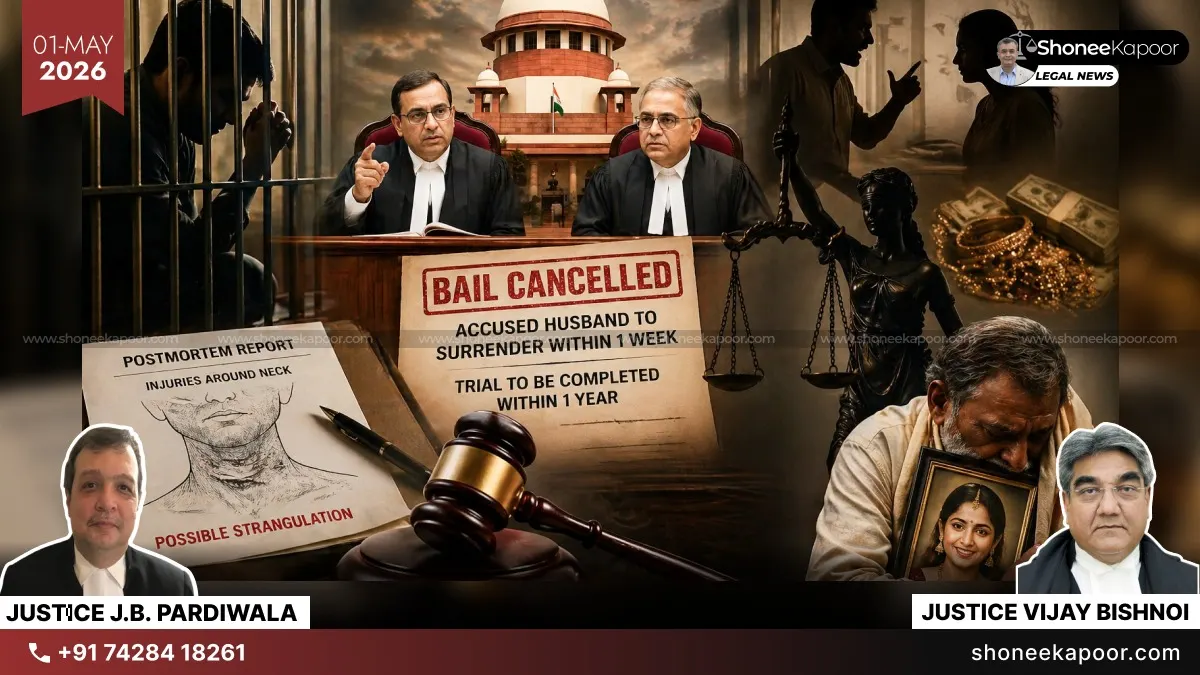
The Supreme Court cancelled the husband’s bail in a dowry death case, citing ignored evidence and Section 113B presumption.
Do statutory presumptions shift the balance so heavily that the man must prove innocence even before the trial begins?
NEW DELHI: The Supreme Court of India cancelled the bail granted to a husband accused in a dowry death case, raising serious concerns about how the Allahabad High Court exercised its discretion.
The Court directed the accused to surrender within one week and ordered that the trial be completed within one year. While the order focuses on the gravity of allegations, it also reflects how, in matrimonial disputes, the legal system often proceeds on strong presumptions at the very initial stage, significantly impacting the liberty of the accused husband.
The matter reached the Court through a special leave petition filed by the deceased woman’s father challenging the grant of bail. At the outset, the Supreme Court examined the postmortem report, which recorded injuries around the neck, indicating possible strangulation. At this stage, before full trial and cross-examination, such medical observations often become decisive factors, even though the defence has limited opportunity to contest them in detail.
During the hearing, Justice Pardiwala directly questioned the accused’s counsel and said:
“With these types of allegations and with the death within seven years, why should you be granted bail? Argue to the point, counsel, don’t make flimsy arguments, or we will cancel here and now. You have been charged with an offence of dowry death, and your wife was found dead under suspicious circumstances in your house. There were external injuries on her body. How do you explain the death of your wife?”
This reflects the judicial approach where, once the case falls within the framework of dowry death, the burden effectively shifts on the accused at a very early stage.
The Court also criticised the High Court’s approach and observed:
“What is wrong with this High Court, we [have] failed to understand. In cases where bail should not be granted, bail is granted.”
Such remarks indicate a tightening stance on bail in matrimonial offences, where courts are increasingly cautious, but this also raises broader concerns about consistency and balance in bail jurisprudence.
When the State’s counsel pointed out that the accused had already spent 18 months in custody, the bench was not persuaded. Justice Pardiwala remarked:
“You something Mr Counsel? This is a case of murder. 304B, yes. She has been strangulated to death; you want us to demonstrate? Come to page 31 [of postmortem report].”
This highlights how, despite prolonged incarceration without conviction, the seriousness of the allegation continues to outweigh considerations of personal liberty at the bail stage.
The Court noted that the marriage took place in February 2019 and the death occurred in July 2024, within seven years, attracting the presumption under Section 113B of the Indian Evidence Act. This shifts the burden onto the accused husband at an early stage, often before full trial, placing him in a defensive position from the outset.
The bench clarified that it was not commenting on the merits since the trial is ongoing, but held that granting bail in such circumstances was not legally sustainable. This highlights the ongoing tension between the right to personal liberty and the seriousness of allegations in matrimonial offences.
The Supreme Court of India cancelled the bail, directed surrender within one week, and ordered the trial to be completed within one year, emphasising the need for speed where an accused remains in custody.
Explanatory Table Of Laws & Provisions Involved
| Law / Provision | Purpose | How Applied in This Case |
| Section 304B IPC (Dowry Death) | To punish deaths of married women caused by dowry-related harassment within 7 years of marriage | Applied as the core offence since the woman’s death occurred within 7 years of marriage under suspicious circumstances |
| Section 113B, Indian Evidence Act | Creates a legal presumption that the husband or relatives caused dowry death if cruelty or harassment is shown before death | Used by the Court to presume involvement of the husband, strengthening the case against him at the bail stage |
| Bail Principles under Criminal Procedure (CrPC) | To ensure bail is granted based on seriousness of offence, evidence, and circumstances | Supreme Court held that the High Court failed to properly apply these principles in a serious offence |
| Postmortem Report (Medical Evidence) | To establish cause of death and nature of injuries | Injuries around the neck indicating possible strangulation were relied upon to deny bail |
| Prima Facie Evidence Standard | To assess whether sufficient initial evidence exists to proceed against the accused | Court found strong prima facie material, making bail legally unsustainable at this stage |
Case Details
- Case: SLP arising from dowry death bail matter
- Court: Supreme Court of India
- Bench: Justice JB Pardiwala and Justice Vijay Bishnoi
- Petitioner: Father of the deceased woman
- Respondent: Accused husband
- Factual Timeline:
- Marriage: February 2019
- Death of wife: July 2024
Key Takeaways
- Bail in matrimonial offences like Section 304B IPC is increasingly being denied at the threshold due to statutory presumptions, effectively reversing the practical burden onto the accused husband even before trial.
- Section 113B of the Evidence Act operates as a powerful tool, where mere proximity of death within 7 years of marriage can overshadow the presumption of innocence at the bail stage.
- Length of custody (even 18 months) is being given limited weight when allegations are serious, raising concerns about prolonged pre-trial incarceration of men without conviction.
- Courts are relying heavily on initial medical reports like postmortem findings, despite the defence having limited opportunity to challenge such evidence at the early stage.
- While speedy trial directions are given, the larger issue remains that men in matrimonial cases often face immediate liberty restrictions first, with due process and full defence coming much later.
This Could Change Your Case-Get FREE Legal Advice-Click Here!
Disclaimer: The views and opinions expressed in this article are those of the Indian courts and do not necessarily reflect the official policy or position of “ShoneeKapoor.com” or its affiliates. This article is intended for informational and educational purposes only. The content provided is not legal advice, and viewers should not act upon this information without seeking professional counsel. Viewer discretion is advised.
