
Is wife’s suicide enough to prove cruelty by husband and in-laws?
Supreme Court holds that criminal conviction requires clear evidence, not assumptions or emotional allegations, acquits husband in 498A case over lack of specific proof.
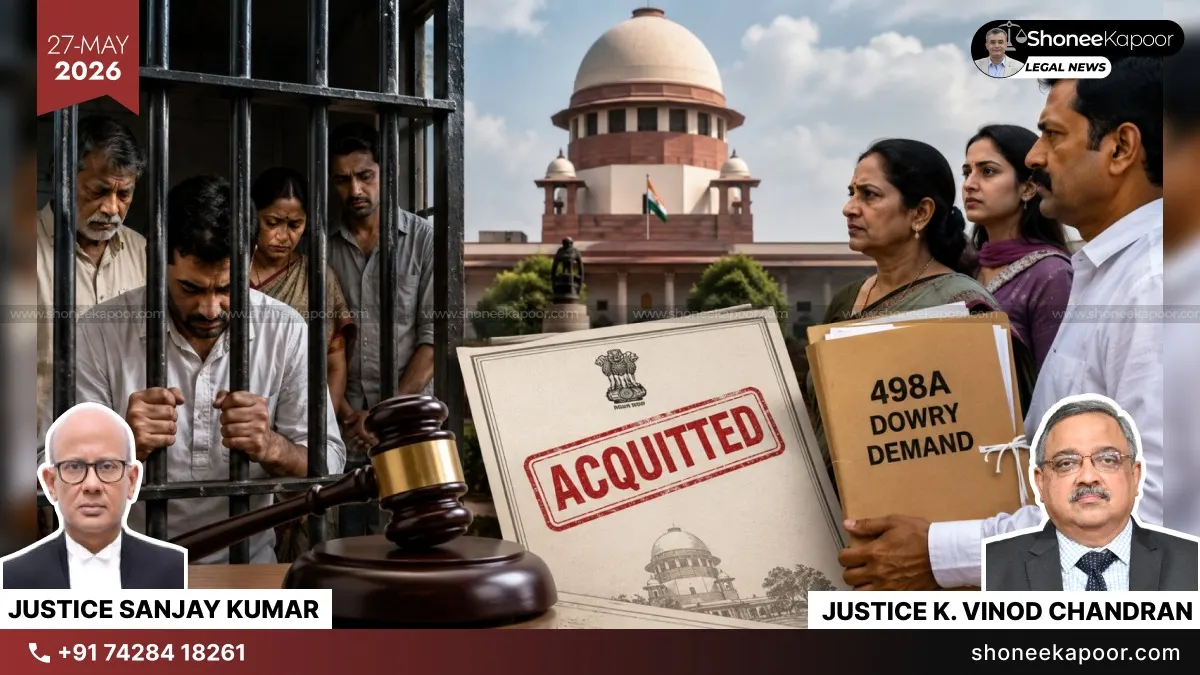
NEW DELHI: In an important judgment dated May 16 2026, the Supreme Court of India acquitted a husband who was earlier convicted under Section 498A IPC. The judgment was delivered by Justice K. Vinod Chandran along with Justice Sanjay Kumar. The Court observed that vague allegations and unproven claims cannot be the basis for conviction in criminal law.
The case came from Odisha, where the husband and his family members were accused of harassing a woman for dowry and driving her to suicide. The trial court had earlier acquitted them under Section 304B IPC related to dowry death because there was no proper evidence of dowry demand. However, the same court convicted them under Section 498A IPC and Section 4 of the Dowry Prohibition Act.
The Supreme Court strongly questioned this contradiction. The Court said:
“The conviction under the DP Act is inconsistent with the finding of the trial court that there is no demand of dowry established.”
The Bench also said it was “bewildering” that conviction under Section 498A IPC was recorded only on the basis of “general and omnibus allegations”.
During the hearing, the Court examined the evidence carefully. The prosecution mainly relied on statements of the woman’s relatives and some letters allegedly written by the deceased woman. The Court found that none of the witnesses gave clear details about specific incidents, dates, exact demands, or the role played by each accused person.
The judgment noted that the allegations made by the family members were “general and omnibus.” The Court also observed that there were no “specific or definite instances” mentioned in evidence.
The prosecution claimed that village mediation meetings were held after disputes between the couple. However, the evidence about such meetings was inconsistent. One witness spoke about six people attending the mediation, but another witness denied knowledge about it before the police investigation.
The Supreme Court also refused to rely on the letters produced in court. The judges pointed out serious defects in proving those documents. The Court recorded that there was “no date seen from the letters.” It further noted that the investigating officer “took no steps to ascertain whether the handwriting is of the deceased.”
While discussing the contents of the letters, the Court said they were vague and unclear. The Bench observed that “no clear case of harassment or torture comes out” from those letters. According to the Court, the letters only showed “discord between the two families” and “abiding dismay at the conduct of both the families.”
The Court clarified an important legal position regarding Section 498A IPC. It stated that even without dowry demand, cruelty or unlawful demands can still attract Section 498A. However, proper proof is necessary in every criminal case.
The judgment clearly stated:
“There need not be a demand of dowry, since any unlawful demand made by the husband or his family is covered under Explanation (b).”
The Court also explained that “mindless acts of physical or mental torture” driving a wife to suicide may amount to cruelty under the law.
Despite this legal position, the Supreme Court held that the prosecution completely failed to prove cruelty in the present matter. The Court finally observed:
“The evidence led, both the oral testimony and the documents, fall short of establishing the crime under Section 498-A.”
Setting aside the judgments of both the trial court and the High Court, the Supreme Court acquitted the husband and ordered his release. The appeal was allowed in full.
Explanatory Table: Laws And Sections Involved
| Law / Section | Purpose | Relevance in This Case |
| Section 498A IPC | Punishes cruelty by husband or relatives towards a married woman | Husband and in-laws were convicted under this section by lower courts, but Supreme Court acquitted them |
| Section 304B IPC | Deals with dowry death when a woman dies unnaturally within 7 years of marriage due to dowry harassment | Trial court acquitted accused because dowry demand was not proved |
| Section 34 IPC | Applies when multiple persons allegedly act together with common intention | Used along with Section 498A against husband and in-laws |
| Section 4, Dowry Prohibition Act, 1961 | Punishes demand for dowry | Supreme Court held conviction under this section could not survive because dowry demand itself was not proved |
| Explanation (a) to Section 498A IPC | Covers physical or mental cruelty severe enough to drive a woman to suicide | Supreme Court discussed this while explaining law on cruelty |
| Explanation (b) to Section 498A IPC | Covers harassment for unlawful demands, even beyond dowry | Court clarified that unlawful demand can attract 498A even without dowry demand |
| Probation of Offenders Act, 1958 | Allows release of convicted persons on probation instead of jail in certain cases | High Court had earlier released in-laws under probation |
| Section 4, Probation of Offenders Act | Provision for release on probation after conviction | Applied by High Court before Supreme Court reversed conviction entirely |
Case Details
- Case Title: Gandadhipa Sahu v. State of Odisha & Ors.
- Court: Supreme Court of India
- Case Number: Criminal Appeal arising out of SLP (Crl.) No. 21118 of 2025
- Neutral Citation: 2026 INSC 544
- Date of Judgment: 26 May 2026
- Bench: Justice Sanjay Kumar and Justice K. Vinod Chandran
- Counsels:
- For Appellant: Senior Advocate Sri Kailash Vasdev
- For Respondent-State: Ms. Ankita Chaudhary, State Counsel
Key Takeaways
- Mere allegations are not evidence. The Supreme Court clearly held that “general and omnibus allegations” cannot be the basis for conviction under Section 498A IPC.
- Specific incidents, dates, unlawful demands, and clear proof are necessary in criminal cases. Emotional statements alone are insufficient.
- Courts cannot sustain dowry-related convictions when even the allegation of dowry demand itself is not properly proved.
- Unverified letters, contradictory witness statements, and vague family allegations cannot override the principle of proof beyond reasonable doubt.
- Matrimonial disputes are increasingly seeing exaggerated accusations, and criminal law cannot be used as a tool for punishment without legally admissible evidence.
This Could Change Your Case-Get FREE Legal Advice-Click Here!
Disclaimer: The views and opinions expressed in this article are those of the Indian courts and do not necessarily reflect the official policy or position of “ShoneeKapoor.com” or its affiliates. This article is intended for informational and educational purposes only. The content provided is not legal advice, and viewers should not act upon this information without seeking professional counsel. Viewer discretion is advised.
