
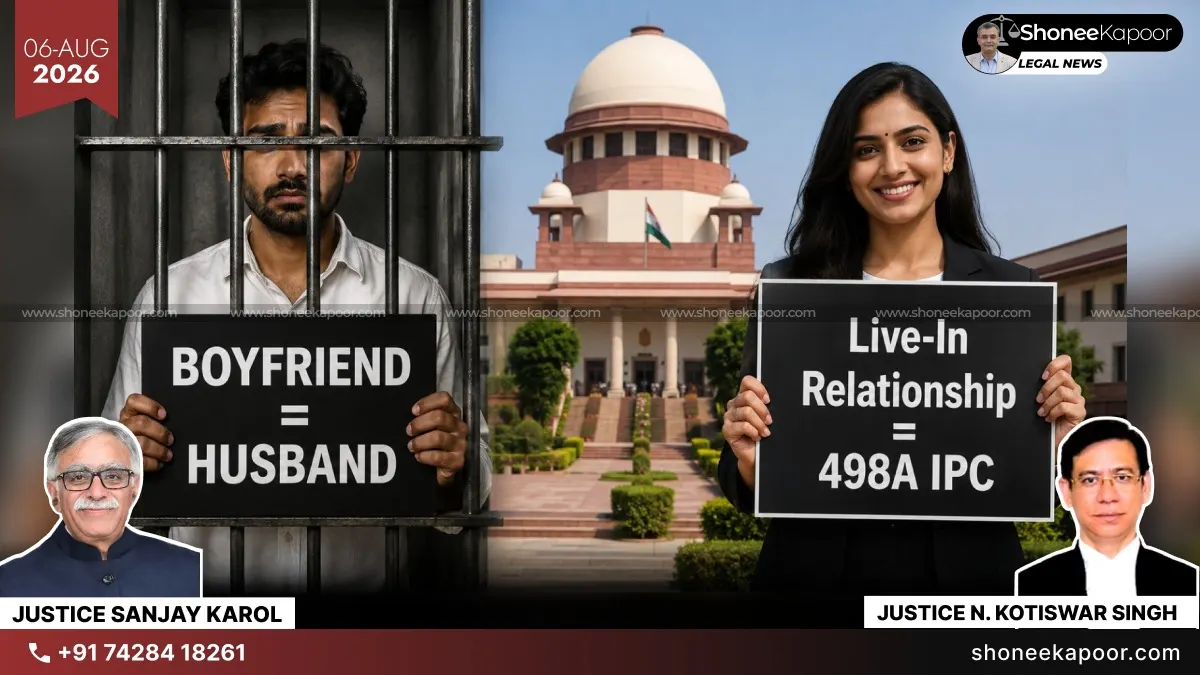
Can a man be prosecuted as a “husband” under Section 498A even when there is no legally valid marriage? The Supreme Court has expanded the provision to certain live-in relationships, while placing the initial burden of proof on the woman and reiterating safeguards against arrest.
NEW DELHI: The Supreme Court has ruled that a man in a live-in relationship may be prosecuted as a “husband” under Section 498A of the Indian Penal Code, 1860, even if the parties were not legally married.
However, the Court clarified that Section 498A will not automatically apply to every live-in relationship. The woman must first show that the relationship was in the nature of marriage and that both parties had an intention to marry.
A Bench comprising Justice Sanjay Karol and Justice Nongmeikapam Kotiswar Singh held that limiting the word “husband” only to men in legally valid marriages would defeat the object of Section 498A and create an unreasonable distinction under Article 14 of the Constitution.
The case arose from a relationship between the appellant and the second respondent. They were stated to have married according to Hindu customs in 2010 and lived together in Bengaluru.
Their relationship ended in 2016. Thereafter, two criminal complaints were filed against the appellant under Section 498A IPC and provisions of the Dowry Prohibition Act, 1961.
The appellant argued that no legally valid marriage had taken place. He submitted that Section 498A is a penal provision and must be strictly interpreted. According to him, a man cannot be prosecuted as a “husband” when the marriage itself is not valid in law.
The Karnataka High Court rejected this argument and refused to quash the criminal proceedings. It noted the allegation that the appellant had concealed his earlier marriage and had represented himself as the second respondent’s husband.
The appellant then approached the Supreme Court.
Before the Supreme Court, the appellant and the Union of India argued that the word “husband” under Section 498A should mean only a man in a valid marriage.
It was also submitted that a woman in a live-in relationship is not without legal protection because the Protection of Women from Domestic Violence Act, 2005 already recognises relationships in the nature of marriage.
On the other hand, the second respondent and the amicus curiae argued that Section 498A is a social welfare provision and should be interpreted according to its purpose. They submitted that a restrictive interpretation could allow a person to avoid criminal liability merely by questioning the validity of the marriage.
The Supreme Court rejected the argument that the Domestic Violence Act provides an adequate substitute for Section 498A.
The Court observed that proceedings under the Domestic Violence Act are mainly civil in nature, while Section 498A creates criminal consequences. Therefore, the availability of one remedy cannot be treated as a replacement for the other.
The Court stated:
“This distinction between ‘married’ and ‘live-in relationship in the nature of marriage’, in as much as it relates to the protection envisaged by Section 498A, has no rational nexus with the object of preventing domestic violence and is as such offensive to Article 14 of the Constitution of India.”
The Supreme Court also referred to the right of an adult to choose a partner as part of personal liberty and autonomy recognised in K.S. Puttaswamy v. Union of India.
It observed that cruelty or harassment by a partner does not depend only on whether the marriage was legally registered or valid. According to the Court, denying criminal protection only because the relationship was not a formal marriage could create an unreasonable classification.
The Court further observed:
“When the objective of the Section 498A was to provide coverage to those cases where harassment by husband or in-laws through wilful conduct causing mental or physical injury or driving the woman to suicide, then to say that such harassment can only be caused when they are married and not before that, in our considered view, would be a case of over simplification.”
At the same time, the Supreme Court placed an important restriction on the application of Section 498A.
It clarified that every romantic relationship, informal relationship or live-in arrangement cannot be treated as a marriage for criminal prosecution.
The relationship must satisfy the legal requirements of a “relationship in the nature of marriage”. In addition, there must be an intention between the parties to marry.
The Court distinguished such relationships from casual or temporary arrangements. It noted that even a relationship satisfying some of the indicators laid down in Indra Sarma v. V.K.V. Sarma may not necessarily involve an intention to enter into marriage.
Importantly, the Supreme Court held that the initial burden of establishing the intention to marry will lie on the woman seeking protection under Section 498A.
Therefore, a mere claim of being in a live-in relationship may not by itself be sufficient. The nature of the relationship, conduct of the parties, representations made, duration of cohabitation and intention to marry may have to be examined on the basis of evidence.
The Court stated:
“Those relationships that are in the nature of marriage and also have the requisite intent to marry are the closest to marriage itself, and it is those relationships that shall be entitled to the protection of this Section.”
The Supreme Court also recognised the possibility of misuse of Section 498A and directed the authorities to strictly follow the safeguards laid down in Arnesh Kumar v. State of Bihar.
Under the Arnesh Kumar guidelines, arrest cannot be made mechanically merely because an offence is registered. The police must examine whether arrest is genuinely necessary and comply with the statutory requirements before taking a person into custody.
This direction is particularly significant because extending Section 498A to live-in relationships may increase the number of cases in which the status of the relationship itself becomes disputed.
Questions such as whether the parties intended to marry, whether one party misrepresented marital status and whether the relationship was genuinely similar to marriage may require evidence and trial. Such disputed claims should not automatically result in arrest or punishment before judicial determination.
On the facts of the present case, the Supreme Court refused to quash the proceedings.
It held that the allegations in the complaint, when accepted at their face value, disclosed a prima facie cognizable offence. The Court observed that the actual nature of the relationship and the truth of the allegations could not be finally decided at the stage of quashing.
These issues would have to be examined by the Trial Court after considering the evidence produced by both sides.
The appeals were accordingly disposed of, and the Trial Court was directed to proceed with the case in accordance with law.
EXPLANATORY TABLE OF LAWS AND SECTIONS
| LAW / SECTION | WHAT IT MEANS (SHORT) | ROLE IN THIS CASE |
| Section 498A IPC | Punishes cruelty by husband or his relatives. | SC held it can also apply to certain live-in partners treated as “husbands.” |
| Dowry Prohibition Act, 1961 | Punishes giving, taking and demanding dowry. | Dowry-related allegations were also part of the case. |
| Protection of Women from Domestic Violence Act, 2005 | Provides civil remedies like protection, residence and maintenance. | SC said it is not a substitute for criminal action under Section 498A. |
| Article 14, Constitution | Guarantees equality before law. | SC said excluding marriage-like live-in relationships from Section 498A would violate Article 14. |
| Article 21, Constitution | Protects life, liberty and personal autonomy. | SC relied on the right to choose a partner as part of personal liberty. |
| Arnesh Kumar v. State of Bihar (2014) | Prevents automatic arrests in Section 498A cases. | SC directed police to strictly follow these safeguards in such live-in cases. |
| K.S. Puttaswamy v. Union of India (2017) | Recognised privacy and personal autonomy as fundamental rights. | SC relied on it to recognise an individual’s freedom to choose a partner. |
| Indra Sarma v. V.K.V. Sarma (2013) | Defined what qualifies as a “relationship in the nature of marriage.” | SC used this test to decide when a live-in relationship can attract Section 498A. |
CASE DETAILS
| PARTICULAR | DETAILS |
| Case Title | Dr. Lokesh B.H. & Ors. v. State of Karnataka & Anr. |
| Court | Supreme Court of India |
| Jurisdiction | Criminal Appellate Jurisdiction |
| Neutral Citation | 2026 INSC 784 |
| Bench | Justice Sanjay Karol, Justice Nongmeikapam Kotiswar Singh |
| Arising From | SLP (Criminal) Nos. 2240–2241 of 2026 |
| Diary Number | Diary No. 1062 of 2026 |
| Date of Judgment | 3 August 2026 |
| Impugned Judgment | Common judgment dated 18 November 2025 passed by the Karnataka High Court |
| High Court Proceedings | Criminal Petition Nos. 8134 of 2024 and 9412 of 2021 |
| Final Result | Appeals disposed of; request to quash the criminal proceedings rejected |
| Trial Court Direction | Trial Court permitted to proceed according to law |
| Important Limitation | Observations regarding the facts were confined to deciding the quashing petitions and were not findings on the merits of the criminal case |
COUNSELS AND APPEARANCES
| PARTY OR ROLE | COUNSEL |
| For the Appellants | Mr. Anand Sanjay M. Nuli, Senior Advocate |
| For the State of Karnataka | Mr. Brijender Chahar, Additional Solicitor General |
| For Respondent No. 2 | Ms. Hetu Arora Sethi |
| Amicus Curiae | Ms. Aishwarya Bhati, Additional Solicitor General |
| Amicus Curiae | Ms. Nina R. Nariman, Advocate |
KEY TAKEAWAYS
- No valid marriage may still mean a 498A case: A male live-in partner can be treated as a “husband” when the relationship was in the nature of marriage and carried an intention to marry.
- Not every live-in relationship qualifies: A casual relationship, temporary arrangement or unilateral expectation of marriage cannot automatically attract Section 498A.
- The initial burden lies on the woman: She must establish the marriage-like nature of the relationship and the intention to marry before claiming protection under this expanded interpretation.
- An allegation must not become an automatic arrest warrant: The Supreme Court directed strict compliance with the Arnesh Kumar safeguards and prohibited mechanical arrests of the man and his relatives.
- The real danger is punishment before proof: A man may now face criminal proceedings over disputed questions of commitment and relationship status. Courts and police must ensure that a failed relationship is not casually converted into a criminal marriage.
This Could Change Your Case-Get FREE Legal Advice-Click Here!
Disclaimer: The views and opinions expressed in this article are those of the Indian courts and do not necessarily reflect the official policy or position of “ShoneeKapoor.com” or its affiliates. This article is intended for informational and educational purposes only. The content provided is not legal advice, and viewers should not act upon this information without seeking professional counsel. Viewer discretion is advised.
