
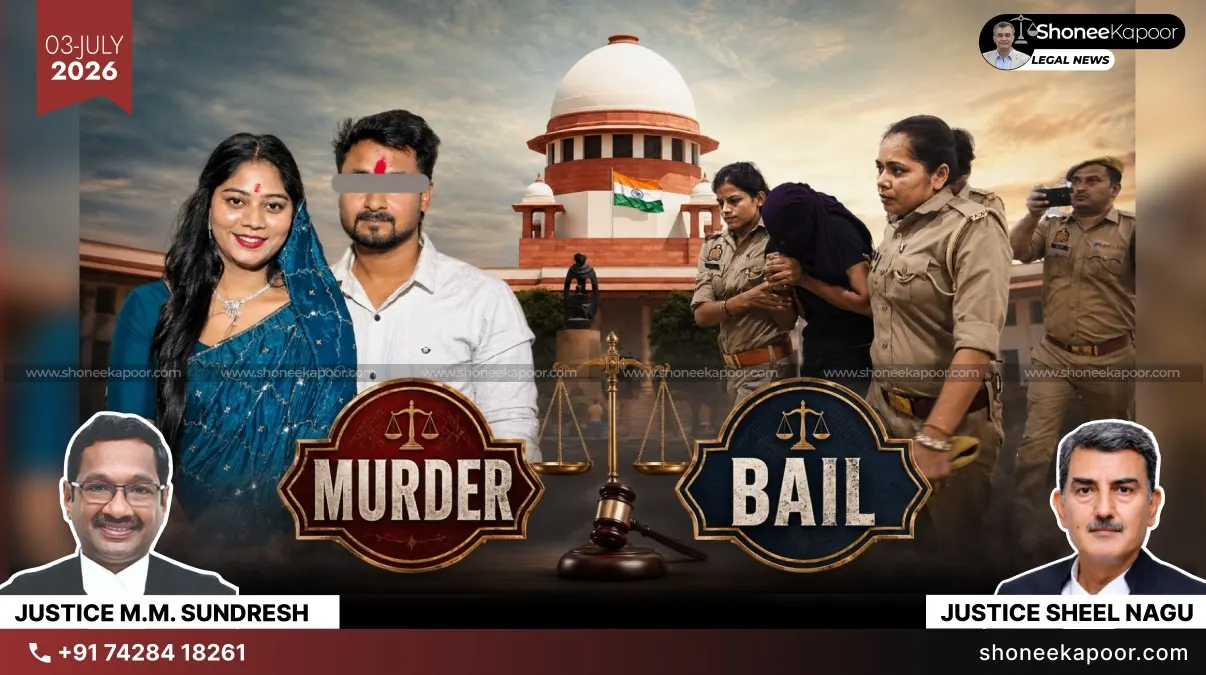
Can a prime accused in her husband’s alleged honeymoon murder get bail because police failed to properly communicate arrest grounds? Meghalaya Police has now moved the Supreme Court, saying Sonam Raghuvanshi may abscond if released.
NEW DELHI: The Meghalaya Police has moved the Supreme Court seeking an immediate stay on the bail granted to Sonam Raghuvanshi, the prime accused in the alleged murder of her husband Raja Raghuvanshi during their honeymoon in Meghalaya.
The matter was mentioned on Thursday, July 2, 2026, before a vacation Bench of the Supreme Court comprising Justices M.M. Sundresh and Sheel Nagu. Solicitor General Tushar Mehta appeared for the State and requested an urgent hearing.
The case has again brought focus on how a serious murder case can get affected by procedural lapses during arrest. In this case, the accused is the wife of the deceased husband, and the prosecution has alleged a larger conspiracy involving hired assailants and her alleged lover.
The Meghalaya High Court had, on June 29, 2026, upheld the order of a Shillong trial court granting bail to Sonam Raghuvanshi. The bail was granted on the ground that the police had failed to effectively communicate the grounds of arrest to her.
Before the Supreme Court, the State argued that the bail order should be stayed immediately. The State said there was a real risk that the accused may abscond if the bail order was allowed to operate.
“The High Court has granted bail, stating that the grounds of arrest were not provided to her… It was a mere typographical error though. We want the bail order to be stayed. She will abscond if released,” Mr. Mehta submitted.
After hearing the request, the Supreme Court Bench agreed to list the matter for hearing on Friday, July 3, 2026.
The High Court had earlier dismissed the State’s appeal against the April 2026 order of the Additional Deputy Commissioner (Judicial), Shillong, who had granted bail to Sonam Raghuvanshi on procedural grounds.
Justice W. Diengdoh of the Meghalaya High Court held that the police had failed to effectively communicate the grounds of arrest. According to the High Court, this violated the constitutional safeguards available to an arrested person.
The prosecution had argued that the mistake was only a clerical or typographical error. However, the High Court did not accept this argument. The Court found that the document used to communicate the grounds of arrest was prepared without proper application of mind and contained allegations that had no connection with the present case.
“If this is the manner in which the intimation of the grounds of arrest is made, the same reflects a total non-application of judicious mind on the part of the arresting agency,” the High Court observed.
The High Court held that such serious errors went to the root of the arrest process and justified the grant of bail. The Court made it clear that if the basic arrest procedure itself was defective, later attempts to correct the process would not help the prosecution.
“The foundational basis for building up a case against the accused/respondent being found lacking, all other attempts to rectify the subsequent actions or process will have to fail”, Justice Diengdoh said.
At the same time, the High Court clarified that its findings were limited only to the legality of the arrest procedure. The Court said its observations should not be treated as comments on the investigation or the trial.
Before the High Court, the State had argued through Advocate General Amit Kumar that the error was inadvertent and had caused no real prejudice to the accused. The State said Sonam Raghuvanshi was fully aware of the nature and gravity of the allegations against her. It was also argued that a procedural defect alone should not become a ground for bail in a serious murder case.
The case relates to the murder of Indore businessman Raja Raghuvanshi. He had travelled to Meghalaya with his wife Sonam Raghuvanshi for their honeymoon in May 2025.
The couple went missing on May 23, 2025, while vacationing in the Sohra region of Meghalaya. Raja Raghuvanshi’s body was later recovered from a deep gorge on June 2, 2025.
According to the prosecution, Sonam Raghuvanshi conspired with hired assailants to murder her husband. The prosecution has also alleged that the conspiracy was hatched with her alleged lover Raj Kushwaha, with the objective of securing financial gain.
The Supreme Court will now examine whether the bail granted to Sonam Raghuvanshi should continue or be stayed. The issue before the Court is not only about the seriousness of the murder allegations, but also about whether a defect in communicating arrest grounds can justify bail in such a grave case.
For the family of Raja Raghuvanshi, the matter is not merely technical. A husband lost his life during what was supposed to be his honeymoon. The prosecution alleges that his own wife was part of the conspiracy. Yet the case has reached the Supreme Court because of an alleged procedural failure by the police.
EXPLANATORY TABLE OF LAWS AND SECTIONS MENTIONED
| LAW / SECTION | WHAT IT MEANS | ROLE IN THIS CASE |
| Section 483 BNSS | Provision relating to bail powers under the Bharatiya Nagarik Suraksha Sanhita | Sonam Raghuvanshi filed the bail application under this section. |
| Section 103(1) BNS | Murder | Main serious offence alleged in the case relating to Raja Raghuvanshi’s death. |
| Section 238(a) BNS | Causing disappearance of evidence / giving false information to screen offender | Mentioned in the charges against the accused. |
| Section 309(6) BNS | Robbery/dacoity-related aggravated offence | Mentioned in the charges framed in the case. |
| Section 3(6) BNS | Common intention / joint liability principle under BNS | Used to connect multiple accused in the alleged conspiracy. |
| Section 403(1) BNS | Wrong section wrongly mentioned in arrest papers instead of Section 103(1) BNS | This became the key controversy. The court found that Sonam was not properly informed that she was arrested for murder under Section 103(1). |
| Section 25(1)(A) Arms Act | Offence relating to prohibited arms/ammunition | Added through supplementary chargesheet against Sonam and other accused. |
| Section 35 Arms Act | Liability where offence is committed by company/persons in charge, or connected Arms Act liability | Mentioned with Arms Act charge in the supplementary chargesheet. |
| Article 21 Constitution of India | Right to life and personal liberty | Court relied on this to say illegal arrest affects personal liberty. |
| Article 22(1) Constitution of India | Arrested person must be informed of grounds of arrest and allowed legal counsel | Core ground for bail. Court held grounds of arrest were not effectively communicated. |
| Article 22(5) Constitution of India | Safeguard in preventive detention matters regarding communication of grounds | Discussed through Supreme Court precedents to explain importance of communication of grounds. |
| Section 47 BNSS | Requirement to communicate full particulars of offence and grounds of arrest | Mentioned as the BNSS equivalent of Section 50 CrPC. |
| Section 50 CrPC | Police must inform arrested person of offence and grounds of arrest | Cited through judgments to compare arrest safeguards. |
| Section 50A CrPC | Obligation to inform relatives/friends about arrest and entry in records | Mentioned in cited precedent discussion on arrest compliance. |
| Section 19(1) PMLA | Arrest under PMLA and communication of grounds | Discussed through Pankaj Bansal precedent on written grounds of arrest. |
| Section 45 PMLA | Bail restrictions under PMLA | Mentioned in precedent to explain why grounds of arrest help accused seek bail. |
| Section 302 IPC | Murder under old IPC | Mentioned in cited State of Karnataka v. Darshan precedent while discussing gravity of murder charge. |
| Sections 22(c), 25, 29 NDPS Act | Commercial quantity drug offence, related offences and conspiracy/abetment | Mentioned only in cited Labius Arengh case, not as charges against Sonam. |
CASE DETAILS
| DETAIL | INFORMATION |
| Trial Court Case | Bail Application No. 93(T)2026 in Session Case No. 41(T)2025 |
| Court | Court of Smt. D.R. Kharbteng, Addl. D.C. (Judicial), Shillong |
| District | East Khasi Hills |
| Trial Court Order Date | 27.04.2026 |
| Accused / Bail Applicant | Sonam Raghuvanshi |
| Deceased | Raja Raghuvanshi |
| FIR | Sohra P.S. Case No. 7/2025 |
| Informant | Vipin Raghuvanshi, brother of deceased Raja Raghuvanshi |
| Trial Court Result | Bail allowed |
| Bail Bond | Rs. 50,000 with two sureties of like amount |
| High Court Bench | Justice W. Diengdoh, Meghalaya High Court |
| Supreme Court Bench Mentioned In News | Justices M.M. Sundresh and Sheel Nagu |
| Supreme Court Mentioning Counsel | Solicitor General Tushar Mehta for the State |
| High Court State Counsel Mentioned In News | Advocate General Amit Kumar |
| Trial Court Counsel For Sonam | Shri S. Rana, Dy. LADC |
| Trial Court Counsel For Prosecution | Shri K.C. Gautam |
KEY TAKEAWAYS
- Raja Raghuvanshi is dead, but the system is debating paperwork.
A man lost his life, yet the focus shifted to procedural lapses by police. - Sonam Raghuvanshi is not some minor accused.
She is the prime accused in her husband’s alleged honeymoon murder conspiracy. - One police mistake can weaken justice for a male victim.
Bad arrest documents, careless drafting and procedural errors can give benefit to the accused. - Men’s deaths are often reduced to legal technicalities.
When a husband is killed, the emotional and legal outrage is never equal to cases where women are victims. - The dead man’s family is now fighting two battles.
One against the accused, and another against the incompetence of the system that may damage the case before trial.
This Could Change Your Case-Get FREE Legal Advice-Click Here!
Disclaimer: The views and opinions expressed in this article are those of the Indian courts and do not necessarily reflect the official policy or position of “ShoneeKapoor.com” or its affiliates. This article is intended for informational and educational purposes only. The content provided is not legal advice, and viewers should not act upon this information without seeking professional counsel. Viewer discretion is advised.
