
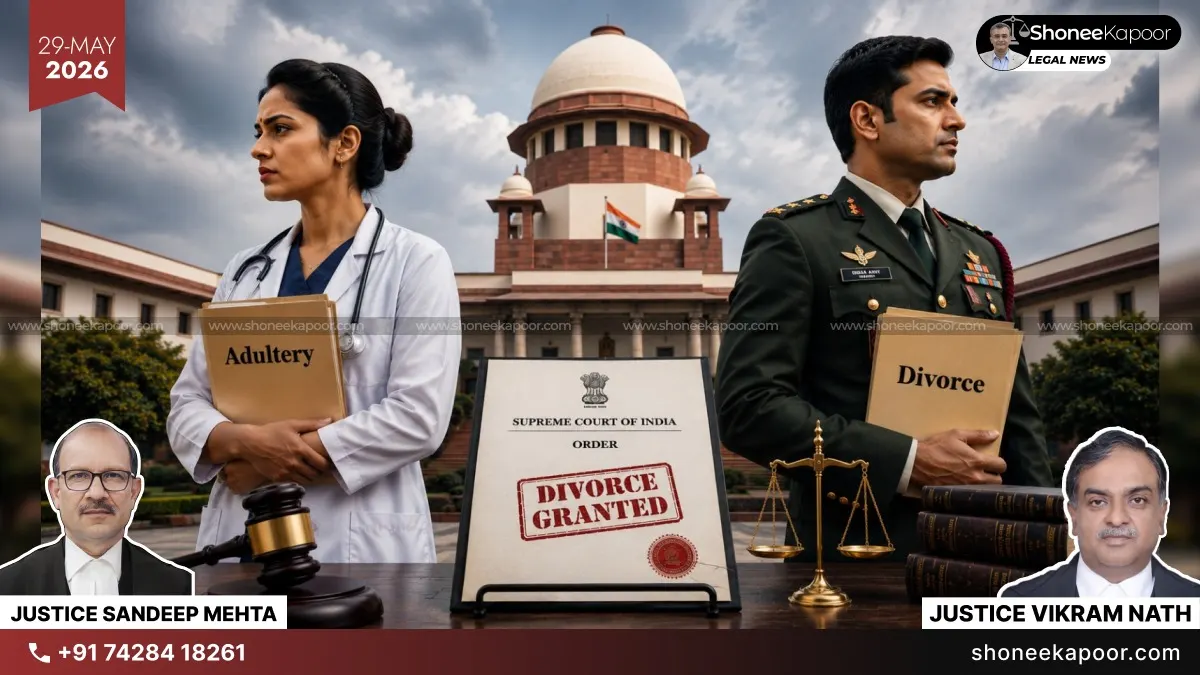
Should a husband be forced to remain married indefinitely because matrimonial allegations are still disputed?
The Supreme Court observed that a marriage which survives only on paper serves no meaningful purpose when there is no possibility of reconciliation between the parties.
NEW DELHI: The Supreme Court of India has granted divorce to an Army officer husband and his doctor wife, bringing an end to a long-running matrimonial dispute that had continued for several years. The judgment was delivered by Justice Vikram Nath and Justice Sandeep Mehta on May 27, 2026.
The marriage between the parties was solemnised in April 2017. However, serious disputes arose soon after, and the wife left the matrimonial home. She accused the husband of adultery and also initiated multiple legal proceedings, including cases under the Domestic Violence Act, maintenance proceedings, and complaints before police authorities.
During the course of the dispute, both parties entered into a settlement in 2019. They agreed to seek divorce by mutual consent, and the husband agreed to pay ₹31 lakh as permanent alimony. He paid ₹20 lakh in two instalments. Later, according to the husband, the settlement amount was revised to ₹32 lakh. The first motion for mutual consent divorce was filed, but the second motion was never completed because the wife withdrew her consent and stopped appearing before the court.
As a result, the mutual consent divorce proceedings came to an end. The husband then approached higher courts seeking dissolution of the marriage. Even before the Supreme Court, the wife opposed the grant of divorce and stated that she wanted to pursue a contested divorce petition on the ground of adultery.
After interacting with both parties and examining the record, the Supreme Court found that the relationship had completely collapsed. The Court noted that the parties had been living separately for more than eight years and were involved in several civil and criminal cases against each other.
The Court observed:
“The marriage between the parties has irretrievably broken down and there is no possibility of reconciliation whatsoever.”
Referring to the prolonged litigation and bitterness between the spouses, the Court said:
“The record shows long standing acrimony between the parties and a multiplicity of civil and criminal proceedings initiated by both sides.”
Explaining why the marriage could not be allowed to continue merely on paper, the Court held:
“To compel the parties to remain bound in a marriage that exists only on paper would serve no legitimate purpose.”
The Court therefore concluded:
“We are, therefore, satisfied that this is an appropriate case for the exercise of jurisdiction under Article 142 of the Constitution of India.”
The Supreme Court also considered the issue of permanent alimony. Although the parties had earlier agreed on ₹32 lakh, the Court examined their financial condition, earning capacity, standard of living, duration of marriage, years of separation and future financial security.
The Court held:
“A sum of Rs. 50,00,000/- (Rupees Fifty Lakhs only) would be a fair, just and adequate amount to fix as permanent alimony.”
The Bench further clarified:
“This amount shall constitute a one-time, full and final settlement of all claims, past and future, arising from this marriage.”
Accordingly, the Supreme Court dissolved the marriage under Article 142 of the Constitution and directed the husband to pay ₹50 lakh in two instalments. The Court also ordered closure of all pending proceedings between the parties, including maintenance, domestic violence and contempt cases, thereby bringing the matrimonial dispute to a complete end.
Explanatory Table: Laws And Sections Involved
| Law / Section | Purpose | How It Was Used In This Case |
| Article 142, Constitution of India | Gives Supreme Court power to do complete justice between parties. | Used to dissolve the marriage despite absence of mutual consent and despite wife’s opposition. |
| Section 13(1)(i), Hindu Marriage Act, 1955 | Divorce on the ground of adultery. | Wife wanted to file a contested divorce petition alleging adultery. |
| Section 125 CrPC (now Section 144 BNSS) | Maintenance for wife, children and parents. | Wife filed maintenance proceedings seeking monthly maintenance. |
| Section 126 CrPC | Procedure in maintenance proceedings. | Husband sought recall of an ex parte maintenance order. |
| Section 128 CrPC | Enforcement and recovery of maintenance orders. | Wife had pending execution proceedings relating to maintenance. |
| Section 12, Protection of Women from Domestic Violence Act, 2005 | Allows an aggrieved woman to seek reliefs for domestic violence. | Wife filed a domestic violence complaint against the husband. |
| Section 90(i), Army Act, 1950 | Maintenance deductions from salary of Army personnel for dependents. | Maintenance was deducted from the husband’s salary pursuant to wife’s application. |
| Contempt of Courts Act, 1971 | Punishes wilful disobedience of court orders. | Two contempt proceedings were pending between the parties. |
Case Details
- Case Title: Salil Dhawan v. Priyanshi Ghai
- Court: Supreme Court of India
- Neutral Citation: 2026 INSC 577
- Case Number: Civil Appeal (Arising out of SLP (C) No. 971 of 2025)
- Judgment Date: 27 May 2026
- Bench: Justice Vikram Nath | Justice Sandeep Mehta
Key Takeaways
- A marriage should be based on a real relationship, not just a legal status on paper.
- When spouses have lived separately for years with no hope of reunion, courts may step in to bring finality.
- Prolonged matrimonial litigation often reflects a complete breakdown of trust and companionship.
- A fair one-time settlement can help both parties move forward and avoid years of further legal battles.
- Justice is not just about preserving marriages—it is also about ending disputes that have become impossible to resolve.
This Could Change Your Case-Get FREE Legal Advice-Click Here!
Disclaimer: The views and opinions expressed in this article are those of the Indian courts and do not necessarily reflect the official policy or position of “ShoneeKapoor.com” or its affiliates. This article is intended for informational and educational purposes only. The content provided is not legal advice, and viewers should not act upon this information without seeking professional counsel. Viewer discretion is advised.
