
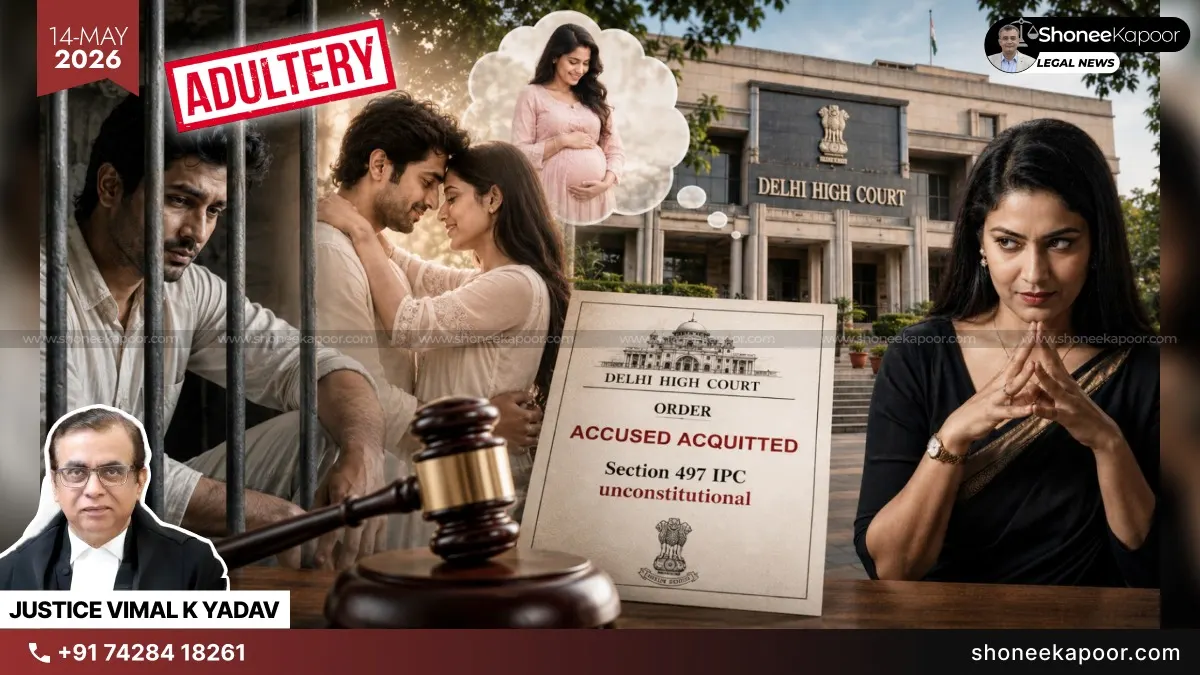
Can a man face years of rape, extortion and adultery allegations even if the relationship existed because the woman wanted a child?
Delhi High Court set aside the adultery conviction in a “Niyog Pratha”-type dispute under an unconstitutional law.
NEW DELHI: Delhi High Court has acquitted a man in an adultery-related criminal case after observing that Section 497 IPC had already been declared unconstitutional by the Supreme Court. Justice Vimal Kumar Yadav passed the judgment on 11 May 2026.
At the very beginning of the judgment, the Court referred to the ancient concept of “Niyog Pratha” and observed:
“The Mahabharata era ‘Niyog Pratha’ resurfaced in the modern times in its new avatar.”
The Court explained that in earlier times, “Niyog Pratha” was followed when a husband was unable to have children or had died childless. According to the Court, the practice was only for continuation of lineage and not for marriage or emotional relationships. The judgment stated:
“It was restricted to procreation only and was not for marriage or any other relationship.”
The matter arose out of an FIR registered under Sections 376, 384 and 506 IPC. According to the prosecution, the accused and his wife were tenants in the house of the prosecutrix.
The woman alleged that in November 2006, the accused’s wife served her “Gajar Ka Halwa,” after which she became unconscious. She later claimed that the accused raped her with the help of his wife and threatened her with the misuse of alleged nude videos.
During the proceedings, a female child was born. However, the accused claimed that the relationship was consensual and that the prosecutrix herself had invited him because her husband was allegedly “not virile enough.” The Court recorded:
“Some sort of similar arrangement was worked out between the Complainant side and the Appellant, whereby the victim reportedly agreed rather invited the Appellant to impregnate the prosecutrix since the husband of the prosecutrix was not virile enough.”
The accused also stated that the prosecutrix wanted a male child and therefore continued the arrangement. The judgment further mentioned allegations regarding monetary demands and land disputes between the parties.
After trial, both the accused and his wife were acquitted of rape and extortion charges. However, despite there being no original charge under Section 497 IPC, the trial court still convicted the accused for adultery and sentenced him to three years’ rigorous imprisonment along with a fine.
Before the High Court, the defence argued that Section 497 IPC had already been struck down by the Supreme Court in Joseph Shine v. Union of India (2019), and therefore no conviction could survive under a law which no longer existed constitutionally.
The prosecution also accepted the legal position and informed the Court that Section 497 IPC was no longer part of Indian criminal law after the Supreme Court judgment.
While allowing the appeal, the High Court observed:
“Something which has been declared ultra vires to the Constitution cannot be made a basis to convict and punish anyone.”
The Court further held:
“Section 497 IPC to be unconstitutional being violative of Article 14, 15 and 21 of the Constitution of India.”
The Court accordingly set aside the conviction, acquitted the appellant and discharged his bail bonds.
Explanatory Table: Laws And Provisions Involved
| Section / Law | What It Deals With | How It Appeared In This Case |
| Section 376 IPC | Punishment for rape | FIR included rape allegations made by the prosecutrix against the accused |
| Section 384 IPC | Punishment for extortion | Allegations were made regarding money and property demands |
| Section 506 IPC | Criminal intimidation | Prosecution alleged threats relating to misuse of alleged nude videos |
| Section 34 IPC | Common intention | Applied because allegations involved both the accused and his wife |
| Section 109 IPC | Abetment | Wife of the accused was charged for allegedly assisting the offence |
| Section 497 IPC | Adultery (now unconstitutional) | Trial court convicted the accused under this section despite acquittal in rape and extortion charges |
| Section 198(2) CrPC | Procedure for prosecuting adultery offences | High Court noted that this procedure was also declared unconstitutional after Joseph Shine |
| Article 14 Constitution of India | Right to equality | Supreme Court held Section 497 IPC violated equality principles |
| Article 15 Constitution of India | Protection against discrimination | Used by Supreme Court while striking down adultery law |
| Article 21 Constitution of India | Right to life and personal liberty | Supreme Court held adultery law violated dignity and personal liberty |
| Article 141 Constitution of India | Supreme Court law binding on all courts | High Court relied on this to follow Joseph Shine judgment |
| Joseph Shine vs Union of India (2019) 3 SCC 39 | Landmark adultery judgment | Supreme Court declared Section 497 IPC unconstitutional |
| Ashok Kumar Singh vs State (2025) SCC OnLine Del 2456 | Delhi High Court judgment | Relied upon for retrospective effect of Joseph Shine ruling |
| Maj. Genl. A.S. Gauraya & Anr. vs S.N. Thakur (1986 AIR 1440) | Supreme Court precedent | Referred to by defence regarding retrospective legal effect |
Case Details
- Case Title: Kamal Kapoor vs State
- Court: Delhi High Court
- Case Number: CRL.A. 844/2013
- Bench: Justice Vimal Kumar Yadav
- Neutral Citation: 2026:DHC:4214
- Date of Decision: 11 May 2026
- Counsels:
- For Appellant: Mr. Satish Sharma, Advocate
- For State: Mr. Satinder Singh Bawa, APP for State with IO SI Urvashi, PS Sonia Vihar
Key Takeaways
- A man cannot continue to suffer punishment under a law which has already been declared unconstitutional.
- Adult consensual relationships should not automatically be converted into criminal liability for men.
- Criminal prosecution based on morality instead of evidence can destroy a man’s life for years before final acquittal.
- Even after acquittal in serious allegations, men often continue facing punishment through misuse or overextension of legal provisions.
- Personal relationships, family pressure and reproductive disputes can easily escalate into long criminal litigation against men in India.
This Could Change Your Case-Get FREE Legal Advice-Click Here!
Disclaimer: The views and opinions expressed in this article are those of the Indian courts and do not necessarily reflect the official policy or position of “ShoneeKapoor.com” or its affiliates. This article is intended for informational and educational purposes only. The content provided is not legal advice, and viewers should not act upon this information without seeking professional counsel. Viewer discretion is advised.
