
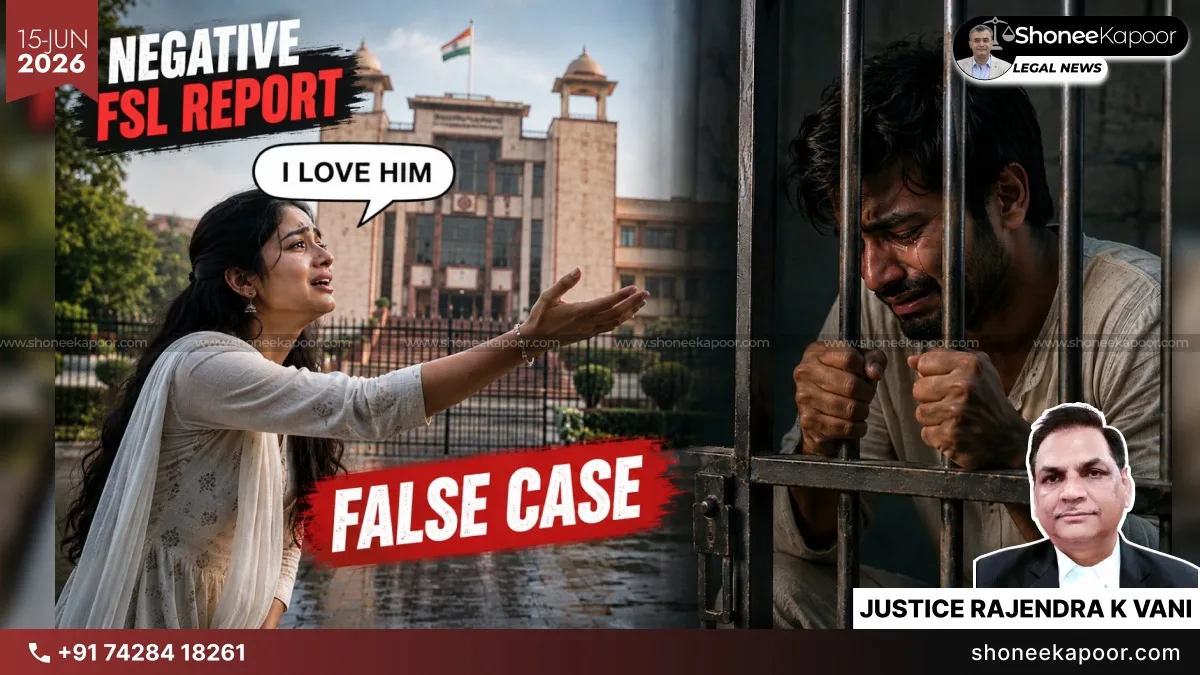
Did the prosecution’s own evidence weaken the case against the accused? Why did the Madhya Pradesh High Court grant bail after more than a year in custody? Read the details behind the court’s decision.
JABALPUR: The Madhya Pradesh High Court granted bail to a man accused in a rape case after noting important developments that emerged during the trial, including the prosecutrix admitting that she was in a love relationship with the accused, a negative forensic report, and the fact that the accused had already spent a long period in jail awaiting trial.
Justice Rajendra Kumar Vani passed the order while allowing the first bail application filed by Chhabilal Uaike in connection with Crime No. 08/2025 registered at Roopjhar Police Station in Balaghat district. The accused is facing charges under Sections 64(2)(m), 351(3), and 332 of the Bharatiya Nyaya Sanhita, which correspond to Sections 376, 506 and 449 of the Indian Penal Code, along with Sections 66E and 67A of the Information Technology Act.
Appearing for the accused, advocate D.S. Parihar argued that Uaike had been in judicial custody since March 11, 2025, and that several aspects of the prosecution’s case justified granting him bail during the pendency of the trial.
The defence submitted that the Forensic Science Laboratory (FSL) report in the case was negative. Because of this, the prosecution had not conducted any DNA examination. It was also pointed out that both the prosecutrix and her father had already been examined before the trial court as prosecution witnesses.
According to the submissions recorded in the order, although the prosecutrix supported the prosecution’s allegations during her examination-in-chief, she admitted during cross-examination that she had been in a love relationship with the accused. The defence further argued that certain photographs available in the case diary did not clearly establish identity because the face of the woman appearing in those photographs was not identifiable.
The accused’s counsel also referred to paragraph seven of the prosecutrix’s deposition and argued that she had admitted that the accused had not forcibly entered her house. Based on these circumstances, the defence contended that there were significant weaknesses in the prosecution case and that the accused had a strong case on merits.
The defence further submitted that the accused was willing to comply with any condition imposed by the Court and requested his release on bail considering the lengthy period already spent in custody.
The State opposed the bail plea. Panel Lawyer D.K. Shukla, appearing for the respondent-State, urged the Court to reject the application.
After hearing both sides and examining the case diary, the High Court found it appropriate to exercise its discretion in favour of the accused. The Court clarified that it was not expressing any final opinion on the allegations but observed that the facts and circumstances justified granting bail.
The Court observed:
“Considering the submissions advanced by learned counsel for the parties and keeping in view the attending facts and circumstances of the case, this Court is inclined to release the applicant on bail.”
Accordingly, the High Court directed that Chhabilal Uaike be released on bail upon furnishing a personal bond of Rs. 50,000 along with one solvent surety of the same amount to the satisfaction of the trial or committal court.
The Court imposed several conditions while granting relief. It directed the accused to cooperate with the investigation and trial proceedings, refrain from influencing witnesses, avoid committing any similar offence, and not seek unnecessary adjournments. The accused was also directed not to leave India without prior permission from the competent court or the investigating officer.
The Court made it clear that violation of any of these conditions would automatically make the bail order ineffective.
A copy of the order has been directed to be sent to the concerned trial court for necessary compliance.
EXPLANATORY TABLE: LAWS AND SECTIONS MENTIONED
| LAW / SECTION | WHAT IT DEALS WITH | HOW IT WAS APPLIED IN THIS CASE |
| Section 439 CrPC / Section 483 BNSS | Special power of High Court and Sessions Court to grant bail | The accused approached the High Court seeking regular bail. |
| Section 64(2)(m) BNS | Punishment for rape under aggravated circumstances (corresponding to Section 376 IPC) | Main allegation against the applicant. |
| Section 351(3) BNS | Criminal intimidation (corresponding to Section 506 IPC) | Allegation that threats were extended to the prosecutrix. |
| Section 332 BNS | House-trespass after preparation for assault, intimidation or wrongful restraint (corresponding to Section 449 IPC) | Prosecution alleged unlawful entry into the house. Defence relied on testimony stating there was no forcible entry. |
| Section 66E, Information Technology Act | Punishment for violation of privacy through capturing, publishing or transmitting private images | Invoked due to allegations involving electronic/private material. |
| Section 67A, Information Technology Act | Publishing or transmitting sexually explicit material electronically | Applied because of allegations relating to sexually explicit digital content. |
| FSL Report | Forensic examination of evidence | The report was negative and no DNA examination was conducted. |
| DNA Examination | Scientific evidence linking accused to offence | The prosecution did not conduct DNA testing due to the negative FSL findings. |
CASE DETAILS
| PARTICULARS | DETAILS |
| Case Title | Chhabilal Uaike v. The State of Madhya Pradesh |
| Case Number | M.Cr.C. No. 12149 of 2026 |
| Court | High Court of Madhya Pradesh, Jabalpur Bench |
| Bench | Hon’ble Shri Justice Rajendra Kumar Vani |
| Date of Order | 08 June 2026 |
| Nature of Case | First Bail Application |
| Crime Number | Crime No. 08/2025 |
| Police Station | Roopjhar Police Station |
| District | Balaghat, Madhya Pradesh |
| Applicant | Chhabilal Uaike |
| Respondent | The State of Madhya Pradesh |
| Neutral Citation | 2026:MPHC-JBP:40918 |
COUNSELS
| PARTY | COUNSEL |
| Applicant/Accused | Shri D.S. Parihar, Advocate |
| Respondent/State | Shri D.K. Shukla, Panel Lawyer |
KEY TAKEAWAYS
- Bail is not acquittal, but men should not spend years in jail before guilt is proven.
- Cross-examination matters. The prosecutrix admitting a love relationship changed the court’s view on bail.
- A negative FSL report and absence of DNA evidence cannot simply be ignored when deciding a person’s liberty.
- Serious allegations must be tested against evidence, not emotions or assumptions.
- Due process exists to protect everyone. Men too deserve fairness, scrutiny of evidence, and the presumption of innocence.
This Could Change Your Case-Get FREE Legal Advice-Click Here!
Disclaimer: The views and opinions expressed in this article are those of the Indian courts and do not necessarily reflect the official policy or position of “ShoneeKapoor.com” or its affiliates. This article is intended for informational and educational purposes only. The content provided is not legal advice, and viewers should not act upon this information without seeking professional counsel. Viewer discretion is advised.
