
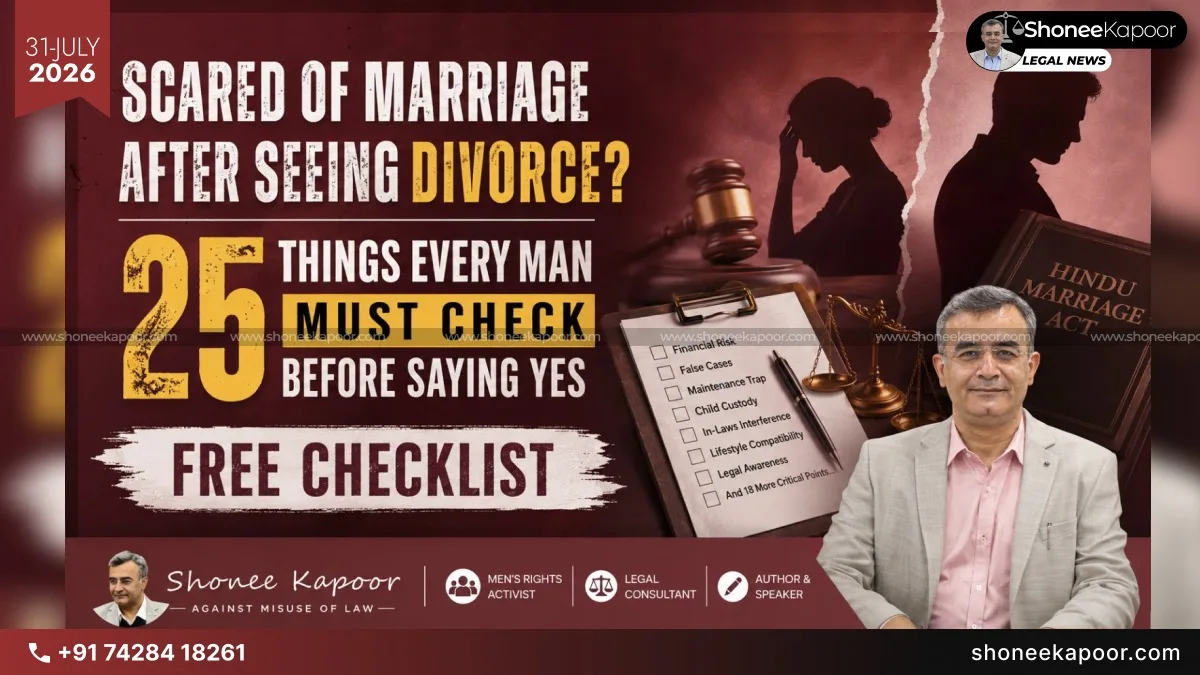
Scared of Marriage After Seeing Divorce? 25 Things Every Man Must Check Before Saying Yes

Written and analysed by Shonee Kapoor
Legal Consultant, Author & Men's Rights ActivistScared of marriage after seeing bitter divorces? Are bitter divorces making you afraid of marriage? Before saying yes, verify these 25 legal, financial and personal facts that most Indian men discover only after entering a courtroom.
NEW DELHI: A man watches his friend spend years fighting maintenance, criminal allegations, property disputes and child-custody proceedings.
He sees another husband lose access to his child. He sees elderly parents dragged into matrimonial litigation. He sees two families spend their savings on lawyers after spending even more on the wedding.
Then someone tells him:
“Do not think negatively. Marriage is about trust.”
Trust is important. Blindness is not trust.
Marriage is an emotional relationship, but it also creates serious legal, financial, residential and parental consequences. Depending on the applicable law and facts, a matrimonial breakdown may lead to divorce, maintenance, domestic-violence proceedings, criminal allegations, residence claims and custody litigation.
I am not advising men to treat every prospective wife as an accused person.
I am advising men to stop entering one of the most consequential legal relationships of their lives without asking basic questions.
You verify documents before buying a flat. You inspect accounts before entering a partnership. You examine employment terms before accepting a job.
But before marriage, many men verify nothing beyond photographs, salary claims and family reputation.
That is not romance.
That is negligence dressed as optimism.
The Legal Reality Men Must Understand Before Marriage
Under the Hindu Marriage Act, both the wife and the husband can seek interim maintenance and permanent alimony, subject to the statutory conditions. However, maintenance may also be claimed by a wife through other legal routes, including Section 144 of the Bharatiya Nagarik Suraksha Sanhita, 2023, and the Protection of Women from Domestic Violence Act, 2005.
The current criminal provisions concerning cruelty by a husband or his relatives are contained in Sections 85 and 86 of the Bharatiya Nyaya Sanhita, 2023. They prescribe imprisonment extending to three years and a fine. Older cases may continue under Section 498A IPC according to the date of the alleged conduct and applicable savings provisions.
The law exists to protect genuine victims. At the same time, the Supreme Court has repeatedly warned against mechanical arrests, vague allegations and abuse of criminal proceedings in matrimonial disputes. In Sushil Kumar Sharma v. Union of India, the Court said:
“The provision is intended to be used a shield and not assassins’ weapon.”
The Court nevertheless upheld the provision and clarified that possible misuse does not make an otherwise valid law unconstitutional.
The correct response is neither hatred nor panic.
The correct response is premarital due diligence.
25 THINGS EVERY MAN MUST CHECK BEFORE MARRIAGE IN INDIA
1. Verify Her Exact Legal Identity
Match the name, date of birth and parental details appearing on the prospective bride’s official documents.
Check whether different documents contain different spellings, surnames or dates of birth. A harmless discrepancy can usually be corrected. An unexplained identity mismatch requires clarification before marriage.
The same verification must be offered by the man. Due diligence should be mutual, not a one-sided interrogation.
2. Confirm That Both Parties Meet the Legal Marriage Conditions
Verify age, legal capacity and the absence of a living spouse wherever the applicable law requires monogamy.
Under the Special Marriage Act, the statutory conditions include that neither party has a spouse living, both possess the required capacity to consent, the man has completed 21 years and the woman 18 years, and the parties are not within a prohibited relationship unless a recognised custom permits it. Comparable core conditions exist under the Hindu Marriage Act.
Do not rely on appearance, social-media profiles or oral assurances.
3. Demand the Final Divorce Decree if She Was Previously Married
“Separated” does not mean “divorced.”
“Divorce case is almost finished” does not mean “divorced.”
“Mutual settlement has been signed” does not mean “divorced.”
A previous marriage ends legally only through a valid decree or another legally recognised mode applicable to the parties.
Examine the certified decree, case number, court, date and whether any appeal or challenge is pending. Remarriage during the subsistence of a prior marriage may attract Section 82 BNS where its ingredients are satisfied. Concealment of the former marriage can carry a higher punishment.
Never marry merely because someone says the earlier spouse has “moved on.”
4. Identify Which Marriage Law Will Govern You
Do not decide the form of marriage after booking the venue.
First determine whether the marriage will be governed by the Hindu Marriage Act, Special Marriage Act or another applicable personal or state law.
This affects:
- Conditions of a valid marriage
- Registration procedure
- Divorce grounds
- Maintenance provisions
- Jurisdiction
- Succession consequences
- Ceremonial requirements
An interfaith or NRI marriage requires additional attention. A ceremony, foreign registration and Indian matrimonial jurisdiction may raise different legal questions.
Take jurisdiction-specific advice before solemnisation—not after litigation begins.
5. Confirm That Consent Is Free and Informed
A marriage should not proceed because the families have announced it, invitations have been printed or money has been spent.
Both parties must be free to say no.
Ask directly whether there is pressure relating to age, family honour, immigration, money, pregnancy, property or a previous relationship.
A reluctant person does not become a willing spouse merely because the wedding has taken place.
6. Register the Marriage Promptly
Marriage registration creates an official record and substantially reduces later disputes regarding the fact and date of marriage.
In Seema v. Ashwani Kumar, the Supreme Court emphasised the evidentiary value of registration and directed the development of compulsory registration mechanisms. But the Court also made an important distinction:
“Registration itself cannot be a proof of valid marriage per se.”
Registration supports proof. It cannot cure a marriage that was otherwise invalid or never properly solemnised.
Complete both the legally required ceremony and the applicable registration process.
7. Ask for Mutual Disclosure of Existing Litigation
Both persons should disclose material pending or concluded cases involving:
- Previous marriage or engagement
- Domestic violence
- Maintenance
- Child custody
- Criminal prosecution
- Serious financial recovery
- Insolvency
- Property disputes affecting promised assets
- Immigration or citizenship fraud
Use only lawful sources, certified records and voluntary disclosure.
Do not hack accounts, impersonate anyone, purchase illegally obtained call records or employ unlawful surveillance.
The refusal to disclose material litigation is itself information.
8. Verify Employment Instead of Believing a Job Title
“Consultant,” “entrepreneur,” “director” and “freelancer” may describe genuine work—or no stable income at all.
With mutual consent, examine:
- Recent salary slips or invoices
- Form 16 or income-tax returns
- Employment continuity
- Business ownership records
- Existing employment bonds
- Anticipated relocation
- Career-break plans
- Realistic post-marriage income expectations
This is not about calculating the woman’s earning capacity to avoid responsibility.
It is about ensuring that both people are entering marriage with the same financial facts.
9. Disclose Loans, Credit-Card Debt and Financial Dependants
Income alone does not reveal financial health.
A person earning ₹2 lakh per month may still be carrying:
- Personal loans
- Education loans
- Credit-card rollover
- Business losses
- Family liabilities
- Informal borrowings
- Tax defaults
- Guaranteed loans for relatives
Both parties should prepare a written summary of assets, debts, EMIs and regular obligations.
Hidden debt has destroyed many marriages long before any legal case was filed.
10. Separate Ownership From Family Claims
Do not accept statements such as:
“This house will eventually become ours.”
“My father will transfer that property after marriage.”
“The family business belongs to everyone.”
Obtain clarity on:
- Who legally owns the house
- Whether it is mortgaged
- Whether it is ancestral, jointly held or self-acquired
- Whether any succession or partition dispute exists
- Whether the promised business share has actually been transferred
- Whether either family expects property transfer as a condition of marriage
Expectation is not ownership. Possession is not title. A future promise is not a registered conveyance.
11. Fix the Wedding Budget Before the Families Start Competing
A lavish wedding financed through debt does not create a stable marriage.
Record:
- Maximum wedding budget
- Contribution voluntarily made by each side
- Vendor responsibility
- Cancellation liability
- Destination and travel costs
- Jewellery ownership
- Return or refund arrangements
- Prohibition on direct or coded demands
Do not allow relatives to create demands while the couple later claims ignorance.
A sentence such as “people of our status normally give a car” may not contain the word dowry, but the law examines substance and connection with marriage—not family vocabulary.
12. Adopt a Written No-Dowry Policy
The Dowry Prohibition Act defines dowry broadly as property or valuable security given or agreed to be given directly or indirectly, at, before or after marriage, when connected with the marriage. Giving, taking and demanding dowry are punishable.
Therefore:
- Make no demand
- Permit no relative to make a demand
- Avoid suggestive WhatsApp messages
- Do not negotiate gifts
- Do not describe compulsory payments as “custom”
- Preserve proof that wedding expenses were voluntary
- Prepare legally compliant lists of voluntary presents
The 1985 Rules require separate written lists of presents given to the bride and bridegroom, prepared at the time of marriage or as soon as possible afterwards, containing relevant particulars.
A “no-dowry declaration” cannot erase an actual demand. Conduct must match the document.
13. Decide the Post-Marriage Residence Before Marriage
Where will the couple live?
With the husband’s parents? With the wife’s parents? In rented accommodation? In a separate floor? In another city or country?
Do not leave this question to assumptions.
Under the Domestic Violence Act, a claimed shared household need not necessarily be property owned or rented solely by the husband. The Supreme Court has interpreted the statutory definition broadly and held that the right of residence can exist irrespective of the woman having a proprietary interest in the premises. A residence right, however, is not the same as ownership.
That makes the residence discussion legally significant for both the couple and elderly parents.
14. Discuss the Role of Both Families
Many marriages do not fail between two individuals. They fail because four parents and ten relatives believe they are parties to every decision.
Discuss:
- Frequency of parental visits
- Financial support to parents
- Care during illness
- Festival arrangements
- Interference in disputes
- Privacy inside the matrimonial home
- Expectations from the daughter-in-law
- Expectations from the son-in-law
- Whether either spouse must permanently live with parents
A man should not expect his wife to become an unpaid caregiver.
A woman should not expect the husband to abandon his parents as proof of loyalty.
Put the real expectations on the table before marriage.
15. Agree on Household Expenses and Financial Autonomy
Decide whether finances will operate through:
- Separate accounts
- A joint household account
- Proportionate contributions
- One-income support
- Shared savings
- Individual emergency funds
Do not transfer assets or add a spouse as co-owner merely to prove love.
Do not force the other person to surrender salary, passwords or financial control.
Nomination, joint ownership, beneficial ownership and inheritance are legally different concepts. Obtain tax and succession advice before transferring high-value assets.
16. Understand Maintenance Before Entering Marriage
Maintenance is not determined through a fixed national percentage.
Under Sections 24 and 25 of the Hindu Marriage Act, either spouse may apply, but the court considers factors including independent income, the other party’s income and property, conduct and the surrounding circumstances. Section 144 BNSS separately enables a wife unable to maintain herself to claim maintenance when the statutory requirements are met.
In Rajnesh v. Neha, the Supreme Court issued guidelines for financial disclosure, overlapping maintenance proceedings, adjustment of earlier awards and the date from which maintenance may be granted.
Important realities:
- An earning wife is not automatically disqualified
- A husband’s salary is not the only relevant figure
- Actual income, needs, liabilities and standard of living matter
- Child maintenance is distinct from spousal maintenance
- Concealment of income can damage credibility
Do not marry after receiving half-knowledge from social media.
17. Make Full Health Disclosure—Lawfully and Respectfully
Material health facts affecting marital life should be discussed honestly by both sides.
This may include:
- Serious chronic illness
- Significant treatment or surgery
- Communicable disease
- Dependency on medication
- Fertility treatment already undertaken
- Severe substance dependence
- A condition materially affecting independent functioning
- Significant hereditary risks where medically relevant
Health disclosure must not become humiliation.
No forced virginity test. No stolen medical records. No illegal access to hospital systems. No demand for intimate examination.
Use informed consent and, where genuinely necessary, a mutually selected qualified doctor.
Mental-health treatment by itself does not make a person unfit for marriage. The relevant questions are capacity, present functioning, honest disclosure and whether a material fact affecting married life has been concealed.
18. Check Addiction and Gambling Behaviour
Do not dismiss repeated intoxication, drug use, gambling or compulsive online betting as “something that will stop after marriage.”
Marriage does not cure addiction.
Examine conduct concerning:
- Alcohol
- Narcotic substances
- Betting applications
- Online gaming debt
- Pornography dependence
- Compulsive shopping
- Repeated borrowing
- Trading losses concealed as investment
The same standard applies to the man.
A person who hides an addiction before marriage is unlikely to become transparent after the wedding.
19. Observe Conflict Behaviour, Not Courtship Behaviour
Almost everyone behaves well during a two-hour restaurant meeting.
Watch what happens when the person hears “no.”
Red flags include:
- Threatening self-harm to force compliance
- Threatening false complaints
- Breaking objects
- Physical aggression
- Public humiliation
- Abusive messages
- Repeated silent punishment
- Monitoring every movement
- Isolating the partner from friends or parents
- Making allegations during every disagreement
- Using private information as blackmail
Indian courts determine mental cruelty from the cumulative conduct and circumstances rather than through one universal formula. False criminal complaints and sustained defamatory allegations have, in appropriate cases, been treated as mental cruelty.
Do not marry a red flag and later call it unexpected.
20. Set Digital Privacy Boundaries
Discuss before marriage:
- Whether phone passwords will remain private
- Whether location sharing is voluntary
- Whether private disputes may be posted online
- Whether conversations may be recorded
- Whether former partners remain in contact
- What counts as online infidelity
- Whether photographs may be uploaded without consent
- Whether family members may access devices
Do not secretly install spyware or clone accounts.
Do not send threats, intimate images or abusive messages that may later become evidence.
Digital communication creates a permanent record of temporary anger.
21. Discuss Previous Relationships Without Conducting a Character Trial
The relevant issue is not whether a person had a past.
The relevant issues are:
- Is the previous relationship genuinely over?
- Is there continuing emotional or financial involvement?
- Is litigation pending?
- Is there a child from an earlier relationship?
- Are private photographs being used for blackmail?
- Is the former partner still being presented publicly as a spouse?
- Was any material promise made that may generate litigation?
Disclosure must be mutual and proportionate.
The purpose is to identify unresolved legal and emotional ties—not to shame either person.
22. Settle the Question of Children Before Marriage
Do not assume every person wants children.
Discuss:
- Whether both want children
- Probable timeline
- Fertility concerns already known
- Adoption
- Assisted reproduction
- Number of children
- Career breaks
- Primary caregiving
- Religious and educational upbringing
- Residence after childbirth
- Role of grandparents
There is no responsible way to “compromise later” when one person wants children and the other does not.
23. Discuss Parenting and Custody Reality
A child is not marital property.
If a marriage breaks down, custody is governed primarily by the child’s welfare, not by a parent’s desire to punish the other spouse. Under Section 26 of the Hindu Marriage Act, courts may pass orders concerning custody, maintenance and education while considering the child’s wishes wherever possible.
In Yashita Sahu v. State of Rajasthan, the Supreme Court stressed the importance of a child receiving the love, affection and company of both parents and addressed meaningful visitation and contact with the non-custodial parent.
Before marriage, ask whether the prospective spouse believes:
- A child belongs only to the mother
- A father is merely a financial provider
- Access can be withheld after separation
- Grandparents should automatically be cut off
- A child may be used to secure financial or litigation advantage
The answer reveals more than a wedding photograph ever will.
24. Understand How Difficult Exit Can Be
Marriage can be solemnised in days. Contested matrimonial litigation may continue for years.
Under Section 13B of the Hindu Marriage Act, mutual-consent divorce ordinarily involves statutory separation and two motions. In Amardeep Singh v. Harveen Kaur, the Supreme Court held that the six-month period under Section 13B(2) is directory and may be waived at the court’s discretion when the prescribed considerations are satisfied, including failed reconciliation and genuine settlement of alimony, custody and other issues.
The Supreme Court may use Article 142 in an appropriate case to dissolve a marriage on irretrievable breakdown, as explained in Shilpa Sailesh v. Varun Sreenivasan. That extraordinary constitutional power does not convert irretrievable breakdown into an ordinary statutory divorce ground available on demand before every Family Court.
Never enter marriage believing that walking out will be legally simple.
25. Postpone the Wedding When Verification Is Treated as an Insult
The final check is the simplest.
What happens when you ask reasonable questions?
Does the other side provide documents and ask for the same transparency from you?
Or do they respond with:
“You do not trust us.”
“Everything will be disclosed after marriage.”
“The date is fixed. It is too late.”
“What will society say?”
“Are you marrying the girl or her documents?”
A genuine marriage proposal can survive reasonable verification.
A fraudulent or unstable arrangement often cannot.
Losing a wedding deposit is cheaper than losing years to litigation.
Postponement is not humiliation.
Sometimes, postponement is self-defence.
What the Supreme Court Has Actually Said
These are judicial observations from written judgments—not social-media versions of the law.
On Registration
In Seema v. Ashwani Kumar, the Supreme Court held that registration has substantial evidentiary value but is not, by itself, conclusive proof of a legally valid marriage.
On Misuse of Cruelty Proceedings
In Sushil Kumar Sharma v. Union of India, the Supreme Court recognised both the legitimate object of the cruelty provision and the danger of its misuse. It made clear that courts must protect genuine victims while ensuring that innocent persons do not suffer because of unfounded allegations.
In December 2024, the Supreme Court in Dara Lakshmi Narayana v. State of Telangana quashed proceedings after finding vague and generalised allegations made in the factual context before it. The Court simultaneously clarified that genuine victims of cruelty must not be discouraged from seeking legal protection.
On Automatic Arrest
The directions in Arnesh Kumar v. State of Bihar require police not to arrest mechanically merely because a cruelty case has been registered. The officer must examine the legal necessity for arrest, provide reasons and materials, and the Magistrate must independently scrutinise detention. These safeguards do not create immunity from arrest where statutory grounds genuinely exist.
On Mutual-Consent Divorce
In Amardeep Singh v. Harveen Kaur, the Supreme Court held that waiver of the second-motion waiting period remains discretionary and depends on the facts, failed reconciliation and settlement of outstanding issues.
These judgments do not establish that every matrimonial complaint is false.
They establish something more fundamental:
No allegation should replace evidence, and no safeguard should replace accountability.
Premarital Documents Both Parties Should Exchange
Subject to consent, relevance and legal advice, both sides may exchange:
- Proof of identity and age
- Proof of current marital status
- Certified divorce or annulment decree, where applicable
- Basic income and employment documents
- Summary of significant assets and liabilities
- Details of children from any previous relationship
- Material pending litigation disclosure
- Written wedding budget and payment responsibility
- Legally compliant lists of voluntary presents
- Written record of major decisions concerning residence, career and children
This record is not a licence to control the other spouse.
It is evidence that two adults entered marriage after honest disclosure.
FAQ’S
Verify the certified final divorce decree, court details, date of decree and whether any appeal or connected proceeding remains pending.
Not automatically. Registration is valuable evidence, but it cannot cure failure to satisfy essential legal or ceremonial requirements.
Yes. Sections 24 and 25 of the Hindu Marriage Act permit either spouse to apply, subject to income, property and other statutory considerations.
Yes. Employment alone does not automatically defeat a claim. Courts examine whether the income is sufficient, along with needs, liabilities, lifestyle and both parties’ financial circumstances.
Arrest is not supposed to be automatic. Police must apply the statutory necessity test and comply with the Supreme Court’s arrest safeguards, although arrest remains possible where lawful grounds exist.
Legal Note: This article provides general legal information as of 31 July 2026. Marriage, succession, registration and divorce consequences can differ according to personal law, domicile, state rules and individual facts. Case-specific advice should be obtained before acting.
Related Articles
NRI Divorce Litigation in India: Step By Step Legal Guide, Real Cases, Real Data, Real Struggles
The article explores how cross-border marriages turn into complex legal battles when love meets the limits of jurisdi...
Anticipatory Bail Application Format Under Section 482 BNSS: PDF & Affidavit
Download anticipatory bail application format under Section 482 BNSS with affidavit, grounds, court procedure, condit...
The Silent Crisis: Men Destroyed by False Allegations in India – How Laws Meant for Protection Are Destroying Innocent Men
Laws Meant for Protection Are Destroying Innocent Men. An FIR is filed and a man’s life collapses before any evidence...
Relevant Judgements
Can an NRI Husband Be Forced to Pay Maintenance in India? Supreme Court Rules Explained for Overseas Indian Men
Living abroad does not automatically protect an NRI husband from maintenance claims in India.But can Indian courts pa...





Share Your Thoughts
Comments are moderated before publication.