
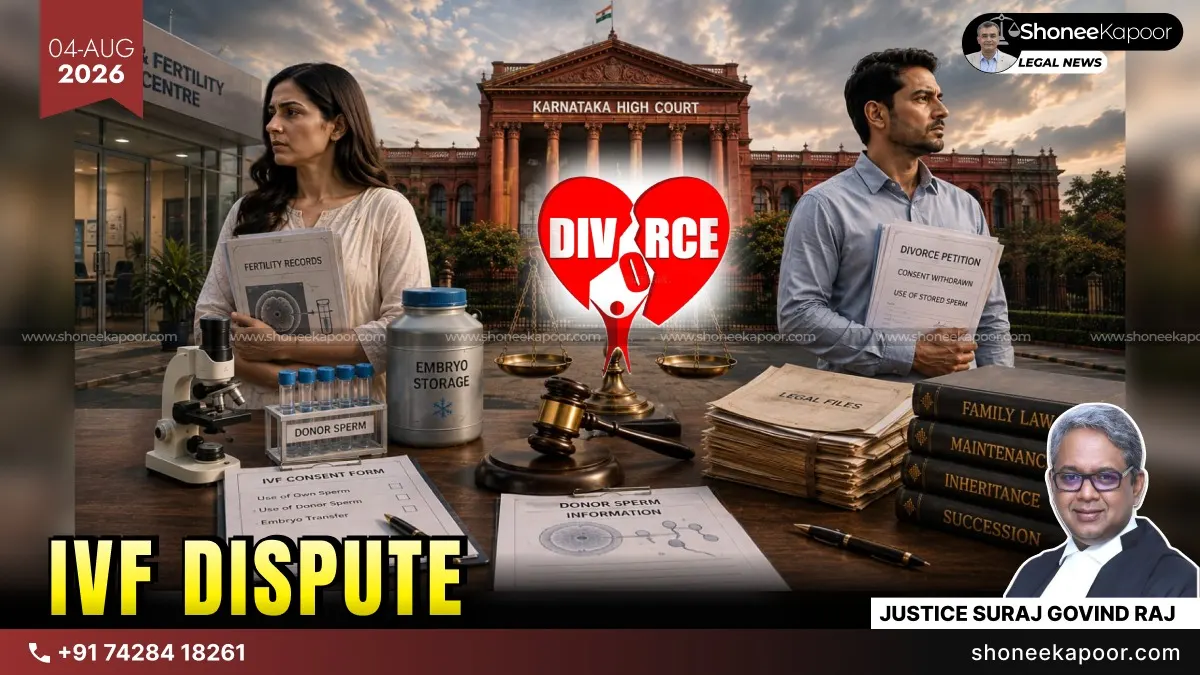
Can a married woman use donor sperm during a pending divorce without making her estranged husband legally responsible? The Karnataka High Court is examining whether IVF law permits it with safeguards against paternity, maintenance and inheritance claims.
BENGALURU: The Karnataka High Court is examining whether a married woman can use donor sperm for IVF while divorce proceedings filed by her husband are still pending.
The woman and her estranged husband had earlier preserved their eggs and sperm at an IVF clinic. They had reportedly undergone seven or eight IVF procedures after being unable to conceive naturally. Both were in their second marriage. The husband had a child from his earlier marriage, while the woman remained childless.
After matrimonial disputes arose and the husband filed for divorce, he withdrew his consent for the use of his stored sperm. The woman then approached the High Court, seeking permission to continue the IVF process.
During the hearing, Justice Suraj Govindaraj made it clear that the Court could not force the husband to allow his sperm to be used against his wishes. His withdrawal of consent must therefore be respected.
The woman’s lawyer, Advocate Parveez Ahamed MR, argued that waiting for the divorce proceedings to conclude could permanently affect her opportunity to become a mother. Referring to the possible delay, counsel said, “I might lose my last chance.”
Her counsel submitted that if the husband did not consent to the use of his sperm, she should at least be permitted to conceive through donor sperm.
The Court then asked whether the husband objected only to the use of his biological material or also objected to the estranged wife becoming a mother through a donor. Justice Govindaraj asked, “What is the problem?”
This distinction is important. A person cannot ordinarily be compelled to become a biological parent against his consent. At the same time, the dispute raises a separate question: whether the woman’s reproductive choice can be protected without imposing paternity, maintenance, inheritance or other legal responsibilities upon the estranged husband.
The Court indicated that, if donor-assisted conception were permitted before the divorce became final, the husband could be protected from all claims connected with the child. It suggested that the woman and the child may be required to give up any claim against him for maintenance, property or succession arising from the donor-assisted birth.
This proposed safeguard recognises an important legal concern. A husband who has neither provided the sperm nor agreed to the conception should not automatically be burdened with lifelong financial or parental obligations merely because the marriage legally continues during a delayed divorce case.
The husband’s lawyer sought time to obtain instructions from his client on the Court’s proposal.
Assistant Solicitor General Sadhana Desai, appearing for the Union of India, raised objections under the Assisted Reproductive Technology (Regulation) Act, 2021. She submitted that the Act recognises commissioning couples and certain eligible single women for assisted reproductive procedures.
Since the parties remain legally married, the woman may not independently qualify as a single woman entitled to obtain donor-assisted IVF outside the statutory framework. The Central government’s counsel also warned that granting such permission without clear legislative support could create complications concerning legal parentage, birth registration, maintenance and succession.
Acknowledging the urgency, the Assistant Solicitor General described it as a “very urgent requirement”, but maintained that any relief must have support in the statute.
Justice Govindaraj observed that reproductive technologies often produce questions that existing laws may not directly answer. Courts may therefore be required to interpret the law carefully while balancing personal autonomy, consent and the legal consequences of parenthood.
However, the Court also indicated that any relief must remain within the statutory framework. It encouraged the parties to consider an amicable solution and adjourned the matter for further hearing.
The High Court has not yet ruled that the woman can undergo IVF using donor sperm. It is presently examining whether such permission can legally be granted while she remains married and whether binding safeguards can completely protect the estranged husband from paternity, property, succession and maintenance claims.
CASE DETAILS
| Particular | Details |
| Court | High Court of Karnataka |
| Case title | Wife v. Husband |
| Petitioner | Estranged wife seeking permission concerning IVF |
| Bench | Justice Suraj Govindaraj |
| Date of hearing | July 28, 2026 |
| Nature of proceedings | Pending petition concerning donor-assisted IVF during divorce proceedings |
| Petitioner’s counsel | Advocate Parveez Ahamed MR |
| Union of India counsel | Assistant Solicitor General Sadhana Desai |
| Final outcome | No final decision; matter adjourned for further consideration |
EXPLANATORY TABLE OF LAWS AND SECTION
| LAW/PROVISION | RELEVANCE TO THIS CASE |
| Assisted Reproductive Technology (Regulation) Act, 2021 | Governs ART clinics, commissioning couples, eligible women, gamete use and consent requirements. |
| Consent for use of gametes | The husband withdrew consent for the use of his stored sperm. The Court indicated that he could not be compelled to provide biological parenthood without consent. |
| Commissioning couple | The ART framework generally treats a legally married couple seeking assisted reproduction as a commissioning couple, subject to statutory conditions. |
| Woman eligible for ART | The Court must examine whether a woman who remains legally married but is separated and facing divorce can independently use donor sperm. |
| Reproductive autonomy | The woman claims that delay may destroy her remaining opportunity to experience motherhood. |
| Right against forced parenthood | The husband’s consent and his right not to become a biological or legal parent against his wishes must also be protected. |
| Maintenance liability | The Court discussed insulating the estranged husband from any future maintenance claim connected with a donor-conceived child. |
| Succession and inheritance | The Court considered whether the child could be prevented from claiming inheritance or property rights against the estranged husband. |
| Legal parentage | Donor conception during an existing marriage may raise questions about who is legally recorded or presumed to be the child’s father. |
| Birth registration | The Central government warned that donor-assisted conception in these circumstances may create difficulties in recording the child’s parentage. |
| Statutory interpretation | The Court is considering whether existing ART law can be interpreted to address a situation that may not have been expressly anticipated by Parliament. |
KEY TAKEAWAYS
- The husband cannot be forced to permit the use of his stored sperm after withdrawing consent.
- The Court is examining whether the wife can instead conceive through donor sperm while the marriage legally continues.
- Any permission may require complete protection for the husband against paternity, maintenance, inheritance and property claims.
- The Central government has argued that the ART Act may not presently allow a married woman to independently seek donor-assisted IVF in these circumstances.
- No final ruling has been delivered. The Court has only raised questions and explored possible legal safeguards.
This Could Change Your Case-Get FREE Legal Advice-Click Here!
Disclaimer: The views and opinions expressed in this article are those of the Indian courts and do not necessarily reflect the official policy or position of “ShoneeKapoor.com” or its affiliates. This article is intended for informational and educational purposes only. The content provided is not legal advice, and viewers should not act upon this information without seeking professional counsel. Viewer discretion is advised.
