
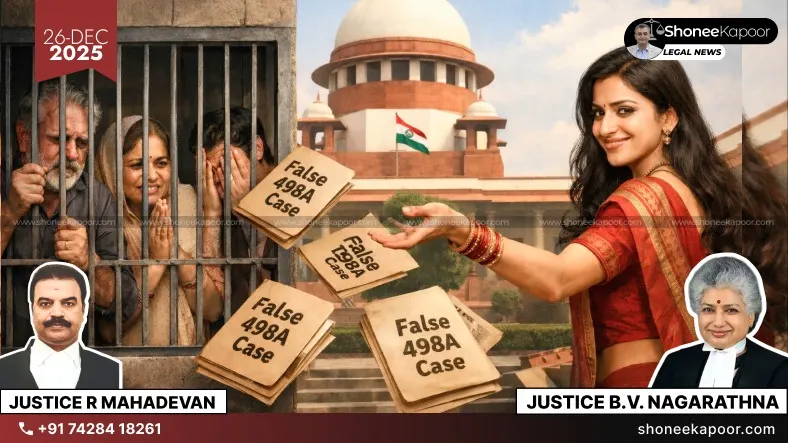
The Supreme Court has ruled that simply naming husband’s relatives without clear and specific allegations is not enough to prosecute them under Section 498A IPC. Vague and general accusations against in-laws amount to misuse of criminal law, the Court held.
NEW DELHI: In a landmark judgment reinforcing safeguards against misuse of matrimonial criminal laws, the Supreme Court of India has quashed criminal proceedings against the parents-in-law of a woman, holding that vague and general allegations without specific roles or incidents cannot justify prosecution under Section 498A of the Indian Penal Code.
The Court observed that the allegations made against the parents-in-law were “vague and omnibus” and did not mention any clear incident, date, or specific act of cruelty or dowry demand attributed to them.
The Bench comprising Justice B.V. Nagarathna and Justice R. Mahadevan allowed the appeal filed by the parents-in-law and set aside the earlier order of the Telangana High Court, which had refused to quash the criminal case and instead asked them to seek discharge before the trial court.
The case arose from a matrimonial dispute between the complainant and her husband, who is the son of the appellants. The marriage took place on August 12, 2012, and the couple had a daughter on November 1, 2013. Almost ten years after the marriage, on March 4, 2023, the complainant approached the Women Police Station at Nalgonda and lodged a complaint.
In her complaint, the woman claimed that at the time of marriage, her family gave Rupees Four Lakhs Fifty Thousand in cash, 90 grams of gold, and household articles. She stated that the couple lived happily for about eight years, but after the birth of their daughter, her husband’s behaviour changed.
She alleged that her husband, “influenced by the words of the appellant(s), sister-in-law and sister-in-law’s husband,” started abusing her, beating her, and demanding an additional dowry of Rupees Four Lakhs.
Based on this complaint, FIR No. 28 of 2023 was registered against six persons, including the parents-in-law, for offences under Sections 498A, 323, 504 read with Section 34 IPC and Section 4 of the Dowry Prohibition Act. After investigation, a chargesheet was filed and the trial court at Nalgonda took cognisance of the offences.
The parents-in-law then approached the High Court under Section 482 of the Code of Criminal Procedure, seeking quashing of the proceedings. However, the High Court declined to interfere and left it open for them to apply for discharge. Challenging this, the appellants approached the Supreme Court. Notably, although notice was served on the complainant, she did not appear before the Supreme Court.
After examining the FIR and the material on record, the Supreme Court found a clear lack of specific allegations against the parents-in-law. The Court highlighted:
“The absence of any specific instance or occasion detailed with particulars wherein the appellant(s) demanded dowry from Respondent No. 2 and on refusal of the same, subjected her to mental and physical cruelty.”
The Court noted that the main accusation was that the husband’s behaviour changed due to the “alleged inducement exercised by the in-laws including the appellant(s) herein.” The Bench made it clear that such general statements are not enough to justify criminal prosecution and observed:
“We therefore find that the aforesaid allegations levelled against the appellant(s), even if taken at their face value, do not prima facie disclose the commission of the alleged offences so as to warrant the initiation of criminal proceedings.”
While analysing the legal position, the Supreme Court relied heavily on its earlier judgment in Dara Lakshmi Narayana vs. State of Telangana. Quoting from that decision, the Court reiterated:
“A mere reference to the names of family members in a criminal case arising out of a matrimonial dispute, without specific allegations indicating their active involvement should be nipped in the bud. It is a well-recognised fact, borne out of judicial experience, that there is often a tendency to implicate all the members of the husband’s family when domestic disputes arise out of a matrimonial discord.”
The judgment further stressed that courts must be careful to prevent unnecessary harassment of innocent relatives based on sweeping and unsupported allegations. The Bench also recalled the Supreme Court’s concern regarding the increasing misuse of Section 498A IPC and quoted:
“However, in recent years, as there have been a notable rise in matrimonial disputes across the country… there has been a growing tendency to misuse provisions like Section 498-A IPC as a tool for unleashing personal vendetta against the husband and his family by a wife.”
The Court clarified that it was not discouraging genuine victims of cruelty from approaching the law, but warned against filing criminal cases with vague allegations or as a counterblast in matrimonial disputes. It emphasised that Section 498A was enacted to protect women from real cruelty related to dowry demands, not to be used as a pressure tactic.
Applying these settled principles, the Supreme Court concluded that the High Court failed to exercise its powers properly to prevent abuse of the legal process.
Accordingly, the Court passed the following order:
“The proceedings instituted against the appellant(s) in C.C. No.338/2023 pending on the file of the Judicial First Class Magistrate (Prohibition and Excise offence) at Nalgonda stand quashed in relation to the appellants herein.”
With this, the appeal was allowed, bringing relief to the parents-in-law who had been facing criminal prosecution solely on the basis of general and non-specific allegations.
Explanatory Table: Laws and Sections Applied in This Case
| Law / Section | Purpose | How It Was Applied in This Case |
| Section 498A IPC | Punishes cruelty by husband or his relatives towards a married woman, especially related to dowry demands | The Court held that vague and omnibus allegations against in-laws, without specific acts or dates, do not justify prosecution |
| Section 323 IPC | Punishes voluntarily causing hurt | No specific incident of physical assault by the parents-in-law was described; hence, no prima facie case |
| Section 504 IPC | Punishes intentional insult with intent to provoke breach of peace | Allegations were general and did not disclose any specific insulting act by the appellants |
| Section 34 IPC | Attributes joint liability when a criminal act is done with common intention | In absence of specific overt acts, common intention could not be presumed |
| Section 3 Dowry Prohibition Act | Punishes giving or taking dowry | No direct role or demand attributed to the parents-in-law with particulars |
| Section 4 Dowry Prohibition Act | Punishes demanding dowry | The Court found no clear or specific dowry demand by the appellants |
| Section 482 CrPC | Inherent powers of High Court to prevent abuse of process and secure justice | Supreme Court held that the High Court should have exercised this power to quash the case |
| Bhajan Lal Guidelines | Lays down categories where FIRs can be quashed | The case was held to fall under misuse and abuse of process category |
| Dara Lakshmi Narayana Case | Clarifies limits of implicating relatives in matrimonial disputes | Directly relied upon to quash proceedings |
Case Summary
- Case Title: Maram Nirmala & Anr. vs. The State of Telangana & Anr
- Court: Supreme Court of India.
- Jurisdiction: Criminal Appellate Jurisdiction
- Case Number: Criminal Appeal arising out of SLP (Crl.) No. 7597 of 2025
- Neutral Citation: 2025 INSC 1496
- Date of Judgment: 16 December 2025
- Bench: Justice B.V. Nagarathna and Justice R. Mahadevan
- Appellants: Mother-in-law and Father-in-law of the complainant
- Respondents: State of Telangana, Wife (Complainant)
- Counsels:
- Counsel for the Appellants – As recorded in the judgment
- Counsel for Respondent No.1 (State of Telangana) – As recorded
- Respondent No.2 – No appearance despite service of notice
Key Takeaways
- Mere Naming Is Not Crime: Simply adding parents-in-law or relatives in an FIR does not create criminal liability under Section 498A IPC.
- Specific Role Is Mandatory: Courts will not allow prosecution unless there are clear, specific, and individual allegations with dates and acts.
- 498A Misuse Acknowledged Again: The Supreme Court has once more recognised that Section 498A is frequently misused as a pressure tactic.
- High Courts Must Intervene Early: If allegations are vague and omnibus, High Courts are duty-bound to quash cases under Section 482 CrPC.
- Relief for Innocent Families: Elderly parents and distant relatives cannot be dragged into criminal trials merely due to matrimonial disputes.
This Could Change Your Case-Get FREE Legal Advice-Click Here!
Disclaimer: The views and opinions expressed in this article are those of the Indian courts and do not necessarily reflect the official policy or position of “ShoneeKapoor.com” or its affiliates. This article is intended for informational and educational purposes only. The content provided is not legal advice, and viewers should not act upon this information without seeking professional counsel. Viewer discretion is advised.

Dear Sir
Dated 28.11.2025 Gujarat State,Mahesana District Trial court has been declared 498A Judgement by aquittal to me & my Parents…Case registered in the year 2021
Case No – CC-11411/2021
Congratulations on the acquittal. Your case reflects exactly what the Supreme Court has repeatedly held—Section 498A is not an automatic arrest or conviction provision. Mere naming of husband and relatives, without specific, date-wise and role-specific allegations, cannot sustain a criminal trial.
Courts have made it clear that omnibus allegations, delayed complaints, and mechanical roping-in of parents amount to abuse of process. Acquittals like yours reaffirm that criminal law cannot be used as a tool of pressure or revenge.
Justice delayed, but truth prevailed. This judgment adds to the growing judicial pushback against misuse of 498A.