
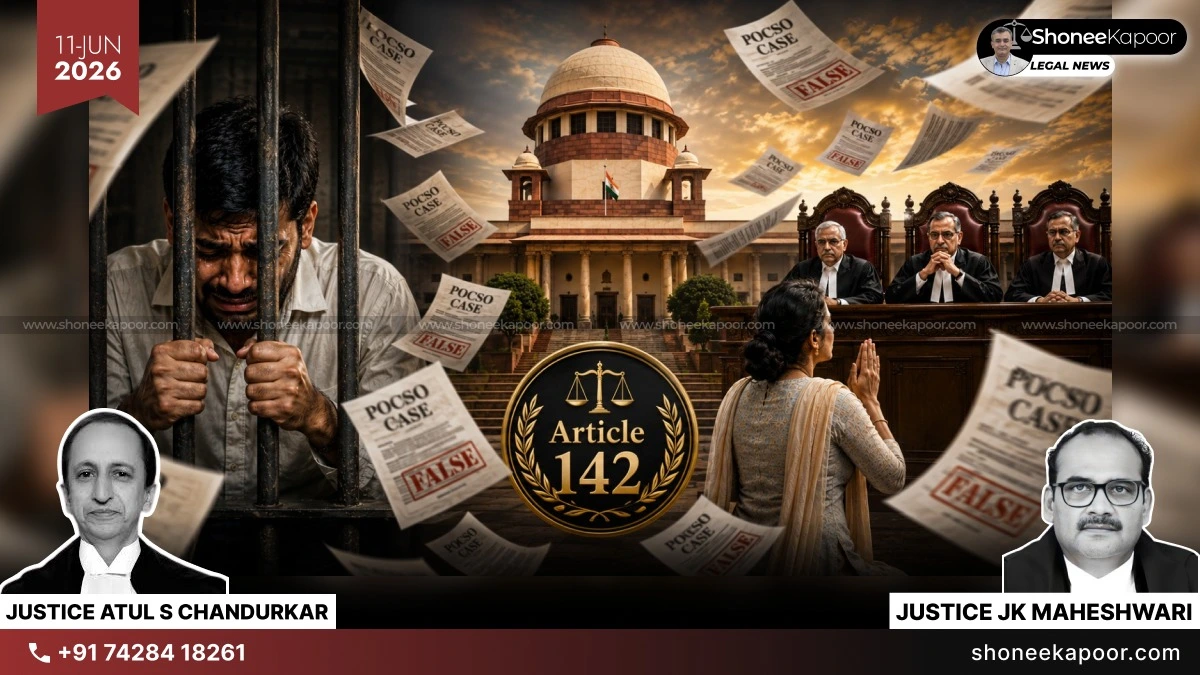
She wanted the case to end after marriage and sought to set aside his conviction. Can extraordinary circumstances change the outcome of a POCSO conviction?
NEW DELHI: The Supreme Court has set aside a conviction under the Protection of Children from Sexual Offences (POCSO) Act by using its extraordinary powers under Article 142 of the Constitution after taking note of the unusual facts of the case. The Court found that the accused and the victim had married after she became a major, had been living together, and had resolved their dispute. The accused also paid Rs. 10 lakh to the victim as compensation.
The judgment was delivered by a Bench of Justice JK Maheshwari and Justice Atul S Chandurkar. However, the Court made it clear that the decision was based entirely on the special facts of this case and should not be used as a precedent in future cases.
The Court observed:
“Accordingly, the appeals are allowed and on the basis of subsequent events the conviction and sentence as directed by Sessions Court confirmed by the High Court stand set aside. The appellant and the victim are left free to live their life peacefully in society as spouse.”
The case dates back to 2019, when the appellant was convicted by the Trial Court under Sections 5(1) and 6 of the POCSO Act and sentenced to ten years in prison. He later challenged the conviction before the Madras High Court, which suspended his sentence during the pendency of the appeal.
Meanwhile, the victim approached the High Court seeking to quash the proceedings. In an affidavit, she stated that she and the accused had been living together for the previous four years, that she wanted to bring an end to the dispute, and that she wished for his conviction to be set aside. However, the High Court rejected her plea in 2021.
The accused then moved the Supreme Court. During the proceedings, the Supreme Court directed that the victim’s statement under Section 164 CrPC be recorded. Since there was uncertainty regarding whether the parties had actually married, the Court later directed the Magistrate to record her statement once again through an order dated November 28, 2024.
According to her statement, the appellant had physical relations with her on the promise of marriage but later refused to marry her. She subsequently filed a police complaint. She later married another man, but when he came to know about her previous relationship with the appellant, he left her. She then returned to stay with her father. Eventually, the appellant’s family approached her with a marriage proposal, and the two got married in 2024 after she had attained the age of majority.
When the matter came up before the Supreme Court on April 6, the victim informed the Court that she no longer wished to pursue the litigation if she was paid Rs. 10 lakh to secure her future. When the matter was listed again, the Court was informed that the amount had already been paid by the appellant, and the Registrar (Judicial) recorded a statement confirming the same.
The State Government also informed the Court that it had no objection to setting aside the conviction, provided the order was not treated as a precedent.
Taking note of the subsequent developments and the overall circumstances, the Supreme Court observed:
“Now as per subsequent statement, appellant and the victim have solemnised the marriage on attaining the age of majority and also received the amount of compensation for his guilt with minor victim. Therefore, at this stage, without entering into the merits of the case, in the peculiar facts, as narrated above, we deem it appropriate to exercise our plenary power under Article 142 of the Constitution of India for setting aside the judgment of conviction and sentence of the appellant for the charge under Section 5(1) of POCSO Act and in terms of the statements as recorded and the appellant is acquitted from the charge.”
The Supreme Court’s order does not examine whether the original conviction was legally correct or incorrect. Instead, it reflects the Court’s willingness to use its constitutional powers to bring finality to exceptional disputes where both parties have moved on with their lives.
The ruling also quietly highlights the complexity of human relationships and criminal litigation. Years after allegations are made, circumstances can change dramatically, raising difficult questions about how the justice system balances punishment, reconciliation, personal autonomy, and the long-term consequences faced by everyone involved.
While the Court emphasised that this order cannot be cited as a precedent, it recognised that justice in rare cases may require looking beyond rigid outcomes and considering the realities that emerge over time.
EXPLANATORY TABLE: LAWS AND SECTIONS INVOLVED
| LAW / SECTION | PURPOSE | APPLICATION IN THIS CASE |
| Section 5(1), POCSO Act, 2012 | Defines aggravated penetrative sexual assault on a child. | The appellant was convicted under this provision. |
| Section 6, POCSO Act, 2012 | Prescribes punishment for aggravated penetrative sexual assault. | Ten years’ imprisonment was imposed by the Trial Court. |
| Section 482 CrPC | Gives inherent powers to High Courts to secure the ends of justice. | Victim sought further examination and setting aside of conviction. |
| Section 391 CrPC | Permits appellate courts to take additional evidence. | Victim requested her deposition be recorded as additional evidence. |
| Section 164 CrPC | Enables recording of statements before a Magistrate. | Supreme Court directed recording and re-recording of the victim’s statement. |
| Article 142, Constitution of India | Allows the Supreme Court to do complete justice in exceptional cases. | Conviction and sentence were set aside using this extraordinary power. |
| POCSO Act, 2012 | Special law protecting children from sexual offences. | The entire prosecution originated under this Act. |
CASE DETAILS
- Case Title: Maruthupandi v. State Represented by the Inspector of Police & Anr. With Maruthupandi v. State Represented by the Inspector of Police & Anr. (Arising out of SLP (Crl.) No. 2782 of 2021 and SLP (Crl.) No. 4907 of 2021)
- Bench: Justice J.K. Maheshwari & Justice Atul S. Chandurkar
- Date of Judgment: 26 May 2026
- Neutral Citation: 2026 INSC 774
COUNSELS
- For the Appellant
- Mr. Rahul Shyam Bhandari, AOR
- Ms. G. Priyadharshni, Advocate
- Mr. Satyam Pathak, Advocate
- For the Respondents
- Mr. Sabarish Subramanian, AOR
- Ms. Arpitha Anna Mathen, Advocate
- Mr. Konark Tyagi, AOR
KEY TAKEAWAYS
- A man spent nearly a decade carrying the label of a convicted offender before the case finally ended through extraordinary judicial intervention.
- The legal system rarely acknowledges the years of stigma, financial burden, and emotional destruction suffered by accused men during prolonged litigation.
- The Supreme Court had to invoke Article 142 because the ordinary process had no answer to dramatically changed circumstances.
- Allegations may begin a case, but the punishment of social condemnation often starts long before the final verdict.
- Justice cannot mean protecting one side while ignoring the irreversible damage inflicted on the other.
This Could Change Your Case-Get FREE Legal Advice-Click Here!
Disclaimer: The views and opinions expressed in this article are those of the Indian courts and do not necessarily reflect the official policy or position of “ShoneeKapoor.com” or its affiliates. This article is intended for informational and educational purposes only. The content provided is not legal advice, and viewers should not act upon this information without seeking professional counsel. Viewer discretion is advised.
