
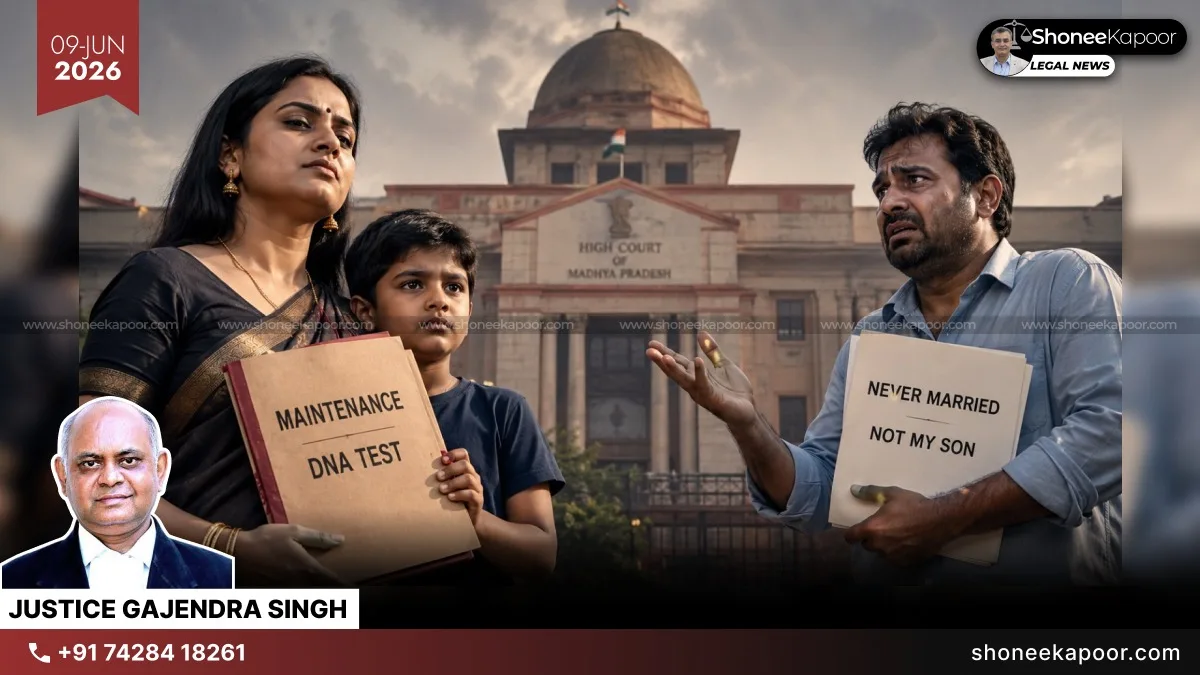
Can a man become liable for maintenance even when marriage is not strictly proved? The MP High Court reiterated that strict proof of marriage is not required under Section 125 CrPC and maintenance can be granted based on surrounding circumstances.
MADHYA PRADESH: The Madhya Pradesh High Court, through Justice Gajendra Singh, has ruled that a woman and her son are entitled to maintenance despite the man’s denial of both marriage and paternity.
The judgment highlights how maintenance proceedings operate on a different standard of proof than criminal cases and how a man’s refusal to undergo a DNA test can significantly affect the outcome.
The dispute began when a woman and her son sought maintenance under Section 125 CrPC, claiming that they had been abandoned without financial support after years of living as a family. The woman asserted that she had married the respondent according to Hindu customs and that the child was born from the relationship.
The man, however, denied the allegations entirely. He maintained that the woman was never his wife and was only employed as a domestic worker in his house. He also denied being the father of the child. Based on these disputes, both the trial court and the appellate court rejected the maintenance claim, giving the man relief at that stage of the litigation.
The matter later reached the High Court, where the woman sought a DNA fingerprinting test to establish paternity. The respondent opposed the request and declined to undergo the test. What started as a dispute over maintenance therefore evolved into a much larger battle over marriage, paternity, and financial liability.
While examining the record, the High Court noted that witnesses had consistently stated that the parties had lived together as husband and wife and that the child was born from the relationship. The Court also observed that the respondent had not offered any explanation regarding the child’s paternity while opposing scientific testing that could have provided a definitive answer.
Referring to the Supreme Court’s decision in Dwarika Prasad Satpathy vs Bidyut Prava Dixit, the Court reiterated:
“The standard of proof of marriage in such proceeding is not as strict as is required in a trial of offence under section 494 of the I.P.C. If the claimant in proceedings under Section 125 of the Code succeeds in showing that she and the respondent have lived together as husband and wife, the Court can presume that they are legally wedded spouses, and in such a situation, the party who denies the marital status can rebut the presumption.”
The High Court ultimately drew an adverse inference from the respondent’s refusal to undergo DNA testing. As a result, despite succeeding before two lower courts, he lost the case in revision and became liable to pay maintenance. Justice Gajendra Singh held that the existence of another marriage could not by itself defeat a maintenance claim where there was sufficient material suggesting that the parties had lived together as husband and wife.
Setting aside the earlier orders, the High Court awarded maintenance of ₹5,000 per month each to the woman and the child, totalling ₹10,000 per month. The amount was made payable from the date of the original application filed in 2014, creating liability for arrears stretching back more than a decade. The Court further directed that maintenance for the woman would continue until remarriage, while maintenance for the child would continue until he attains majority.
EXPLANATORY TABLE OF LAWS AND PROVISIONS INVOLVED
| Law / Section | Purpose | How It Was Applied In This Case |
| Section 125, Code of Criminal Procedure, 1973 | Provides maintenance to wives, children and parents who cannot maintain themselves. | The woman and child sought monthly maintenance under this provision. |
| Section 397, Code of Criminal Procedure, 1973 | Gives revisional jurisdiction to the High Court to examine correctness of lower court orders. | The revision petition was filed before the High Court under this provision. |
| Section 401, Code of Criminal Procedure, 1973 | Gives powers to the High Court while exercising revision jurisdiction. | Used along with Section 397 to challenge the lower court decisions. |
| Section 494, Indian Penal Code, 1860 | Punishes bigamy (marrying again during the lifetime of a spouse). | Mentioned by the Supreme Court precedent to explain that maintenance cases require a lower standard of proof than bigamy prosecutions. |
| DNA Fingerprinting Test | Scientific method used to establish biological parentage. | The woman sought DNA testing to establish paternity, but the respondent refused to undergo the test. |
| Principle Of Adverse Inference | Court may draw an unfavourable inference when a party refuses to produce evidence within its control. | The High Court drew an adverse inference against the respondent because he refused DNA testing. |
CASE DETAILS
- Case Title: Seemabai and Others v. Basantilal
- Case Number: Criminal Revision No. 4517 of 2022
- Court: High Court of Madhya Pradesh, Indore Bench
- Judge: Hon’ble Justice Gajendra Singh
- Date of Judgment: 20 May 2026
- Neutral Citation: 2026:MPHC-IND:14727
- Counsels:
- For Revision Petitioners: Shri Anirudh Saxna, Advocate
- For Respondent: Shri Krishnapal Singh Khichi, Advocate
KEY TAKEAWAYS
- A man can face lifelong financial consequences even when marriage and paternity are disputed, because maintenance proceedings follow a lower standard of proof than criminal trials.
- Refusing a DNA test may backfire. Courts can draw an adverse inference and use that refusal against the man.
- Winning before lower courts does not guarantee success. A revision court can completely reverse the outcome and impose maintenance liability.
- In maintenance cases, cohabitation and witness testimony may carry more weight than many men expect, even when there is no formal proof of marriage.
- Every man involved in a paternity or live-in relationship dispute should understand that evidence strategy matters—silence, non-cooperation, or procedural mistakes can become decisive factors in court.
This Could Change Your Case-Get FREE Legal Advice-Click Here!
Disclaimer: The views and opinions expressed in this article are those of the Indian courts and do not necessarily reflect the official policy or position of “ShoneeKapoor.com” or its affiliates. This article is intended for informational and educational purposes only. The content provided is not legal advice, and viewers should not act upon this information without seeking professional counsel. Viewer discretion is advised.
