
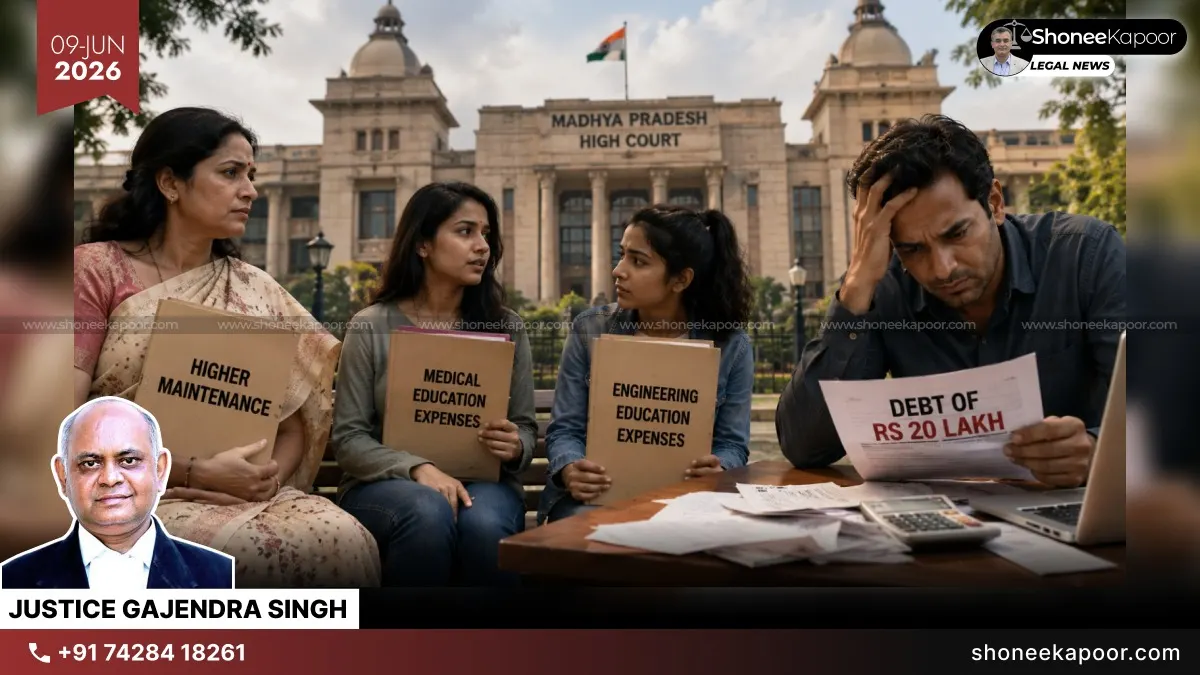
Does a father’s duty end with maintenance, or can courts impose much more? The MP High Court ruled that educational expenses must also be considered and directed a father to bear ₹46.26 lakh towards his daughters’ professional education.
MADHYA PRADESH: The Madhya Pradesh High Court has held that a financially capable father cannot avoid paying for the higher education of his daughters merely because they have attained majority. Justice Gajendra Singh passed the order while partly allowing a revision petition filed by a wife and her two daughters against a maintenance order passed by the Family Court at Mandsaur.
The marriage between the parties was solemnized on 16 April 2000 according to Hindu rites. Two daughters were born from the marriage. In 2018, the wife and daughters filed an application under Section 125 CrPC seeking maintenance on the ground that they were unable to maintain themselves and that the husband had sufficient means. They claimed that the husband was earning around ₹12 lakh per month and sought maintenance along with educational expenses for the daughters.
The husband opposed the claim and argued that the demands were exaggerated and unrealistic. He stated that the wife was already residing in a house constructed by him at a cost of around ₹50 lakh. He further claimed that he was facing financial difficulties, had lost earning opportunities due to a hostile atmosphere and false complaints, and was under a debt of around ₹20 lakh. According to him, he had also made efforts to save the marriage and had entered into compromises, but the wife did not cooperate.
After considering the evidence, the Family Court awarded maintenance of ₹6,000 per month to the wife and ₹3,000 per month each to the two daughters. However, the maintenance granted to the daughters was restricted only until they attained majority.
The wife and daughters challenged the Family Court’s order, claiming that the husband’s actual financial position had not been properly assessed and that the heavy cost of the daughters’ higher education had been overlooked. They also stated that despite providing them a house, the husband was now trying to remove them from it through separate legal proceedings.
The High Court noted that the husband was associated with educational institutions and owned vehicles and multiple bank accounts. Observing that income tax returns do not always reflect a person’s true financial capacity, the Court found him financially capable of bearing the educational expenses of his daughters.
The Court further noted that one daughter was pursuing a medical degree at Kyrgyz State Medical Academy, while the other was studying B.Tech (Computer Science Engineering) at Manipal University, Jaipur, involving significant educational expenses.
While discussing the financial burden of higher education, the Court observed that the Family Court had completely failed to consider these expenses. The Court stated:
“Father is obliged to provide the education to daughter also.”
The Court further emphasised the importance of genuine empowerment of women and observed:
“Woman empowerment does not remain on paper it requires implementation and the father is having sufficient income and cannot deprive the girl children from providing the educational expenses.”
Justice Gajendra Singh noted that the wife was a Bachelor of Education and therefore found no reason to enhance the maintenance awarded to her. However, the Court held that the educational expenses of the daughters had not been taken into account by the Family Court and required separate consideration.
After examining the records relating to tuition fees, hostel charges and other educational expenses, the Court calculated that approximately ₹26.69 lakh had been spent on the medical education of one daughter and approximately ₹19.56 lakh on the engineering education of the other daughter.
Accordingly, the High Court directed the father to pay a total amount of ₹46,26,200 towards the educational expenses incurred for both daughters. The Court ordered that this amount must be paid within four months. It further directed that if the amount is not paid within the stipulated period, it would carry interest at the rate of 6% per annum. Any amount already paid by the father would be adjusted.
With these directions, the High Court partly allowed the revision petition and placed the financial responsibility for the daughters’ higher education on the father, directing him to pay ₹46.26 lakh towards the expenses incurred for their medical and engineering studies.
EXPLANATORY TABLE: LAWS AND PROVISIONS INVOLVED
| Law / Provision | Purpose | Relevance in This Case |
| Section 125 CrPC (now Section 144 BNSS, 2023) | Maintenance for dependants. | Wife and daughters sought maintenance under this provision. |
| Section 19(4), Family Courts Act, 1984 | Challenge Family Court orders. | Revision petition was filed before the High Court under this section. |
| Section 20, Hindu Adoptions and Maintenance Act, 1956 | Duty to maintain children. | Supports a parent’s obligation to maintain and educate children. |
| Article 21, Constitution of India | Right to live with dignity. | Courts have interpreted this to include access to education and basic needs. |
| Article 39(f), Constitution of India | Protect children’s development. | Reflects the State’s policy of ensuring children’s welfare and education. |
| Article 41, Constitution of India | Promote education and assistance. | Supports the broader principle of educational opportunities. |
| Madhya Pradesh Cooperative Society Act, 1973 | Regulates cooperative societies. | Husband’s role in a society registered under this Act was considered while assessing finances. |
CASE DETAILS
- Case Title: Smt. Savita & Others v. Deepak
- Case Number: Criminal Revision No. 1560 of 2022
- Court: High Court of Madhya Pradesh, Indore Bench
- Bench: Hon’ble Shri Justice Gajendra Singh
- Date of Judgment: 29 May 2026
- Neutral Citation: 2026:MPHC-IND:15009
- Counsels:
- For the Petitioners: Shri Vishal Sharma, Advocate
- For the Respondent: Shri Padmnabh Saxena, Advocate
KEY TAKEAWAYS
- A father’s financial responsibility does not automatically end when his children attain majority, especially when higher education expenses are involved.
- Courts can look beyond Income Tax Returns and assess a person’s actual financial capacity through assets, businesses, lifestyle and bank accounts.
- Educational expenses running into lakhs can be imposed on a father even years after the original maintenance proceedings began.
- The judgment reinforces that maintenance litigation can evolve into substantial long-term financial liabilities for fathers based on changing circumstances.
- Accurate disclosure of income, assets and future educational liabilities is critical, as courts may impose significant retrospective financial burdens.
This Could Change Your Case-Get FREE Legal Advice-Click Here!
Disclaimer: The views and opinions expressed in this article are those of the Indian courts and do not necessarily reflect the official policy or position of “ShoneeKapoor.com” or its affiliates. This article is intended for informational and educational purposes only. The content provided is not legal advice, and viewers should not act upon this information without seeking professional counsel. Viewer discretion is advised.
