
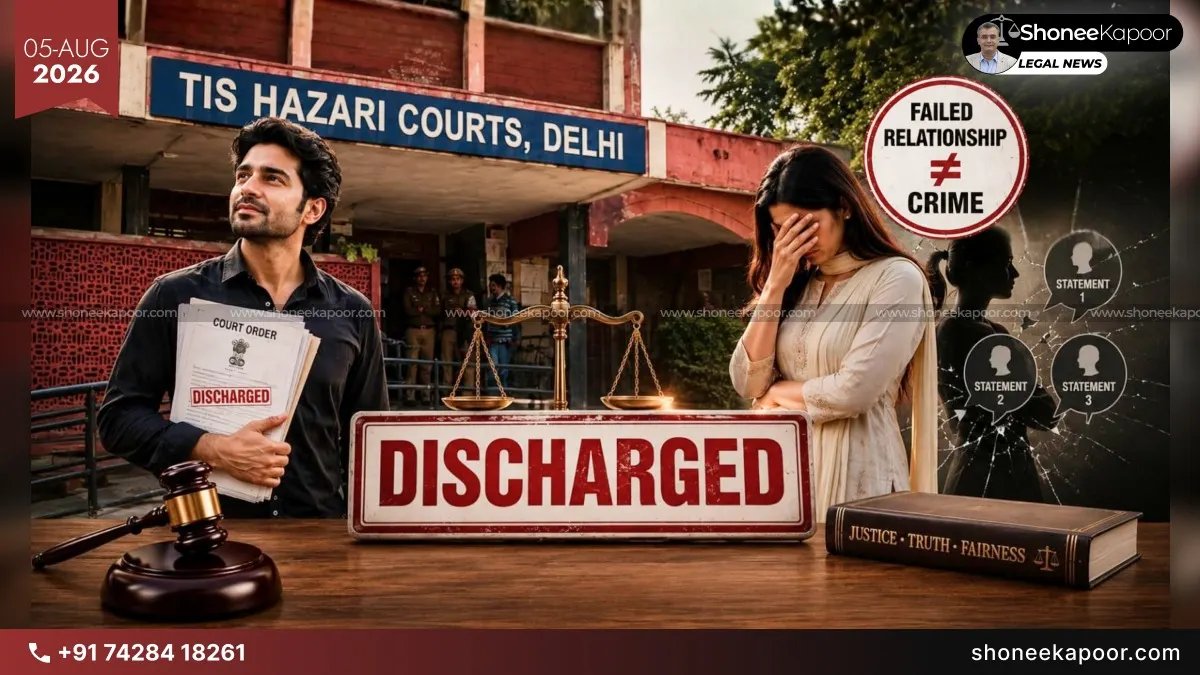
Did the complainant’s own statements contradict the allegation that consent was obtained through a false promise of marriage? The Tis Hazari Court examined three different versions and found no grave suspicion sufficient to put the accused through a criminal trial.
NEW DELHI: Tis Hazari Court, Delhi has discharged an accused after finding that the prosecution’s own material contained major contradictions and failed to create the required grave suspicion for framing charges.
The Additional Sessions Judge (SFTC), Central District, Tis Hazari Courts, Delhi, discharged the accused under Sections 69 and 209 of the Bharatiya Nyaya Sanhita (BNS). The Court held that the prosecution material did not justify framing charges against the accused. The order was passed on 29 July 2026.
According to the prosecution, the complainant alleged that the accused developed a relationship with her after making a promise of marriage and that physical relations were established on that basis. The prosecution relied upon the complaint, statements recorded during investigation, medical records and other documents to support its case.
Appearing for the accused, Advocates Abhimanyu Kumar and Yash Saxena argued that the prosecution’s own documents gave different versions regarding the most important issue in the case: the timing of the alleged promise of marriage and the physical relationship. It was pointed out that the complaint, the statement under Section 183 BNSS, and the medical history recorded in the MLC contradicted each other on these core facts.
While examining these versions, the Court observed:
“The prosecutrix has given three materially contradictory and mutually destructive versions on the most essential ingredient of the offence i.e. the timing and existence of the alleged promise of marriage vis-à-vis the first physical relationship.”
The defence further argued that Section 69 BNS applies only when a false promise of marriage is made with dishonest intention from the very beginning and such promise directly causes the consent for the relationship. It was submitted that the prosecution material itself failed to establish this essential legal requirement.
The defence also argued that the later failure of a relationship cannot automatically convert an otherwise consensual relationship into a criminal offence. The Court found that the complainant’s statement before the Magistrate created a serious difficulty for the prosecution and stated:
“The Section 183 BNSS statement of the prosecutrix demolishes the prosecution’s case.”
After examining the charge-sheet, statements, medical records and other material, the Court found that the prosecution had presented materially contradictory versions regarding the alleged promise of marriage, consent and the sequence of events.
The Court also examined whether any independent witness, document, message or other material supported the allegation that a false promise of marriage had been made with dishonest intention from the beginning. It found no such supporting material and observed:
“There is no independent corroborative evidence of any false promise of marriage.”
The contradictions were not treated as minor differences that could be examined only during trial. The Court found that they directly affected the basic ingredients required to establish an offence under Section 69 BNS.
It accordingly held:
“The material contradictions in the prosecutrix’s own statements are not trivial or peripheral; they strike at the very foundation of the offence under Section 69 BNS.”
At the stage of charge, the Court is not required to conduct a complete trial or finally determine the guilt or innocence of the accused. However, the prosecution material must at least create a strong or grave suspicion that the accused committed the alleged offence.
In the present case, the Court found that the complaint, the Magistrate’s statement and the MLC did not present one clear and consistent prosecution version. The available material also failed to show that an allegedly false promise of marriage existed at the beginning of the relationship and directly caused the complainant’s consent.
The Court therefore concluded:
“No grave suspicion arises against the accused so as to warrant framing of charge under Sections 69/209 BNS.”
The Court further considered the entire prosecution record at its highest value, without testing the evidence as it would during a full trial. Even on that standard, it found that the necessary threshold for framing charges was not satisfied.
The Court recorded:
“The prosecution material, even if taken at its face value in its entirety, does not raise a ‘grave suspicion’ against the accused so as to warrant the framing of charge under Sections 69/209 BNS.”
The Court also found that the contradictions were not capable of being easily explained or reconciled. They concerned the core allegation itself, including when the alleged promise was made, whether it existed before the first physical relationship, and whether it had any direct connection with consent.
The Court concluded that forcing the accused to face a complete criminal trial despite such fundamental defects would not serve the interests of justice. A criminal trial itself carries serious consequences, including social stigma, financial burden, repeated court appearances and prolonged uncertainty for an accused.
The Court therefore held:
“To proceed with the trial in such circumstances would amount to an abuse of the process of law and would cause unnecessary harassment to the accused.”
Accordingly, the accused was discharged from the offences under Sections 69 and 209 BNS. The proceedings relating to the proclamation under Section 84 BNSS were also directed to be closed in view of the discharge.
EXPLANATORY TABLE OF LAWS AND SECTION
| Law / Section | Simple Legal Meaning | How It Applied in This Case |
| Section 69 BNS | Punishes sexual intercourse obtained through deceitful means or a promise of marriage made without an intention to fulfil it. | The Court found no consistent evidence that a false promise existed from the beginning or that it directly caused consent. |
| Section 209 BNS | Deals with failure to appear after a lawful proclamation requiring a person’s presence. | The accused joined the investigation after receiving interim protection. The Court found no deliberate attempt to evade the process. |
| Section 84 BNSS | Provides for issuing a proclamation against a person believed to be absconding or concealing himself. | Proclamation proceedings had been initiated, but the Court directed their closure after discharging the accused. |
| Section 180 BNSS | Permits the police to examine witnesses during an investigation and record their statements. | The investigating agency recorded statements of the complainant, common friend, hotel manager and other witnesses. |
| Section 183 BNSS | Provides for recording a confession or statement before a Judicial Magistrate. | The Court found that the complainant’s Magistrate statement contradicted the FIR and seriously weakened the prosecution case. |
| Section 193(9) BNSS | Permits further investigation after the police report has been filed. | The complainant sought further investigation, but the Court found no valid ground to order it. |
| Section 94 BNSS | Allows a Court or police officer to require the production of documents or electronic records necessary for a proceeding. | The complainant sought CCTV footage and call records. The Court found that the material was delayed and not relevant to framing charges. |
| Section 251 BNSS | Governs consideration of charge and discharge in a Sessions case. | The Court examined whether the prosecution material created grave suspicion and decided to discharge the accused. |
| Grave Suspicion Test | A charge may be framed when the material raises strong or grave suspicion that the accused committed the offence. | The Court found that contradictory and unsupported allegations did not satisfy this test. |
| Consent and False Promise Principle | The false promise must exist from the beginning and must directly influence the woman’s consent. | The different versions failed to show when the alleged promise was made and whether it caused consent. |
CASE DETAILS
| Case Particular | Details |
| Case Title | State vs. S.C |
| Court | Court of Additional Sessions Judge, Central District, Tis Hazari Courts, Delhi |
| Presiding Judge | Ms Shreya Arora Mehta, ASJ/SFTC-02 (Central) |
| Sessions Case Number | SC No. 822/2025 |
| Date of Order | July 29, 2026 |
| Counsel for Accused | Tripaksha Litigation through Advocates Abhimanyu Kumar and Yash Saxena |
| Counsel for State | Sh. Parvesh Sisodia, Substitute Additional Public Prosecutor |
| Counsel for Complainant | Ms Barkha Chhabra, Legal Services Advocate, DLSA Central |
| Final Decision | Accused discharged under Sections 69 and 209 BNS |
KEY TAKEAWAYS
- A failed relationship cannot automatically become a criminal offence against a man.
- Three contradictory versions on consent and promise of marriage destroyed the prosecution’s core case.
- There was no independent evidence proving any false promise of marriage from the beginning.
- The Court found no grave suspicion under Sections 69 and 209 BNS and discharged the accused.
- Dragging a man through trial on an internally broken case is not justice. It is harassment through legal process.
This Could Change Your Case-Get FREE Legal Advice-Click Here!
Disclaimer: The views and opinions expressed in this article are those of the Indian courts and do not necessarily reflect the official policy or position of “ShoneeKapoor.com” or its affiliates. This article is intended for informational and educational purposes only. The content provided is not legal advice, and viewers should not act upon this information without seeking professional counsel. Viewer discretion is advised.
