
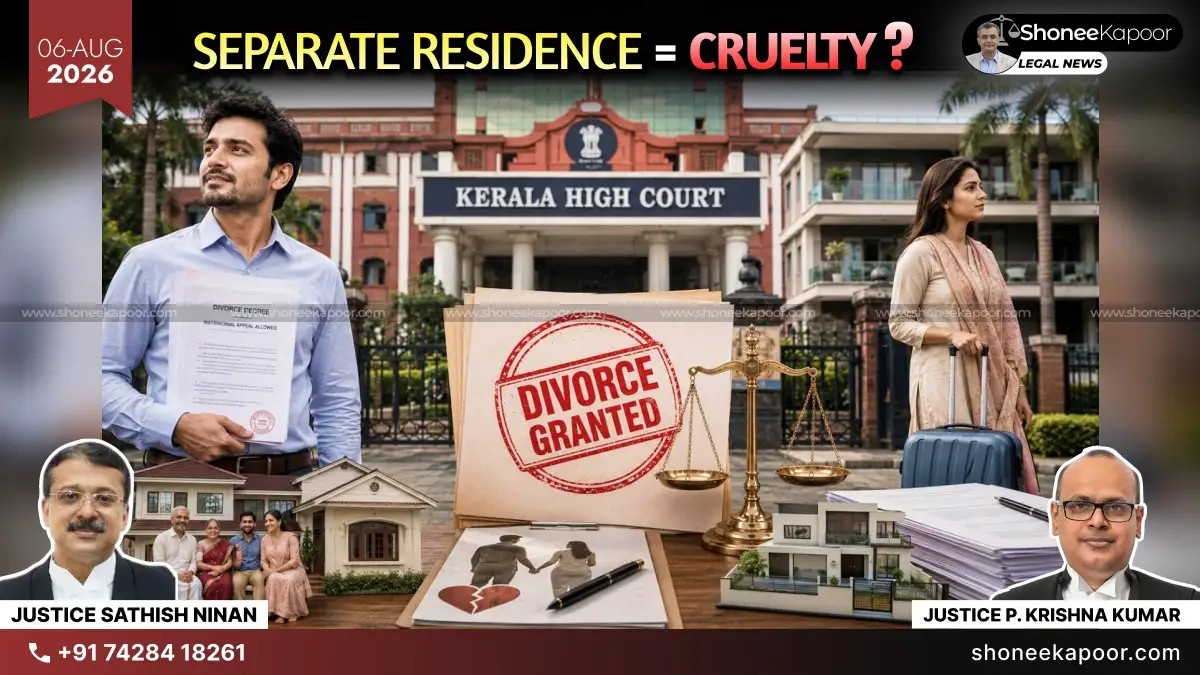
Can a wife refuse to live with her husband merely because he will not leave his parents and arrange a separate house? The Kerala High Court examined her allegations, recorded conversations and nine years of separation before granting the husband a divorce.
ERNAKULAM: The Kerala High Court has held that a wife’s demand to live separately from her husband’s family, without any sufficient or valid reason, may amount to matrimonial cruelty.
A Division Bench of Justice Sathish Ninan and Justice P. Krishna Kumar allowed the husband’s matrimonial appeal and set aside the Family Court order that had rejected his petition for divorce.
The Court observed:
“A demand for a separate residence away from the husband’s family, without sufficient reason, by itself constitutes an act of cruelty.”
The parties married on May 14, 2015, according to Hindu customs. At that time, the husband was employed as an electrical engineer in Dubai. A week after their marriage, the couple moved to Dubai and lived in rented accommodation with the husband’s parents.
During the seventh month of her pregnancy, the wife returned to Kerala. She gave birth to a daughter on August 26, 2016. According to the husband, despite his repeated requests, she did not return to Dubai.
The husband alleged that the wife was willing to return only if he arranged a spacious two-bedroom flat and agreed that she would not have to live with his parents. He stated that accepting these conditions would have forced him to separate from his family.
He also alleged that the wife stopped speaking to him directly, blocked his telephone number and communicated only through her brother. The naming ceremony and the child’s Choroon ceremony were allegedly conducted without consulting or informing him and his family.
The husband initially filed a petition for restitution of conjugal rights because he wanted to resume the marriage and spend time with his child. However, according to him, the wife repeated the same conditions during counselling.
After realising that the dispute could not be resolved, he withdrew the restitution petition and sought divorce on the ground of cruelty under Section 13(1)(ia) of the Hindu Marriage Act, 1956.
The wife denied demanding separate accommodation. She alleged that the husband and his mother had ill-treated her and that interference by her mother-in-law had affected the marriage. She maintained that she was willing to resume the marital relationship.
The husband produced two mobile phones and a CD containing recorded conversations between him and the wife’s brother and between the wife and his father.
During cross-examination, the wife admitted that one recording contained her conversation with her father-in-law. The High Court found that this admitted conversation did not support her allegation that the husband and his mother had ill-treated her.
The Court held that her allegation of cruelty against them was devoid of factual basis. It also rejected her later explanation that she had denied having problems with the family only to prevent a divorce.
Regarding the conversation between the husband and her brother, the Court noted that the wife did not dispute the recording’s genuineness but remained evasive about its contents.
In contrast, the Court found that the husband had successfully faced cross-examination and that there was no reason to disbelieve his evidence. The wife’s brother also failed to appear before the Court despite receiving summons.
The Bench therefore accepted the husband’s case that the wife had refused to return unless he fulfilled the conditions of arranging a separate two-bedroom residence away from his parents.
The Court held that the demand was unsupported by any valid reason because the wife’s allegations of mistreatment were contradicted by her own admitted telephone conversation.
The High Court further found that the wife had deserted the husband without justifiable cause and that the couple had been living separately for at least nine years.
Although desertion was not specifically pleaded as an independent ground for divorce, the Court referred to Deepak Bose v. Shrabonee Bose, in which prolonged desertion and separation were treated as mental cruelty.
The Bench found that the Family Court had failed to properly examine the recorded conversations, the wife’s contradictory stand, her demand for separate residence and the long separation forced upon the husband.
It concluded that the Family Court had reached an erroneous finding by accepting the wife’s version despite material evidence supporting the husband.
The High Court allowed the appeal, set aside the Family Court judgment and dissolved the marriage by a decree of divorce on the ground of matrimonial cruelty. No order regarding costs was passed.
EXPLANATORY TABLE OF LAWS AND SECTIONS
| Law / Section | What It Means | How It Applied In This Case |
| Section 13(1)(ia), Hindu Marriage Act, 1956 | Permits divorce when one spouse treats the other with physical or mental cruelty after marriage. | The husband sought divorce on the ground that the wife unjustifiably refused to resume cohabitation and demanded a separate residence away from his parents. |
| Section 13(1)(ib), Hindu Marriage Act, 1956 | Recognises desertion for a continuous statutory period as a ground for divorce. | Desertion was not independently pleaded, but the Court considered the wife’s unjustified withdrawal and prolonged separation while examining mental cruelty. |
| Restitution of Conjugal Rights | A matrimonial remedy through which a spouse may seek restoration of marital cohabitation when the other spouse withdraws without reasonable cause. | The husband initially filed O.P. No. 290/2017 to resume marital life and secure time with his child but withdrew it after reconciliation efforts failed. |
| Matrimonial Cruelty | Conduct causing such mental pain, suffering or apprehension that continued marital life cannot reasonably be expected. | The unjustified separate-residence condition, refusal to communicate and prolonged separation were treated collectively as cruelty. |
| Desertion | Intentional and unjustified abandonment of one spouse by the other without consent. | The Court found that the wife had remained away from the husband without justifiable cause for several years. |
| Recorded Telephone Conversations | Electronic evidence that may support or contradict a party’s oral and written allegations, subject to proof and admissibility. | The wife admitted one recorded conversation, which weakened her allegation that the husband and his mother had ill-treated her. |
| Cross-Examination | The legal process of testing a witness’s truthfulness, consistency and reliability. | The Court found the wife evasive regarding the recordings, while the husband’s testimony remained credible after cross-examination. |
| Deepak Bose v. Shrabonee Bose, 2022 SCC OnLine All 1967 | A decision recognising that prolonged separation and desertion may amount to mental cruelty. | The Kerala High Court relied upon it while considering the effect of the parties living separately for approximately nine years. |
CASE DETAILS
| Case Particular | Details |
| Case Title | N v. R |
| Neutral Citation | 2026:KER:56542 |
| Court | High Court of Kerala at Ernakulam |
| Case Number | Mat. Appeal No. 308 of 2022 |
| Impugned Proceeding | O.P. No. 519 of 2017, Family Court, Kannur |
| Impugned Judgment Date | October 30, 2021 |
| Bench | Justice Sathish Ninan and Justice P. Krishna Kumar |
| Judgment Authored By | Justice P. Krishna Kumar |
| Hearing Date | July 22, 2026 |
| Judgment Date | July 29, 2026 |
| Counsel for Appellant/Husband | Smt. C. Leena, Advocate |
| Counsel for Respondent/Wife | Sri T.V. Jayakumar Namboodiri, Advocate |
KEY TAKEAWAYS
- A wife cannot force her husband to abandon his parents without proving a valid and serious reason.
- False or unsupported cruelty allegations can collapse when recordings and cross-examination expose contradictions.
- Blocking the husband, refusing direct communication and imposing conditions for cohabitation may amount to mental cruelty.
- A man should not be forced to remain trapped for years in a marriage where his wife has deserted him without justification.
- The husband finally received divorce, but only after losing nearly nine years to separation and litigation. Delayed justice cannot restore lost fatherhood or family life.
This Could Change Your Case-Get FREE Legal Advice-Click Here!
Disclaimer: The views and opinions expressed in this article are those of the Indian courts and do not necessarily reflect the official policy or position of “ShoneeKapoor.com” or its affiliates. This article is intended for informational and educational purposes only. The content provided is not legal advice, and viewers should not act upon this information without seeking professional counsel. Viewer discretion is advised.
