
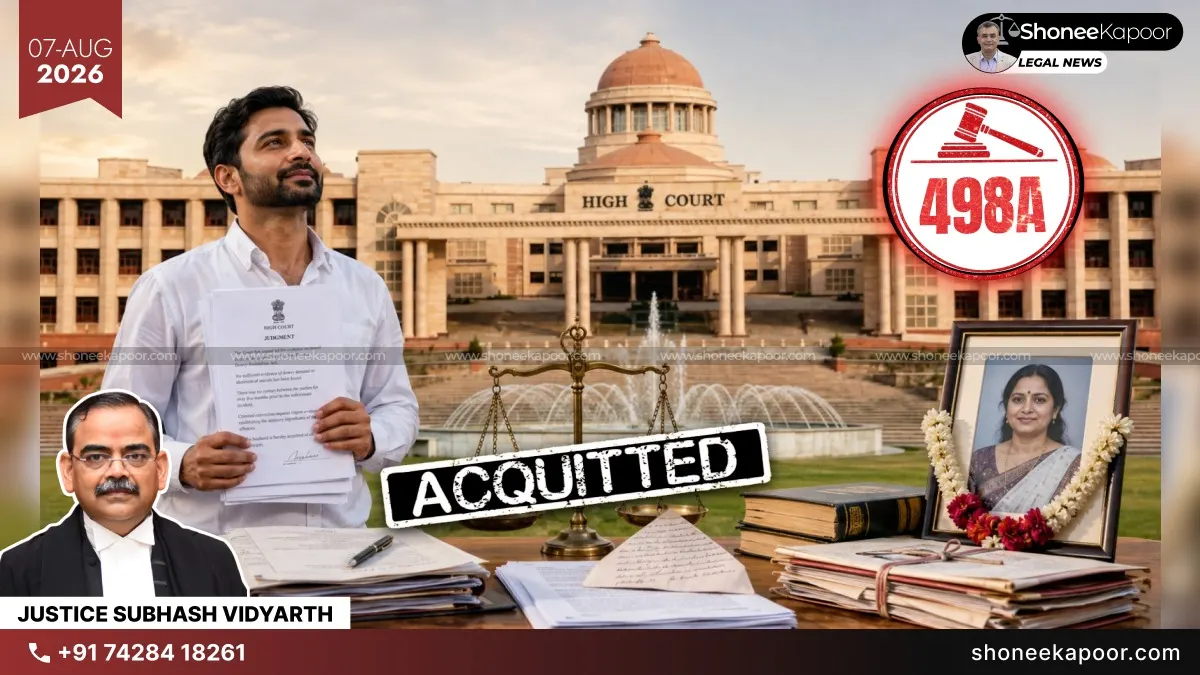
Can a husband be convicted for abetting his wife’s suicide when there was no contact or communication between them for more than five months before her death? The Allahabad High Court has answered this while acquitting a husband of all charges.
UTTAR PRADESH: The Allahabad High Court, Lucknow Bench, has acquitted Ankur Tandon of all charges arising from the suicide of his wife after finding serious gaps in the prosecution evidence and noting that the couple had no contact for five months and twelve days before the suicide. The Court also made an important observation that Section 3 of the Dowry Prohibition Act punishes not only taking dowry but also giving it.
The case arose from a marriage solemnised on 14 December 2004. The prosecution alleged that the husband and his family demanded ₹10 lakh for purchasing a flat. It was alleged that the woman’s father sold a plot and paid ₹6 lakh in cash, but a further demand of ₹4 lakh continued. The wife died by suicide on 2 October 2010.
The Trial Court had convicted the husband under Sections 498A and 306 IPC and the Dowry Prohibition Act, although it acquitted him of Section 304B IPC, relating to dowry death. He was sentenced to two years’ rigorous imprisonment under Section 498A, seven years under Section 306 and five years under Section 4 of the Dowry Prohibition Act.
While examining the evidence, Justice Subhash Vidyarthi found significant inconsistencies regarding the alleged dowry payments. The witnesses did not disclose basic particulars about the plot allegedly sold to arrange ₹6 lakh, including the date of sale, sale consideration and date on which the money was allegedly handed over. The Court also found differences between allegations made in the FIR and the evidence later given before the Trial Court.
The judgment noted that the deceased’s own suicide notes did not contain an allegation regarding any demand for dowry. The evidence also showed that allegations concerning dowry had surfaced in an FIR lodged in April 2010, while matrimonial litigation and complaints between the spouses had already been continuing. The High Court emphasised that the prosecution still had to establish criminal guilt beyond reasonable doubt and the defence could not simply be brushed aside.
While examining the allegation that the deceased’s father had paid ₹6 lakh, the High Court pointed to Section 3 of the Dowry Prohibition Act, which penalises both giving and taking dowry. The Court said:
“Thus, not only taking dowry, but also giving dowry is an offence under Section 3 of the Dowry Prohibition Act. However, as I have come to a conclusion that the allegation that the father of the deceased had given Rs.6,00,000/- to the appellant as dowry, has not been proved.”
The Court ultimately found that the alleged payment itself had not been proved beyond reasonable doubt. Therefore, the allegations concerning taking dowry and the connected cruelty allegations could not sustain the conviction.
The most important issue concerned Section 306 IPC, which punishes abetment of suicide. The Trial Court itself had found that the husband and wife had not been in contact from 20 April 2010, when an FIR had been lodged, until her suicide on 2 October 2010. This meant there had been no contact for five months and twelve days.
On this crucial fact, the High Court observed:
“When the trial Court has held that the appellant had no contact with the deceased for the past 5 months and 12 days before the incident, it cannot be said that the appellant abetted the deceased to commit suicide even without there having been any contact or communication between them”.
The Court stressed that abetment of suicide requires legally provable instigation, incitement, intentional aid or another sufficiently proximate positive act. A strained marriage or past allegations cannot automatically substitute the essential ingredients of Section 306 IPC, particularly where there had been no communication between the accused and the deceased for months before the suicide.
The High Court also examined Section 113A of the Indian Evidence Act, under which a court may, in appropriate circumstances, presume abetment when a married woman commits suicide within seven years of marriage and cruelty is established. However, such a presumption cannot replace the need for cogent foundational evidence.
The Court observed:
“In the absence of any cogent evidence as regards harassment or abetment in any form like aiding or instigating, the appellant cannot be convicted for the offence under Section 306 I.P.C. by straightway invoking Section 113-A so as to presume that he has abetted the commission of suicide”.
This becomes particularly important from the perspective of criminal due process. The occurrence of a suicide, by itself, cannot make the husband criminally responsible. The prosecution must still establish the statutory ingredients connecting his conduct with the suicide. In this case, the High Court found that the essential link was missing.
The High Court further found that the Trial Court had convicted the husband “merely because the relations between the appellant and his wife had turned sour”, while overlooking its own finding that there was no contact between them for more than five months and that no act of instigation during that period had been proved.
The appeal was therefore allowed. conviction and sentence were set aside, and Ankur Tandon was acquitted of all charges. The High Court directed his release subject to compliance with Section 437A CrPC and also ordered that the fine deposited by him be refunded. The judgment was delivered on 31 July 2026.
EXPLANATORY TABLE OF LAWS AND SECTION
| Law / Section | What It Means | Application In This Case |
| Section 498A IPC | Punishes cruelty by a husband or his relatives towards a married woman, including specified dowry-related harassment. | The Trial Court convicted the husband, but the High Court found the prosecution had not proved the cruelty/dowry allegations beyond reasonable doubt. |
| Section 306 IPC | Punishes abetment of suicide. It requires legally established abetment, such as instigation or intentional aid. | The High Court held that no proximate act of abetment was proved, particularly when there had been no contact for 5 months and 12 days. |
| Section 107 IPC | Defines abetment through instigation, conspiracy or intentional aid. | The principles governing Section 107 were relevant to deciding whether the requirements of Section 306 IPC had been satisfied. |
| Section 304B IPC | Deals with dowry death where statutory conditions, including cruelty or harassment connected with dowry soon before death, are proved. | The Trial Court itself acquitted the accused under this provision after noting the absence of contact before the death. |
| Section 3, Dowry Prohibition Act, 1961 | Penalises giving, taking or abetting the giving or taking of dowry, subject to statutory exceptions for qualifying presents. | The High Court specifically noted that giving dowry is also an offence, although the alleged ₹6 lakh payment was not proved. |
| Section 4, Dowry Prohibition Act, 1961 | Punishes demanding dowry. | The conviction could not survive because the prosecution failed to prove the alleged dowry demand to the required criminal standard. |
| Section 113A, Indian Evidence Act, 1872 | Allows a court, subject to statutory conditions, to presume abetment of suicide by a husband or relative where cruelty is established. | The Court held that this presumption could not be invoked automatically without cogent evidence of cruelty or abetment. |
| Section 323 IPC | Punishes voluntarily causing hurt. | It was among the offences mentioned in an earlier FIR between the parties. |
| Section 406 IPC | Punishes criminal breach of trust. | It formed part of the earlier FIR lodged in April 2010. |
| Sections 504 & 506 IPC | Deal with intentional insult and criminal intimidation. | These provisions appeared in earlier criminal complaints between the spouses. |
| Section 384 IPC | Punishes extortion. | The husband had referred to this provision in an earlier complaint arising from the matrimonial dispute. |
| Section 9, Hindu Marriage Act, 1955 | Provides for restitution of conjugal rights. | Earlier matrimonial proceedings under this provision formed part of the background placed before the Court. |
| Section 13, Hindu Marriage Act, 1955 | Governs petitions seeking divorce on legally recognised grounds. | The husband had subsequently instituted divorce proceedings. |
| Sections 200 & 202 CrPC | Concern examination of a complainant and inquiry/investigation before issuance of process in a complaint case. | Documents from the husband’s earlier criminal complaint were produced before the Trial Court. |
| Section 437A CrPC | Requires an acquitted accused to execute bonds for appearance before the higher court if an appeal is filed. | The High Court directed compliance with Section 437A while ordering the appellant’s release. |
CASE DETAILS
| Particular | Details |
| Case Title | Ankur Tandon v. State of U.P. Through Principal Secretary, Home Department, Lucknow |
| Court | High Court of Judicature at Allahabad, Lucknow Bench |
| Case Number | Criminal Appeal No. 3471 of 2024 |
| Neutral Citation | 2026:AHC-LKO:52960 |
| Bench | Hon’ble Justice Subhash Vidyarthi |
| Appellant | Ankur Tandon |
| Respondent | State of U.P. Through Principal Secretary, Home Department, Lucknow |
| Counsel for Appellant | Vivek Kumar Rai and Ajai Kumar |
| Counsel Heard for Appellant | Shri Vivek Kumar Rai |
| Counsel for State | Smt. Shikha Sinha, Additional Government Advocate |
| Trial Court | Special Judge, Ayurveda Scam/CBI, Lucknow |
| Trial Case | Session Trial No. 747 of 2012, arising from Case Crime No. 386 of 2010 |
| Impugned Judgment | 21 September 2024 |
KEY TAKEAWAYS
- No contact for over 5 months seriously weakened the allegation that the husband abetted the suicide.
- Marriage turning sour is not proof of a crime and cannot substitute legal evidence.
- Section 306 IPC needs real instigation or intentional aid, not assumptions against the husband.
- The Court found the alleged ₹6 lakh dowry payment itself was not proved beyond reasonable doubt.
- A man can lose years fighting serious criminal charges, but suspicion, emotion and matrimonial allegations cannot replace proof beyond reasonable doubt.
This Could Change Your Case-Get FREE Legal Advice-Click Here!
Disclaimer: The views and opinions expressed in this article are those of the Indian courts and do not necessarily reflect the official policy or position of “ShoneeKapoor.com” or its affiliates. This article is intended for informational and educational purposes only. The content provided is not legal advice, and viewers should not act upon this information without seeking professional counsel. Viewer discretion is advised.
