
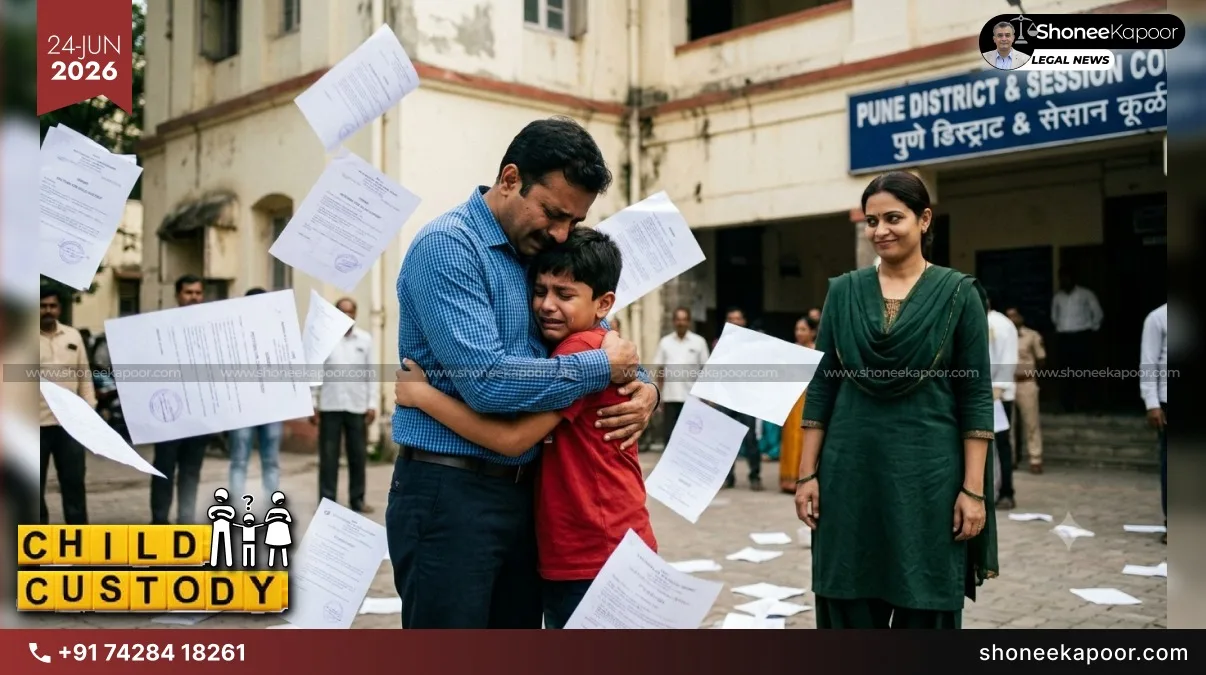
Can a mother’s custody still be called safe if the child is allegedly turned against his own father? A Pune Family Court has broken the usual assumption that only mothers are natural caregivers and granted interim custody of a 10-year-old boy to his father.
MAHARASHTRA: A Pune Family Court granted interim custody of a 10-year-old boy to his father after observing that the child’s welfare was not safe in the mother’s custody.
The Court made strong observations on the conduct of the mother and said that custody matters cannot be decided only on the old assumption that a mother is always the natural caregiver and the father is only a financial provider.
The case was heard by Judge Ganesh Ghule. The Court noted that the wife did not appear to respect her husband, maintain the household or create a nurturing environment at home.
“Pious duties of a wife towards her husband, nurturing the home, maintaining the respect, providing emotional support in traditional and religious perspectives, managing the household diligently, communicating with kindness, creating welcoming environment – these appears to be foreign terms to her,” the Court said.
The Court also observed that the mother had treated the father and his family with extreme hostility.
“Keeping the marriage vows, caring for her husband physically and emotionally, praying for him, and seeking his good in all things is expectation however she treated him as if he and his family is her seven generation enemy thus, in the company of such a women, the future of the Child is not safe,” it added.
The custody dispute relates to a child who was living in Pune till 2022. Later, the child and both parents shifted to Singapore and stayed there till March 2025. The mother then returned to India with the child.
The father approached the Family Court under the Guardians and Wards Act and sought custody of the child. He claimed that the child was wrongly removed from Singapore when he was away on a business trip. He also argued that the child should be sent back to Singapore, where he had been studying and living for almost three years.
The mother opposed the father’s plea. She made allegations of domestic violence, emotional abuse and infidelity against him. She also claimed that the child was settled in Pune, was doing well in school and wanted to stay with her.
After looking at the material placed before it, the Court found that the child was being influenced against his father. The Court said that if the child continued to hear negative things about his father, it could permanently damage the father-son relationship.
The Court also warned that the child may be used as a tool against the father if he continued to remain with the mother. This is an important observation because in many custody disputes, fathers are reduced to visitors and payers, while their emotional bond with the child is slowly destroyed.
The Court further observed that the mother seemed more interested in fighting legal cases than making any effort to repair the marriage. It noted that while she expected financial support from the husband, she had not shown willingness to reconcile and was treating him like an enemy.
The Court also considered material suggesting that the child was under emotional stress. It noted that the boy had allegedly written lyrics about death.
“We cannot ignore that, a child of 10 Yrs old allegedly wrote a lyric about the death,” it said.
The Court said that the facts showed an urgent need to remove the child from the mother’s custody. It also noted that the mother had repeatedly obstructed access between the father and the child, which appeared to be an attempt to alienate the child from his father.
The Court accepted that the child was loved in his maternal home. However, it still held that the father was in a better position to protect the child’s welfare, education and future.
The Judge noted that the father was working in a senior leadership position in Singapore. He had stable income, proper housing, access to international schooling and family support.
“This is a fit case wherein we need to break unwritten assumption that a mother is the only ‘natural’ caregiver, while the father is merely the ‘provider’,” the Court said.
The Court also rejected the argument that allegations about the father’s character or his alleged relationship with the family’s maid were enough to automatically deny him custody.
The Court gave importance to the custody proceedings in Singapore. It noted that the Singapore Family Justice Court had already directed that custody be restored to the father.
Since that order had not been challenged, the Pune Court held that the principle of comity of courts must be respected.
The order is significant because it recognises that a father is not just an ATM or weekend visitor in a child’s life. If the material shows that the mother is damaging the child’s bond with the father, courts can and must look beyond stereotypes and decide custody on the real welfare of the child.
EXPLANATORY TABLE: LAWS AND LEGAL PRINCIPLES MENTIONED IN THIS CASE
| LAW / LEGAL PRINCIPLE | WHAT IT MEANS | HOW IT WAS RELEVANT IN THIS CASE |
| Guardians and Wards Act | This law allows a court to decide who should have custody or guardianship of a minor child. The main test is the welfare of the child. | The father approached the Pune Family Court under this Act seeking custody of his 10-year-old son. |
| Interim Custody | Temporary custody granted by the court while the main case is still pending. | The Court granted interim custody of the child to the father after finding urgency in removing the child from the mother’s custody. |
| Welfare of the Child Principle | In custody cases, the child’s welfare is more important than the rights of either parent. | The Court held that the child’s emotional health, education, future and relationship with his father were important factors. |
| Parental Alienation | When one parent influences the child against the other parent, damaging their relationship. | The Court found that the child was being influenced against the father and that negative exposure could permanently damage the father-son bond. |
| Comity of Courts | Indian courts may respect and consider orders passed by foreign courts, especially in cross-border family disputes. | The Singapore Family Justice Court had directed restoration of custody to the father. Since that order was unchallenged, the Pune Court said it should be respected. |
| Singapore Family Justice Court Order | A foreign custody order passed by the Singapore court. | The Pune Court gave importance to the Singapore order because the child had been living and studying in Singapore before being brought to India. |
| Domestic Violence Allegations | Allegations of cruelty, abuse or violence within the domestic relationship. | The mother alleged domestic violence, emotional abuse and infidelity against the father, but the Court did not treat those allegations as automatic grounds to deny custody. |
| Access / Visitation Rights | Right of the non-custodial parent to meet or communicate with the child. | The Court noted that the mother had allegedly obstructed access between the father and child, which weighed against her. |
| Best Interest of Child In Cross-Border Custody | Courts look at the child’s settled life, schooling, emotional condition and future stability. | The child had lived in Singapore for nearly three years. The father argued that the child should return to Singapore for continuity in education and life. |
CASE DETAILS
| DETAIL | EXTRACTED INFORMATION |
| Court | Family Court, Pune |
| Case Type | Child custody / guardianship dispute |
| Main Law Invoked | Guardians and Wards Act |
| Order Type | Interim custody order |
| Date of Order | May 16, 2026, as reported by LiveLaw |
| Judge / Bench | In-charge Family Court Judge Ganesh Ghule |
| Child | 10-year-old boy |
| Custody Granted To | Father |
KEY TAKEAWAYS
- Father is not just a provider
The Court clearly recognised that a father is also a caregiver, protector and emotional anchor for the child. - Mother’s custody is not automatically safe
Custody cannot be given on gender. The real test is the child’s welfare, not the mother-only stereotype. - Parental alienation is child abuse in disguise
The Court noted that the child was being influenced against the father. This is how many fathers are slowly erased from their children’s lives. - Child cannot be used as a weapon against father
The Court warned that the child could be used as a tool against the father if custody remained with the mother. - Men deserve equal parenting rights
This case exposes the brutal truth: fathers fight for love, time and custody, while society often treats them only as money machines.
This Could Change Your Case-Get FREE Legal Advice-Click Here!
Disclaimer: The views and opinions expressed in this article are those of the Indian courts and do not necessarily reflect the official policy or position of “ShoneeKapoor.com” or its affiliates. This article is intended for informational and educational purposes only. The content provided is not legal advice, and viewers should not act upon this information without seeking professional counsel. Viewer discretion is advised.
