
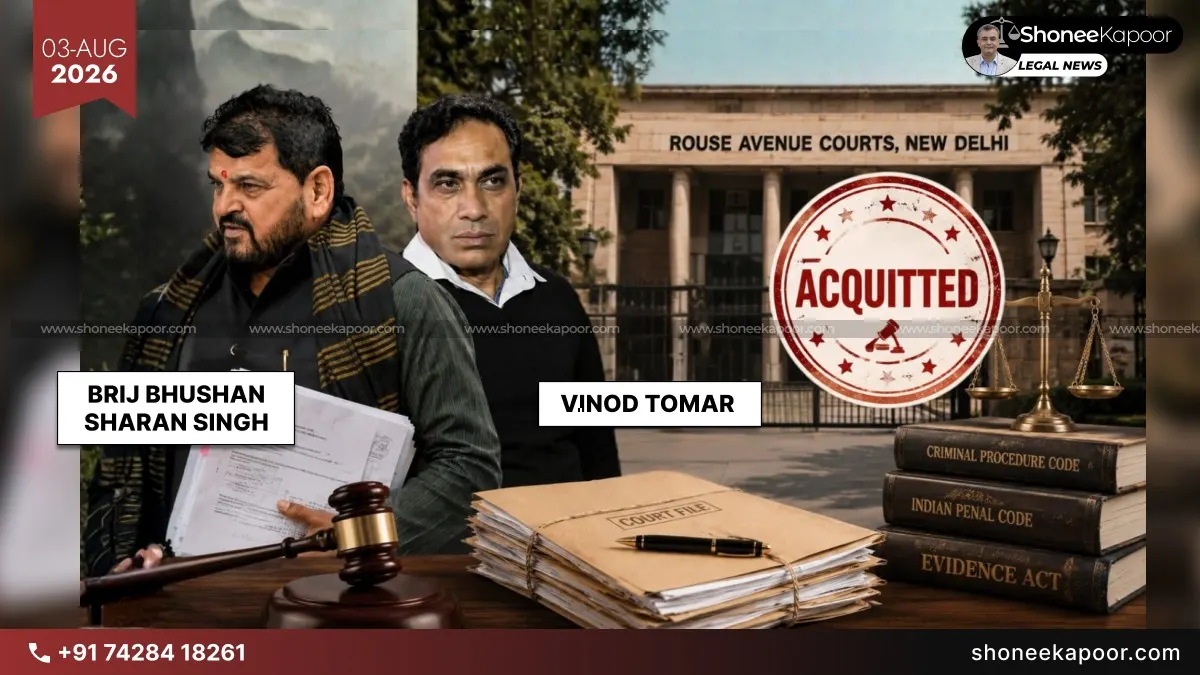
Did the prosecution fail to prove the allegations that triggered nationwide protests and years of public condemnation? Delhi court has acquitted Brij Bhushan Sharan Singh and Vinod Tomar, giving them complete relief in the criminal trial.
NEW DELHI: Delhi Rouse Avenue District Court acquitted former Wrestling Federation of India chief Brij Bhushan Sharan Singh and former WFI Assistant Secretary Vinod Tomar in the widely discussed women wrestlers’ sexual harassment case.
Additional Chief Judicial Magistrate Ashwini Panwar of the Rouse Avenue Courts delivered the verdict after completion of the trial and final arguments. As the proceedings were conducted in-camera and members of the media were not permitted inside the courtroom, the detailed reasoning of the court was not immediately available in the public domain.
Singh’s lawyers described the decision as an “honourable acquittal”.
The acquittal ends a criminal trial that arose from allegations made by women wrestlers against Singh during his tenure as WFI president. The allegations had caused nationwide controversy, public protests and strong criticism of Singh even before the evidence was finally tested in court.
Delhi Police had registered an FIR following complaints made by the wrestlers. On June 15, 2023, the police filed a charge sheet against Singh for alleged offences under Sections 354, 354A, 354D and 506(1) of the Indian Penal Code.
The allegations included outraging the modesty of a woman, sexual harassment, stalking and criminal intimidation. Singh consistently denied the accusations and contested the prosecution’s case.
On May 10, 2024, the trial court found sufficient material to frame charges against Singh under Sections 354 and 354A IPC in relation to five complainants. A charge under Section 506(1) IPC was also framed concerning allegations made by two wrestlers.
Vinod Tomar was separately charged with criminal intimidation based on an allegation that he had threatened one of the complainants.
Framing of charges, however, does not mean that an accused has been proved guilty. It only means that the court finds sufficient grounds for conducting a trial. The prosecution must still establish every essential ingredient of the alleged offences beyond reasonable doubt.
During the trial, the prosecution relied upon the statements of the complainants and other material collected during the investigation. The defence challenged the allegations, the surrounding circumstances and the reliability of the prosecution’s evidence.
After examining the evidence and hearing both sides, the court acquitted Singh and Tomar of the charges. The acquittal means that the prosecution was unable to establish criminal liability to the standard required by law.
The case had already caused serious political, professional and reputational consequences for Singh. The accusations became the subject of intense public debate and protests before the trial court could determine whether they were legally proved.
The final verdict underlines a basic principle of criminal law: an allegation, irrespective of the publicity surrounding it, cannot replace legally admissible and reliable evidence. Public opinion cannot be treated as a substitute for a judicial finding.
A person facing allegations may remain under social suspicion for years, even when the criminal court ultimately finds that the charges have not been proved. An acquittal may close the criminal case, but it cannot automatically return the years, reputation and opportunities lost during the proceedings.
The prosecution has the responsibility to prove its case beyond reasonable doubt. The accused is not required to prove his innocence. If the evidence creates reasonable doubt about the prosecution’s version, the benefit must legally go to the accused.
The case involving a minor wrestler was separate from the present trial. The complainant later withdrew the accusations, following which Delhi Police filed a cancellation report under the Protection of Children from Sexual Offences Act. The competent court accepted the cancellation report and closed that case in May 2025.
The present acquittal concerned the criminal proceedings arising from the complaints of the adult wrestlers. The case had continued for approximately three years and had attracted significant national attention.
EXPLANATORY TABLE OF LAWS AND SECTIONS
| Law and Provision | What It Means | Application in This Case |
| Section 354, Indian Penal Code, 1860 | Punished assault or use of criminal force against a woman with the intention of outraging her modesty, or with knowledge that her modesty was likely to be outraged. | The trial court had framed charges against Singh under this provision. He was subsequently acquitted. |
| Section 354A, Indian Penal Code, 1860 | Defined and punished sexual harassment, including unwelcome physical contact, demands for sexual favours, showing pornography against a woman’s will and sexually coloured remarks. | Charges were framed against Singh based on the allegations made by the complainants. The final verdict resulted in acquittal. |
| Section 354D, Indian Penal Code, 1860 | Criminalised stalking, including repeatedly following or contacting a woman despite clear disinterest, subject to statutory exceptions. | This provision was mentioned in the police charge sheet. |
| Section 506(1), Indian Penal Code, 1860 | Provided punishment for criminal intimidation where a person threatened another with injury to body, reputation or property. | Singh faced this charge concerning allegations by two wrestlers. Tomar was also charged with allegedly threatening one complainant. Both were acquitted. |
| Section 34, Indian Penal Code, 1860 | Fixed joint responsibility where several persons committed a criminal act in furtherance of a common intention. | This provision may apply where the prosecution alleges coordinated conduct by more than one accused. Its precise treatment must be confirmed from the complete judgment. |
| Section 228A, Indian Penal Code, 1860 | Restricted publication of information capable of revealing the identity of victims of specified sexual offences. | The identities of the complainants should not be disclosed in reporting on the case. |
| Section 327(2), Code of Criminal Procedure, 1973 | Required trials involving specified sexual offences to be conducted in-camera. | Media representatives were reportedly not allowed inside when the verdict was pronounced. |
| Protection of Children from Sexual Offences Act, 2012 | Provides special procedures and offences concerning sexual abuse of persons below 18 years of age. | A separate complaint involving a minor wrestler was closed after the police cancellation report was accepted. It was not part of the present acquittal concerning adult complainants. |
| Section 235/248, Code of Criminal Procedure, 1973 | Empowers the trial court to record a judgment of conviction or acquittal after considering the evidence and hearing the parties, depending on the trial procedure followed. | The court exercised its criminal trial jurisdiction and acquitted both accused. The exact applicable provision should be confirmed from the signed judgment. |
| Bharatiya Nyaya Sanhita, 2023 | Replaced the IPC from July 1, 2024, but offences allegedly committed before its commencement ordinarily continue to be governed by the earlier penal law, subject to constitutional safeguards. | The allegations related to a period before the BNS came into force, and the prosecution was conducted under the IPC provisions mentioned in the charge sheet. |
CASE DETAILS
| Particular | Details |
| Case Title | State v. Brij Bhushan Sharan Singh and Another, |
| Court | Rouse Avenue District Courts, New Delhi |
| Presiding Judge | Additional Chief Judicial Magistrate Ashwini Panwar |
| Jurisdiction | Criminal trial jurisdiction |
| Accused No. 1 | Brij Bhushan Sharan Singh |
| Accused No. 2 | Vinod Tomar |
| Complainants | Women wrestlers whose identities are legally protected |
| Date of Judgment | August 3, 2026 |
| Counsel for Brij Bhushan Sharan Singh | Rajiv Mohan, Rishabh Bhati, Rehan Khan and Suryansh Singh, Advocates |
| Result | Brij Bhushan Sharan Singh and Vinod Tomar acquitted |
KEY TAKEAWAYS
- Both men were acquitted after years of criminal proceedings and public condemnation.
- An allegation is not proof, and framing of charges does not establish guilt.
- Their reputation, career and public standing suffered before the final verdict.
- The separate POCSO case had already been closed after acceptance of the police cancellation report.
- Men must not be publicly declared guilty before evidence is tested and guilt is proved beyond reasonable doubt.
This Could Change Your Case-Get FREE Legal Advice-Click Here!
Disclaimer: The views and opinions expressed in this article are those of the Indian courts and do not necessarily reflect the official policy or position of “ShoneeKapoor.com” or its affiliates. This article is intended for informational and educational purposes only. The content provided is not legal advice, and viewers should not act upon this information without seeking professional counsel. Viewer discretion is advised.
