
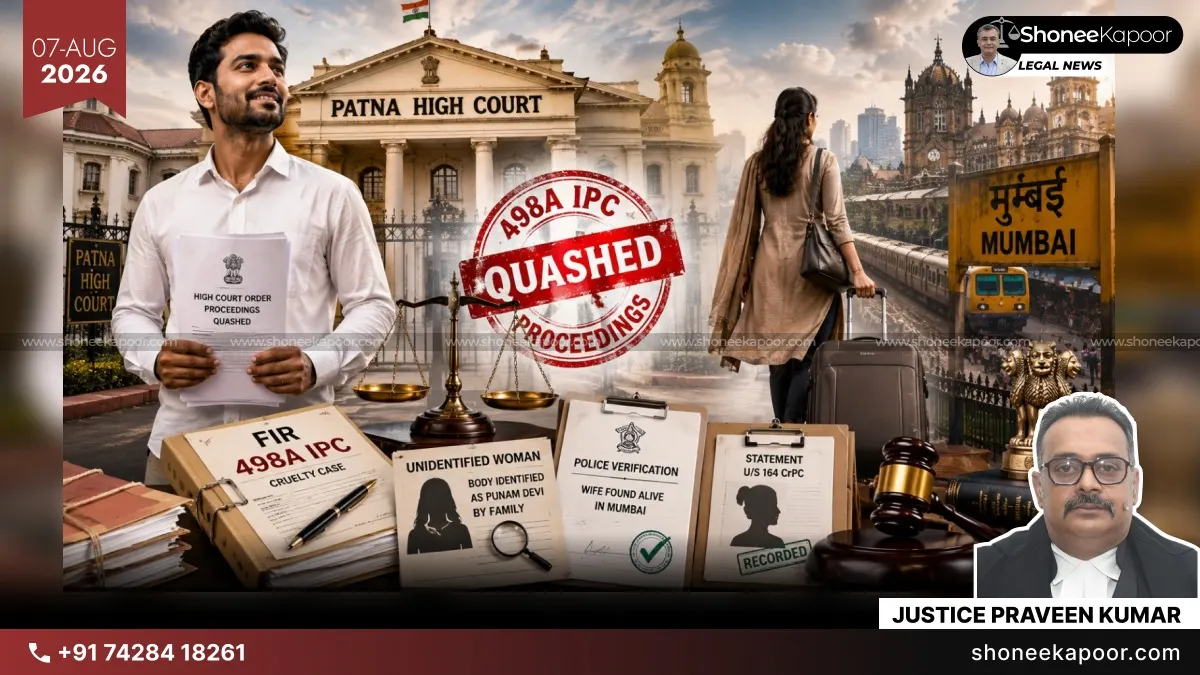
Can a husband be forced to face a cruelty case after his wife voluntarily left for Mumbai and her family allegedly identified another woman’s dead body as hers? The Patna High Court has now quashed the Section 498A IPC proceedings against him.
PATNA: The Patna High Court has quashed a Section 498A IPC cruelty case against a husband in an extraordinary matrimonial dispute where his wife, whose family had identified an unidentified female body as hers, was later found alive.
The marriage between Dinesh Kushwaha and Punam Devi took place on May 11, 2016 according to Hindu rites and customs. According to the complaint, her father allegedly gave ₹5.50 lakh in cash, a motorcycle and a gold chain as gifts/dowry.
The wife alleged that after her gawna, she reached her matrimonial home on February 15, 2017, where the husband told her that he was already married. She further alleged that her in-laws denied her food and water, tortured her and ultimately forced her out of the matrimonial home after retaining her stridhan.
The complaint further alleged that the accused spread false rumours to her parents that she had died. Her parents thereafter mistakenly identified a decomposed unidentified female body recovered by Pachrukhi Police as Punam Devi, leading to registration of Pachrukhi P.S. Case No. 33/2017.
The husband, however, presented a completely different version before the High Court.
His counsel submitted that the wife had stayed in the matrimonial home for barely ten days and voluntarily left on February 25, 2017 before travelling to Mumbai.
The defence further alleged that her family had deliberately identified an unrelated female body as Punam Devi to fabricate a murder/dowry-death case against the husband and his family.
According to the submissions recorded in the judgment, police subsequently received information that Punam Devi was alive and that her family members were attempting to secretly take her back to Mumbai. She was taken into custody and her statement was recorded under Section 164 CrPC, where, according to the petitioner’s submissions recorded by the Court, she admitted that she was alive and had voluntarily run away to Mumbai.
The husband argued that the subsequent complaint was an afterthought intended to harass and falsely implicate him and his family. His counsel also relied upon the Supreme Court judgment in Preeti Gupta v. State of Jharkhand, (2010) 7 SCC 667, referring to concerns regarding exaggerated allegations against husbands and their relatives in matrimonial disputes.
The State and the wife opposed the petition and argued that the Magistrate had correctly taken cognisance on the basis of prima facie material.
After considering the entire facts, materials and judicial pronouncements, Justice Praveen Kumar quashed the cognisance order dated September 19, 2017, passed by the Additional Chief Judicial Magistrate-XVI, Gopalganj, for the offence under Section 498A IPC.
The application was accordingly allowed.
EXPLANATORY TABLE OF LAWS AND SECTIONS
| Law / Section | What It Means | Application In This Case |
| Section 498A, IPC | Penalises cruelty by a husband or his relatives against a married woman, including specified serious wilful conduct and harassment connected with unlawful demands. | The Magistrate had taken cognisance against the husband under Section 498A. The High Court quashed that cognisance order. |
| Section 164, CrPC | Provided for recording statements or confessions before a Magistrate during investigation. | According to the petitioner’s submissions, the wife’s statement was recorded and she admitted that she was alive and had voluntarily gone to Mumbai. |
| Preeti Gupta v. State of Jharkhand, (2010) 7 SCC 667 | Supreme Court decision discussing, among other things, concerns surrounding exaggerated implication of husbands and relatives in matrimonial disputes. | The husband relied upon this judgment while seeking quashing of the proceedings. |
| Quashing of Cognisance | High Court intervention terminating the challenged criminal proceeding/order where the legal requirements for quashing are met. | The Patna High Court quashed the Magistrate’s September 19, 2017 cognisance order. |
CASE DETAILS
| Case Particular | Details |
| Case Title | DK v. State of Bihar & Anr. |
| Court | High Court of Judicature at Patna |
| Case Number | Criminal Miscellaneous No. 33530 of 2018 |
| Arising From | Complaint Case No. 741 of 2017, Gopalganj |
| Bench | Hon’ble Mr Justice Praveen Kumar |
| Decision Date | August 4, 2026 |
| Impugned Order | September 19, 2017 |
| Trial Proceedings | Trial No. 2356 of 2017/1812 of 2018 |
| Section Involved | Section 498A IPC |
| Result | Cognisance order quashed; application allowed |
COUNSELS APPEARED
| Party | Counsel |
| Petitioner | Mr. Prashant Kumar, Advocate; Mr Animesh Kumar, Advocate |
| State of Bihar | Mr. Awadhesh Kumar Singh, APP |
| Opposite Party No. 2 / Wife | Mr. Suresh Prasad Bhakta, Advocate; Mr. Rameshwar Thakur, Advocate |
KEY TAKEAWAYS
- Husband Faced 498A Proceedings Even After Wife Was Found Alive-The woman whose family had identified another body as hers was later found alive in Mumbai.
- An Unidentified Woman’s Body Was Mistaken For The Wife-Her family identified a decomposed female body as Punam Devi, triggering another criminal case.
- Husband Alleged A Deliberate Attempt To Frame His Family-His counsel argued that the wrong identification was used to build a murder/dowry-death case against him and his relatives.
- Wife’s Section 164 CrPC Statement Became Crucial-According to the husband’s submissions, she admitted that she was alive and had voluntarily gone to Mumbai.
- Patna High Court Finally Quashed the 498A Cognisance-After considering the facts, materials and judicial precedents, the High Court quashed the proceedings against the husband.
This Could Change Your Case-Get FREE Legal Advice-Click Here!
Disclaimer: The views and opinions expressed in this article are those of the Indian courts and do not necessarily reflect the official policy or position of “ShoneeKapoor.com” or its affiliates. This article is intended for informational and educational purposes only. The content provided is not legal advice, and viewers should not act upon this information without seeking professional counsel. Viewer discretion is advised.
