
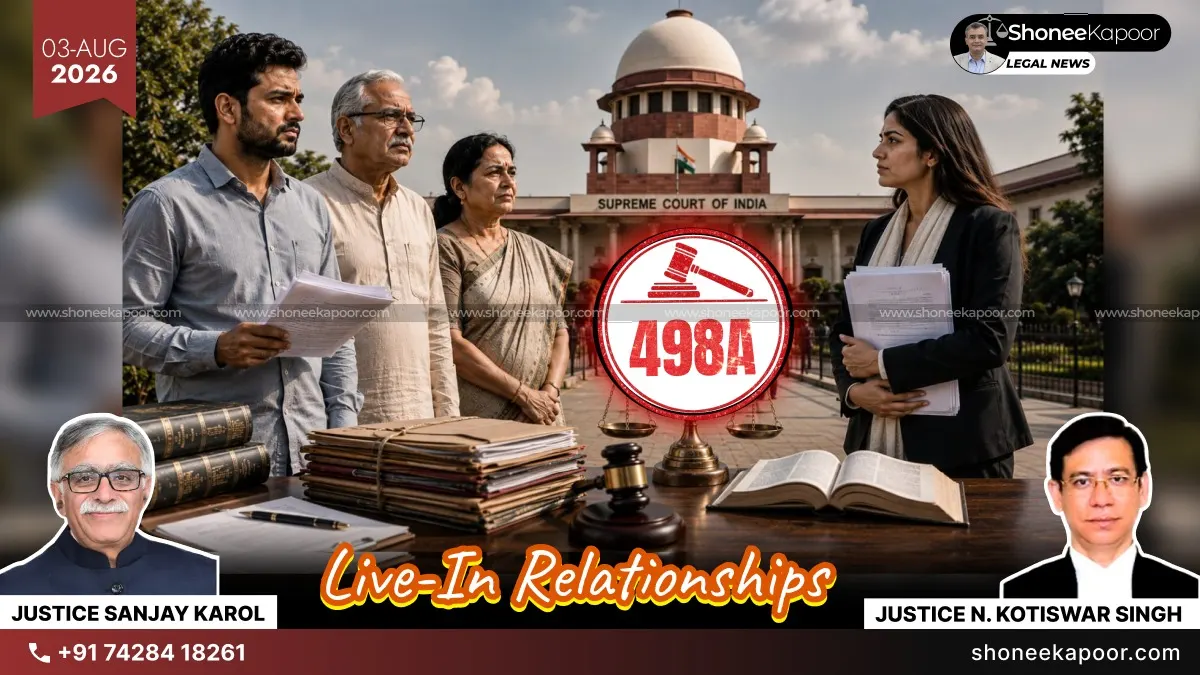
Can a woman prosecute a man and his family under Section 498A even when no legally valid marriage exists? The Supreme Court has expanded the provision to live-in relationships, but imposed a crucial burden of proof and protection against automatic arrest.
NEW DELHI: The Supreme Court of India has held that Section 498A IPC may apply to a man in a live-in relationship, even without a legally valid marriage, when the relationship was in the nature of marriage and the parties intended to marry each other.
A Bench of Justice Sanjay Karol and Justice N. Kotiswar Singh ruled that the absence of a valid marriage would not automatically prevent criminal proceedings for alleged cruelty against the male partner and his relatives.
However, the Court clarified that not every live-in relationship will attract Section 498A.
The initial burden will lie upon the woman to establish that the relationship was genuinely in the nature of marriage and that an intention to marry formed an intrinsic part of the relationship.
The Court held:
“Section 498A is held to be applicable to live-in relationships that qualify as relationships in the nature of marriage, with the intent to marry being established as an intrinsic part thereof.”
This requirement is significant because a temporary, casual or ordinary live-in relationship cannot automatically be treated as a marriage for imposing criminal liability upon the man and his family.
The ruling came in an appeal filed by Dr Lokesh B.H. and other accused relatives against a November 2025 judgment of the Karnataka High Court refusing to quash the criminal proceedings against them.
The complainant alleged that Lokesh had married her while concealing that his first marriage was still subsisting.
She further accused Lokesh and his relatives of dowry harassment, cruelty and attempting to set her on fire.
These allegations have not been finally proved. The Supreme Court was examining whether the criminal prosecution should be terminated at the preliminary stage.
Lokesh argued that the alleged second marriage was legally void and, therefore, he could not be treated as a “husband” under Section 498A IPC.
The Karnataka High Court rejected this argument and held that Section 498A could extend to void or voidable marriages and live-in relationships resembling marriage.
The Supreme Court affirmed the broader legal principle but added an important safeguard: the woman must first establish the existence of a relationship in the nature of marriage and the parties’ intention to marry.
The Court observed that the Protection of Women from Domestic Violence Act, 2005 expressly recognises relationships in the nature of marriage but largely provides civil remedies.
Section 498A, by contrast, creates serious criminal liability and therefore requires a higher legal threshold.
The Court confined its ruling specifically to Section 498A and clarified that the same interpretation would not automatically apply to every other penal provision.
Most importantly, the Supreme Court directed strict compliance with the arrest safeguards laid down in Arnesh Kumar v. State of Bihar.
The Bench ordered that no live-in partner or his relatives should be arrested without a preliminary inquiry in such cases.
This protection is crucial from a men’s-rights perspective because a disputed live-in relationship can now expose not only the man but also his parents, siblings and relatives to criminal proceedings traditionally associated with marriage.
The preliminary inquiry must examine whether the relationship actually possessed the legal characteristics of marriage and whether the required intention to marry existed.
A mere allegation of a live-in relationship, broken promise or domestic dispute cannot automatically justify arresting the man and his entire family.
On the facts of the case, the Supreme Court refused to quash the prosecution and dismissed the appeal.
The allegations will therefore be examined during the criminal proceedings, where the prosecution will have to establish the necessary facts and offences in accordance with law.
EXPLANATORY TABLE OF LAWS AND SECTIONS
| Law or Provision | What It Means | Application in This Case |
| Section 498A, Indian Penal Code, 1860 | Punishes a husband or his relative for subjecting a woman to legally defined cruelty, including specified harassment connected with unlawful demands. | The Supreme Court held that it may apply to a live-in relationship in the nature of marriage where an intention to marry is established. |
| Section 85, Bharatiya Nyaya Sanhita, 2023 | The corresponding present provision dealing with cruelty by a husband or his relatives after the BNS replaced the IPC. | The reported case arose under Section 498A IPC. The applicable provision depends upon the date of the alleged acts. |
| Article 14, Constitution of India | Guarantees equality before law and equal protection of laws. | The Court reportedly reasoned that completely excluding relationships resembling marriage from protection against cruelty may conflict with the object of the law. |
| Protection of Women from Domestic Violence Act, 2005 | Provides protection, residence, monetary and other remedies to women in domestic relationships, including relationships in the nature of marriage. | The Court distinguished its largely civil remedies from the criminal consequences imposed under Section 498A. |
| Arnesh Kumar v. State of Bihar | Supreme Court precedent prohibiting routine or automatic arrests in Section 498A and similar offences. | The Court directed that no live-in partner or relative should be arrested without a preliminary inquiry. |
| Quashing of Criminal Proceedings | Constitutional and statutory courts may terminate a criminal case where no offence is disclosed or continuing it would abuse the legal process. | The accused sought quashing, but the Supreme Court held that the prosecution should continue. |
CASE DETAILS
| Particular | Details |
| Case Title | X and Ors v. State Of Karnataka and Anr |
| Court | Supreme Court of India |
| Bench | Justice Sanjay Karol and Justice N. Kotiswar Singh |
| Appellants | Dr Lokesh B.H. and Other Accused Relatives |
| Respondents | State of Karnataka and Others |
COUNSELS APPEARED
| Party | Counsel Details |
| For the Petitioners | Senior Advocate Anand Sanjay M. Nuli, with Advocates Ashritsai Torgal and Shiva Swaroop, instructed by Nuli & Nuli |
| For the Respondents | Advocates Naveen Sharma, Swati Bhushan Sharma, S.K. Sharma, Payal Gola, Hetu Arora Sethi, Lalit Mohini Bhat, Siddarth Agarwal, Rahul Jain, Kanak Bathwal and Sanidhya Kumar |
| Additional Appearances | Additional Solicitors General Brijendra Chahar and Aishwarya Bhati, with assisting advocates |
| Amicus Curiae | Advocate Nina Nariman, assisted by Advocates Svarit Uniyal Mishra and Paduja Mishra |
KEY TAKEAWAYS
- A man can now face Section 498A even without a legally valid marriage, if the relationship is later claimed to be “in the nature of marriage.”
- The woman must first prove a genuine intention to marry; a broken relationship alone cannot be converted into a criminal matrimonial case.
- Every failed live-in relationship cannot become a weapon against the man and his family through automatic allegations of cruelty.
- The man and his relatives cannot be arrested merely because a complaint is filed; a preliminary inquiry must come first.
- Extending Section 498A beyond formal marriage increases the danger of misuse against men, making strict evidence, judicial scrutiny and arrest safeguards indispensable.
This Could Change Your Case-Get FREE Legal Advice-Click Here!
Disclaimer: The views and opinions expressed in this article are those of the Indian courts and do not necessarily reflect the official policy or position of “ShoneeKapoor.com” or its affiliates. This article is intended for informational and educational purposes only. The content provided is not legal advice, and viewers should not act upon this information without seeking professional counsel. Viewer discretion is advised.
