
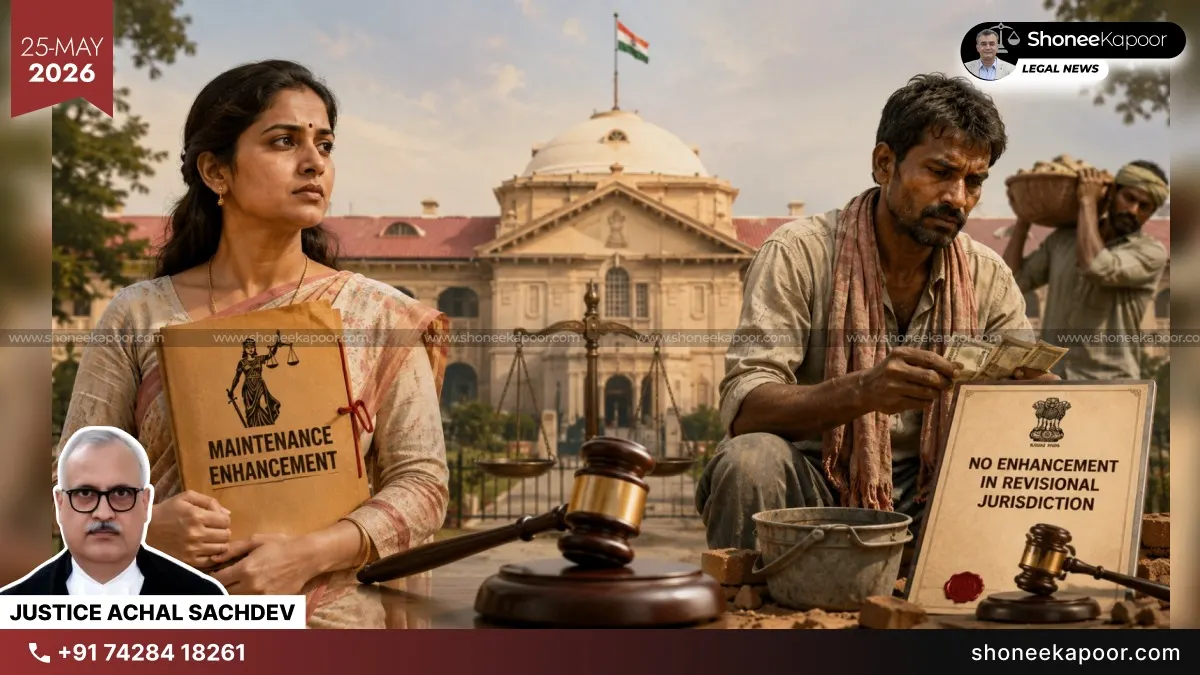
Can revisional jurisdiction be used for fresh financial examination against husbands?
The Allahabad High Court observed that revisional jurisdiction is limited to examining legality and procedural correctness, not for conducting fresh evidentiary exercises.
PRAYAGRAJ: Justice Achal Sachdev of the Allahabad High Court dismissed a criminal revision filed by a wife seeking enhancement of maintenance beyond Rs. 2500 per month granted by the Family Court. The Court held that the High Court does not have the power to reassess evidence or directly increase maintenance while exercising revisional jurisdiction.
The dispute arose after the marriage allegedly broke down due to matrimonial differences and allegations of dowry harassment. The wife claimed that she was subjected to cruelty, additional dowry demands and later separated from her husband. She further alleged that she was not being maintained and therefore sought Rs.30,000 per month as maintenance under Section 125 CrPC.
The Family Court, however, awarded only Rs.2500 per month from the date of filing of the maintenance application. Unsatisfied with the amount, the wife approached the Allahabad High Court seeking enhancement.
Before the High Court, the husband denied all allegations and argued that he had very limited income and was working as a daily wage labourer earning around Rs.5000-6000 per month. He also submitted that the wife was educated and capable of earning independently through tuition and sewing work. According to him, he was financially weak and already struggling to support his parents.
While refusing to interfere with the Family Court order, the High Court made it clear that revisional jurisdiction is very limited in nature. The Court explained that the High Court can only examine whether there is any legal error, impropriety or jurisdictional defect in the lower court order. It cannot conduct a fresh inquiry into disputed facts or reassess financial evidence.
Justice Achal Sachdev observed:
“The High Courts hands are tied by the statutory limits of revisional jurisdiction. It is confined to examining legality, propriety, or jurisdictional correctness.”
The Court further clarified:
“The High Court cannot directly increase or decrease the maintenance amount in revision.”
The judgment stated that enhancement of maintenance requires examination of fresh evidence regarding increase in income, inflation, financial changes and new needs of the claimant, which can only be done by the trial court.
Referring to the Supreme Court judgment in Rajnesh v. Neha (2020), the High Court quoted:
“(iii) that if the order passed in the previous proceeding(s) requires any modification or variation, it would have to be done in the same proceeding in which the order was passed.”
The Court further observed:
“Revisional courts lack the power to conduct this evidentiary exercise.”
Further strengthening the husband’s stand, the Court added:
“They cannot substitute their own factual findings for those of the trial court.”
The High Court finally held that if maintenance enhancement is sought due to changed circumstances, the proper legal remedy is to file an alteration application under Section 127 CrPC or Section 146 BNSS before the Family Court itself.
Accordingly, the criminal revision seeking enhancement of maintenance was dismissed and the husband received relief from further interference by the High Court.
Explanatory Table: Laws And Sections Involved
| Law / Section | Purpose | Relevance In This Case |
| Section 125 CrPC | Provision allowing wife, children or parents to claim maintenance if neglected financially | Wife sought monthly maintenance under this section |
| Section 127 CrPC | Provision allowing modification or enhancement of maintenance if circumstances change later | High Court said enhancement must be sought under this section before trial court |
| Section 144 BNSS | New equivalent provision replacing Section 125 CrPC under Bharatiya Nagarik Suraksha Sanhita | Mentioned as corresponding new law for maintenance |
| Section 146 BNSS | New provision corresponding to Section 127 CrPC for alteration of maintenance | Court directed remedy under this provision |
| Revisional Jurisdiction | Limited power of High Court to examine legality or procedural errors only | Court held High Court cannot reassess facts or increase maintenance directly |
| Rajnesh v. Neha (2020) | Supreme Court judgment regarding maintenance proceedings and overlapping jurisdiction | Relied upon by High Court while refusing enhancement |
| Rajathi v. C. Ganesha AIR 1999 SC 2374 | Supreme Court judgment stating wife’s statement about inability to maintain herself is sufficient unless disproved by husband | Relied upon by Family Court while granting maintenance |
Case Details
- Case Title: Huda Khanam vs State of U.P. and Another
- Court: High Court of Judicature at Allahabad
- Bench: Hon’ble Justice Achal Sachdev
- Case Number: Criminal Revision No. 5384 of 2025
- Neutral Citation: 2026:AHC:109684
- Date of Judgment: 12 May 2026
- Counsels:
- For Revisionist: Adil Jamal, Shabeh Jamal
- For Opposite Party: G.A., Mohammad Abid Ali
Key Takeaways
- Maintenance disputes cannot become a shortcut for endless re-litigation in higher courts without proper evidence and procedure.
- Allegations alone are not enough to justify automatic financial enhancement against a husband without factual examination before the competent court.
- Financial claims must be tested through evidence, cross-examination and proper judicial process instead of emotional assumptions.
- Higher courts are meant to correct legal errors, not to conduct fresh trials or rewrite factual findings every time one side is dissatisfied.
- Procedural safeguards exist to ensure that matrimonial litigation does not become a tool for continuous financial pressure without due process.
This Could Change Your Case-Get FREE Legal Advice-Click Here!
Disclaimer: The views and opinions expressed in this article are those of the Indian courts and do not necessarily reflect the official policy or position of “ShoneeKapoor.com” or its affiliates. This article is intended for informational and educational purposes only. The content provided is not legal advice, and viewers should not act upon this information without seeking professional counsel. Viewer discretion is advised.
