
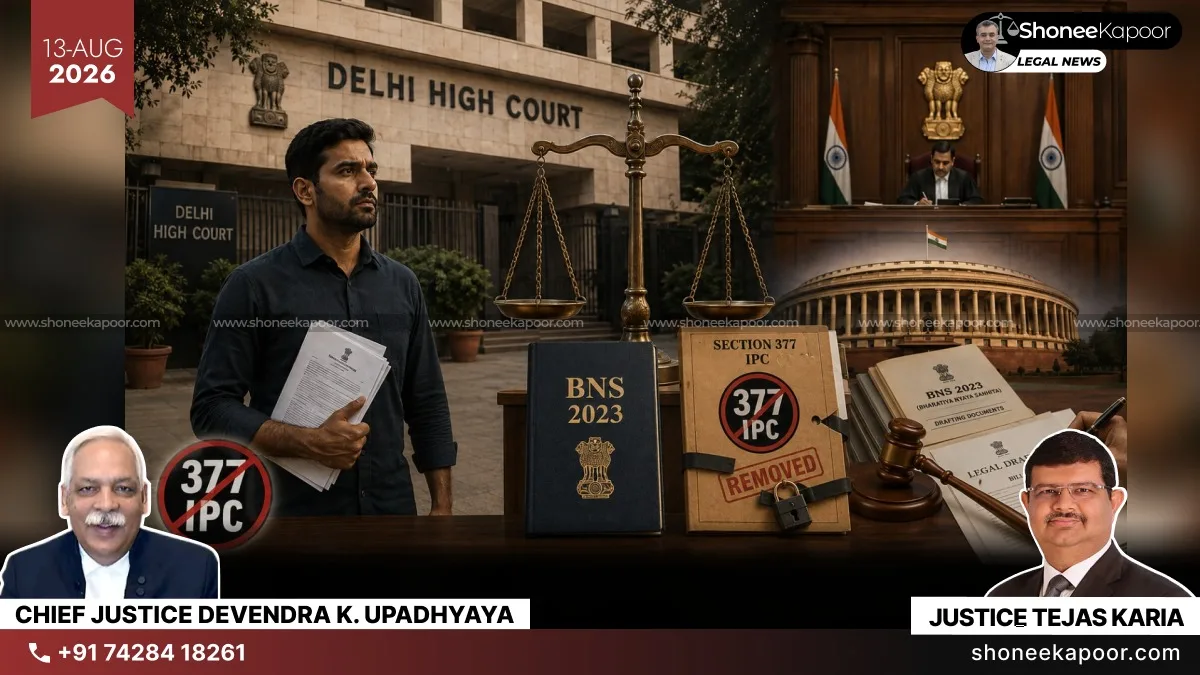
Can courts bring back a deleted Section 377 IPC-type offence through interpretation of the BNS, 2023? The Delhi High Court said such changes fall within the power of the legislature, not judicial law-making.
NEW DELHI: The Delhi High Court has observed that courts cannot “create” offences that were earlier present under Section 377 of the Indian Penal Code (IPC) but are no longer included in the Bharatiya Nyaya Sanhita, 2023 (BNS).
The Court said that deciding whether such an offence should exist is a matter of legislative policy and can only be addressed by Parliament.
A petition before the Court argued that certain BNS sexual offence provisions should be interpreted in a gender-neutral manner because the present law mainly covers cases where the accused is a man and the victim is a woman.
The Division Bench of Chief Justice Devendra Kumar Upadhyaya and Justice Tejas Karia stated that courts cannot introduce an offence that the legislature has not created.
The Bench observed:
“We understand your [petitioners’] anxiety, but these are legislative policy matters… The offence has to be described. Which is the authority that can do it? It’s the legislature. What can we do about it? Can we provide something which is not provided for by the legislature? Can we by judicial fiat create an offence?”
The Court further explained that offences relating to women under the BNS cannot be expanded to cover situations that were earlier dealt with separately under Section 377 IPC.
The Bench said:
“The problem which you are facing is the dropping of Section 377 [IPC] from BNS. Now, to reach that, you are targeting the offences against women. The offences against women were always offences against women. There was a separate category of unnatural offences, which has been dropped. Now, you can’t use Article 14 [of the Constitution] to reach the same destination by targeting offences against them because those offences were always there.”
Petitioners Challenge Gender-Based Limitations Under BNS
The petition was filed by advocates Shubhi Srivastava, Ajay Kumar Singh, Prince Kumar, N Zubemo Lotha and Garima Singh, along with former civil servant Ashok Kumar Singh.
The petitioners argued that provisions dealing with rape, sexual assault, stalking, voyeurism and related offences under BNS were limited to a male accused and female victim framework.
They contended that this leaves gaps where the victim may be a man, transgender person, third-gender person, or where the accused is not a male.
The petitioners sought either a gender-neutral interpretation of these provisions or directions to the Central Government to amend the law.
They also argued that removal of Section 377 IPC from BNS without a replacement provision created a legal gap.
During arguments, the counsel submitted:
“Now, what will happen if a man is violated or an animal is violated? The police with the offence of hurt or grievous hurt.”
The Court thereafter tagged the matter with similar petitions and listed the matter for further hearing in October.
EXPLANATORY TABLE OF LAWS AND SECTIONS
| Law / Section | What It Means | Relevance In This Case |
| Section 377 IPC (Indian Penal Code) | Earlier provision that punished certain non-consensual sexual acts described as being “against the order of nature with any man, woman or animal. It provided punishment up to 10 years. | The petitioners argued that removal of Section 377 IPC from the Bharatiya Nyaya Sanhita (BNS), 2023 created a legal gap because similar protection was not separately provided. |
| Bharatiya Nyaya Sanhita, 2023 (BNS) | The new criminal law replacing the IPC framework from 1 July 2024. It defines and provides punishment for various criminal offences. | The challenge before the Delhi High Court was regarding whether BNS sexual offence provisions should be interpreted as gender-neutral and cover situations beyond the existing framework. |
| Sections 63, 64, 65, 66 BNS | Provisions relating to rape and related punishments under BNS. | Petitioners argued that these provisions mainly operate within a male accused and female victim framework, leaving certain categories of victims without specific remedies. |
| Sections 67, 68, 69, 70 BNS | Provisions dealing with other sexual offences and related punishments. | The petition questioned whether these provisions should apply in a broader gender-neutral manner. |
| Sections 72, 73, 75, 77, 78 and 81 BNS | Provisions dealing with offences such as disclosure-related offences, stalking, sexual harassment and other sexual misconduct. | Petitioners argued that restricting these offences only to certain gender combinations creates unequal protection under criminal law. |
| Article 14, Constitution of India | Guarantees equality before law and equal protection of laws to all persons. | Petitioners relied on Article 14 to argue that BNS provisions should receive a gender-neutral interpretation. |
| Legislative Policy Principle | Criminal offences and punishments are created by the legislature through law-making. | The Delhi High Court held that courts cannot create a new offence that Parliament has not included in the statute. |
| Judicial Interpretation / Judicial Fiat | Courts can interpret existing laws but generally cannot add new offences or rewrite legislation. | The Bench observed that creating a Section 377 IPC-like offence under BNS would amount to judicial law-making, which is beyond the Court’s role. |
| Public Interest Litigation (PIL) | A legal proceeding filed to address issues affecting public interest. | The petition was filed seeking a gender-neutral interpretation of BNS sexual offence provisions and directions for legal reform. |
CASE DETAILS
| Case Particular | Details |
| Case Title | PIL Challenging Gender-Neutrality Of BNS Sexual Offence Provisions |
| Court | Delhi High Court |
| Bench | Chief Justice Devendra Kumar Upadhyaya and Justice Tejas Karia |
| Nature of Proceeding | Public Interest Litigation (PIL) |
| Petitioners | Shubhi Srivastava, Ajay Kumar Singh, Prince Kumar, N Zubemo Lotha, Garima Singh and former civil servant Ashok Kumar Singh |
| Respondent | Union of India / Central Government (as the petition challenged BNS provisions and sought directions for amendment) |
| Date Of Hearing | 12 August 2026 |
KEY TAKEAWAYS
- A crime against a man does not become less serious because the law was not drafted for him.
- Removing Section 377 IPC without a replacement raises questions about legal protection available to male victims.
- Courts cannot rewrite criminal law, but Parliament must ensure every victim gets equal protection.
- Gender-based assumptions in criminal laws can leave genuine male victims without a clear legal remedy.
- Justice cannot depend on the gender of the victim; the law must protect every person equally.
This Could Change Your Case-Get FREE Legal Advice-Click Here!
Disclaimer: The views and opinions expressed in this article are those of the Indian courts and do not necessarily reflect the official policy or position of “ShoneeKapoor.com” or its affiliates. This article is intended for informational and educational purposes only. The content provided is not legal advice, and viewers should not act upon this information without seeking professional counsel. Viewer discretion is advised.
