
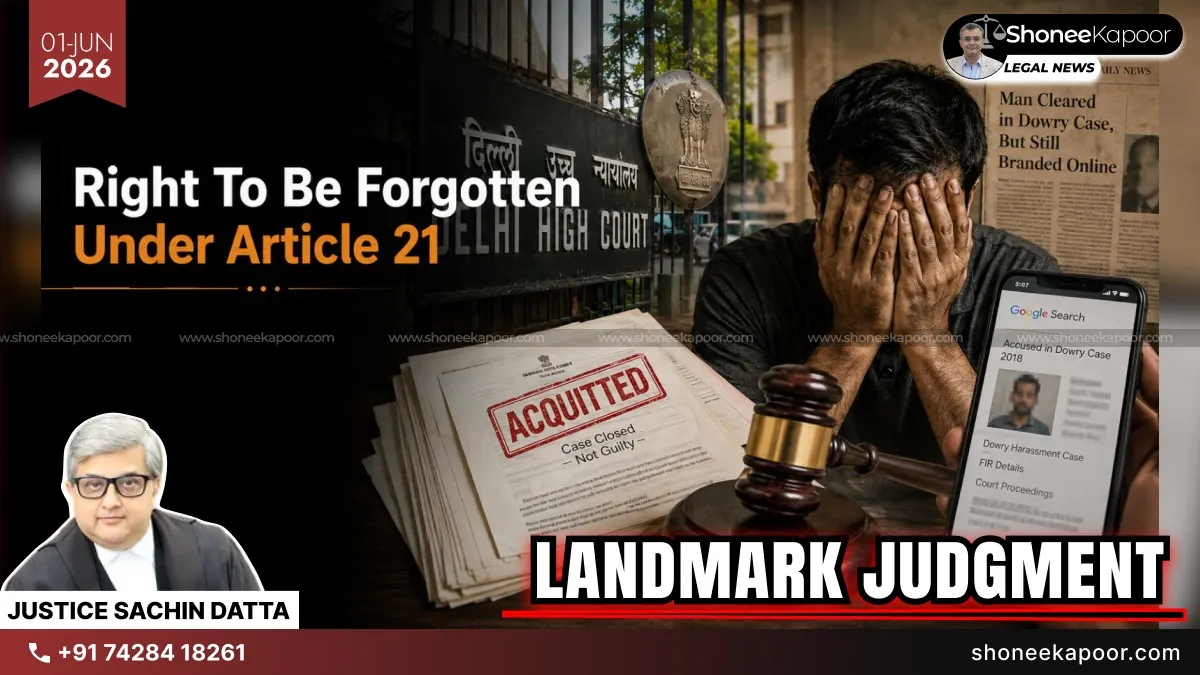
Can old court cases continue to damage a person’s life even after they win or are acquitted? The Delhi High Court has now laid down clear rules on when names and personal details can be hidden from online court records.
NEW DELHI: The Delhi High Court has recognised the Right to Be Forgotten as an important part of the fundamental right to privacy guaranteed under Article 21 of the Constitution.
In a significant judgment, Justice Sachin Datta held that individuals can seek the removal, masking or de-indexing of personal information from online judicial records if continued public access causes disproportionate harm to their privacy, dignity and reputation.
Explaining the importance of the right, the Court observed:
“The right to be forgotten thus reflects the evolution of privacy in response to the permanence of online information. In a society where digital records are virtually indelible, the ability to seek erasure ensures that informational self-determination remains effective. It protects individuals from perpetual exposure to past events that may no longer bear relevance, while preserving their dignity and autonomy in the society.”
The judgment was passed while deciding a batch of petitions seeking de-indexing, de-linking or removal of online content. The petitioners argued that the right to privacy also includes the right to be forgotten.
The Court examined petitions filed by different categories of people, including individuals acquitted in criminal cases, parties involved in matrimonial disputes and persons whose names had appeared incidentally in court proceedings. Many of them argued that internet search results continued to connect their names with old legal disputes, affecting their personal relationships, social standing and professional opportunities even after the proceedings had ended in their favour.
Apart from seeking removal of news reports, the petitioners also sought relief against legal databases such as Indian Kanoon, which publish court judgments online. They requested that names and personal details be masked so that their identities do not appear in internet search results.
After examining the issue in detail, the High Court laid down a framework for dealing with requests seeking removal or masking of personal information from online judicial records.
The Court clarified that the objective is to protect privacy without affecting the integrity of judicial records. Under the framework, only names and personal identifiers would be concealed. The legal reasoning, findings and conclusions contained in the judgment would continue to remain publicly available.
Justice Datta further clarified that unredacted versions of judgments would remain preserved in official court records and would continue to be accessible to courts, parties and competent authorities whenever required for legitimate legal purposes. The masking process would apply to both existing and future digital versions of judgments.
The Court also directed that once a masking order is passed, search engines and legal databases must de-index the judgment from name-based searches so that the concerned person’s identity does not easily appear online.
At the same time, the Court noted that judicial forums would retain the power to review, modify or revoke such orders if circumstances change. It also stressed that such applications should be decided promptly because continued online disclosure of personal information may cause ongoing harm to affected individuals.
The judgment is expected to have a significant impact on men whose names remain permanently linked to legal disputes on the internet, including those who were acquitted, wrongly implicated, or otherwise associated with proceedings that have long since ended. The Court sought to strike a balance between transparency of judicial records and the individual’s right to move forward with dignity after legal proceedings conclude.
Explanatory Table: Laws, Rights & Legal Principles Discussed
| LAW / PROVISION | PURPOSE | HOW IT WAS APPLIED |
| Article 21, Constitution of India | Protects life and personal liberty | Court held that Right to Privacy and Right to Be Forgotten flow from Article 21. |
| Right To Privacy | Constitutional protection of personal autonomy | Used as the foundation for recognising the Right To Be Forgotten. |
| Right To Be Forgotten | Allows individuals to seek removal, masking or de-indexing of personal information in appropriate cases | Court formally recognised and structured its application in India. |
| Digital Personal Data Protection Act, 2023 | Governs protection and processing of personal data | Discussed while examining evolving privacy jurisprudence and erasure rights. |
| Section 228A IPC | Protects identity of sexual offence victims | Cited as an existing example where law already permits masking of identities. |
| POCSO Act, 2012 | Protects children from sexual offences | Mentioned as a statute where anonymity and privacy protections already exist. |
| Juvenile Justice (Care and Protection of Children) Act, 2015 | Protects identity of children in conflict with law and children in need of care | Referenced as another example of legally recognised identity protection. |
| K.S. Puttaswamy v. Union of India | Landmark privacy judgment | Relied upon to hold that privacy is a fundamental right and includes informational privacy. |
| Jorawer Singh Mundy v. Union of India | Delhi HC right-to-be-forgotten precedent | Discussed as one of the important precedents supporting de-indexing relief. |
| Vysakh K.G. v. Union of India | Kerala HC decision on Right To Be Forgotten | Relied upon while discussing delisting and de-indexing principles. |
Case Details
- Case Title: Laksh Vir Singh Yadav v. Union of India & Ors. & Connected Matters
- Lead Case Number: W.P.(C) 1021/2016 & Connected Matters
- Date of Judgment: 29.05.2026
- Court: Delhi High Court
- Bench: Justice Sachin Datta
- Neutral Citation: 2026:DHC:4297
Counsels Appearing
For Petitioners
- Mr. Akhil Sibal, Senior Advocate
- Mr. Arvind Nigam, Senior Advocate
- Mr. Rohit Madan
- Mr. Rahul Kumar
- Various counsels representing individual petitioners in the connected matters.
For Union of India
- Multiple CGSCs, SPCs and Government Panel Counsels including:
- Ms. Nidhi Raman
- Mr. R. Venkat Prabhat
- Mr. Himanshu Pathak
- Mr. Rakesh Kumar
- Mr. Jitendra Kumar Tripathi
- Other Government Counsels appearing in connected matters.
For Google LLC
- Mr. Arvind Nigam, Senior Advocate
- Ms. Mamta R. Jha
- Mr. Rohan Ahuja
- Team of Advocates appearing for Google LLC.
Key Takeaways
- Acquittal means little if old allegations continue appearing online and branding innocent men as criminals for life.
- Matrimonial and criminal disputes often leave a permanent digital scar on men even after cases end in their favour.
- The Court recognised that reputation, dignity and future opportunities deserve protection, not just legal acquittal.
- Search engines cannot become lifelong punishment mechanisms for people who have already faced and survived litigation.
- The judgment strengthens the principle that a person should not remain publicly condemned forever for allegations, disputes or proceedings that no longer have legal relevance.
This Could Change Your Case-Get FREE Legal Advice-Click Here!
Disclaimer: The views and opinions expressed in this article are those of the Indian courts and do not necessarily reflect the official policy or position of “ShoneeKapoor.com” or its affiliates. This article is intended for informational and educational purposes only. The content provided is not legal advice, and viewers should not act upon this information without seeking professional counsel. Viewer discretion is advised.
