
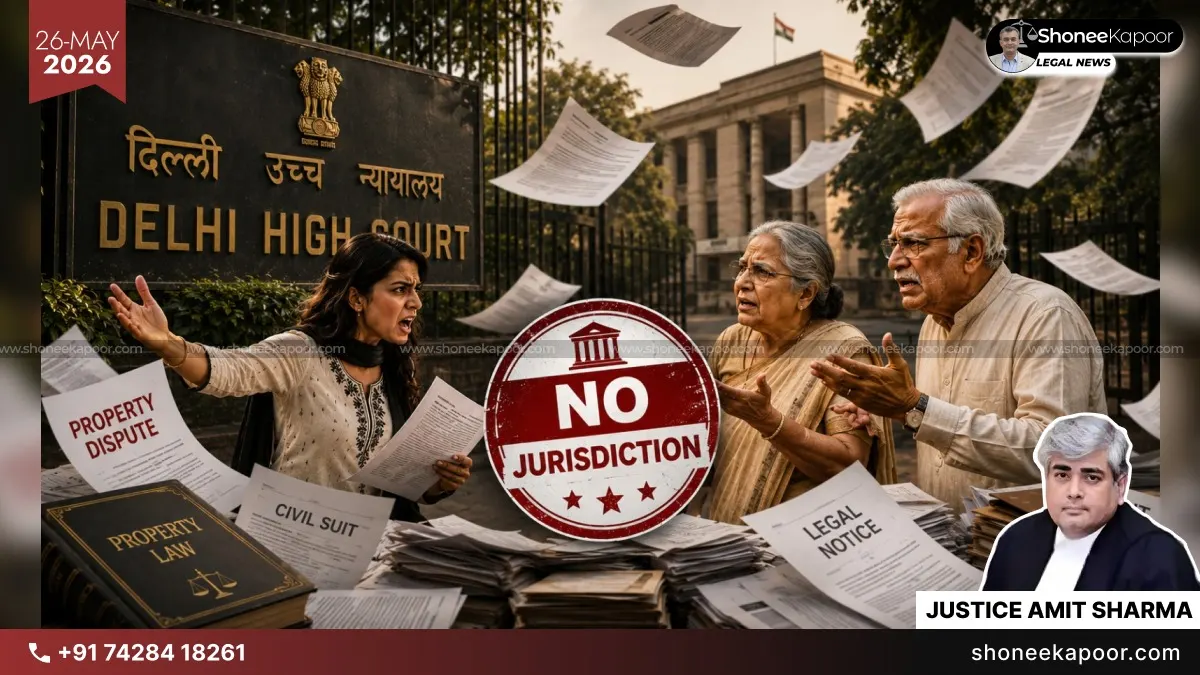
Can a daughter-in-law stop eviction by calling every property dispute a “shared household” issue? Delhi High Court has now made an important clarification that may impact many families facing long-running property battles.
PROPERTY DISPUTES NEW DELHI: The Delhi High Court has ruled that ownership disputes between in-laws and a daughter-in-law over a self-acquired property cannot automatically be treated as matrimonial disputes just because the parties are related through marriage.
Justice Amit Sharma observed that property ownership rights exist independently from marital relationships and such disputes can be decided by ordinary civil courts instead of Family Courts.
The matter started after a mother-in-law filed a suit seeking mandatory and permanent injunction against her son and daughter-in-law regarding a property which she claimed was her self-acquired property. She told the court that the couple were only licensees staying on the second floor of the house and sought directions for them to vacate the premises.
The daughter-in-law challenged the maintainability of the case before the civil court. She argued that since the dispute arose from a matrimonial relationship, the matter should be heard only by the Family Court under Sections 7 and 8 of the Family Courts Act, 1984.
She also claimed that the property was her “shared household” under the Protection of Women from Domestic Violence Act.
However, the High Court rejected this argument and relied upon the earlier Division Bench judgment in Geeta Anand v. Tanya Arjun. The Court clarified that the real test is whether the dispute directly arises from the marital relationship itself.
“The right of respondent No.1 (mother-in-law) to seek mandatory and permanent injunction cannot be stated to be ‘circumstances arising out of a marital relationship’… It is, in fact, her proprietary rights over the subject property,” the Court observed.
The Court further clarified that the mother-in-law was asserting her ownership rights and not seeking relief because of matrimonial discord.
“Her right to seek such reliefs, as noted hereinbefore, arises out of her claim of ownership over the subject property, and exists independent of ‘circumstances arising out of a marital relationship’,” it observed.
The High Court finally upheld the trial court’s order dismissing the daughter-in-law’s application under Order VII Rule 11 CPC and refused to transfer the case to the Family Court.
The judgment is likely to become important in several ongoing disputes where elderly parents and in-laws claim that self-acquired properties are being dragged into prolonged matrimonial litigation despite ownership documents being in their favour.
The ruling also reinforces that merely using terms like “shared household” cannot automatically convert every ownership dispute into a family court matter when independent proprietary rights are involved.
Explanatory Table Of Laws & Sections Mentioned In The Case
| LAW / SECTION | WHAT IT MEANS IN SIMPLE ENGLISH | HOW IT WAS USED IN THIS CASE |
| Article 227 of Constitution of India | Gives High Courts power to supervise lower courts | Petition was filed challenging the trial court order |
| Order VII Rule 11 CPC | Allows rejection of a plaint if legally not maintainable | Daughter-in-law sought dismissal of the civil suit under this provision |
| Order VII Rule 10 CPC | Allows return of plaint to proper court if filed in wrong court | Used to argue that the matter should go to Family Court |
| Section 151 CPC | Gives inherent powers to courts for justice | Invoked along with procedural objections |
| Sections 7 & 8, Family Courts Act, 1984 | Define exclusive jurisdiction of Family Courts in matrimonial disputes | Daughter-in-law argued the dispute arose from marriage and should go to Family Court |
| Section 7(1)(d), Family Courts Act | Covers suits arising out of marital relationships | Court examined whether property ownership dispute truly arose from marriage |
| Protection of Women from Domestic Violence Act, 2005 | Law protecting women from domestic abuse and shared household rights | Daughter-in-law claimed the house was her “shared household” |
| Section 2(s), DV Act | Defines “shared household” | Used by petitioner to claim residential rights in property |
| Section 12, DV Act | Provision to file domestic violence complaint | Petitioner had already filed a complaint under this section |
| Section 125 CrPC | Right to claim maintenance | Wife filed maintenance case for herself and daughters |
| Sections 323/341/506 IPC | Hurt, wrongful restraint and criminal intimidation offences | FIR was lodged by petitioner against respondents |
Case Details
| PARTICULARS | DETAILS |
| Case Title | A J @ L v. K S & Anr. |
| Case Number | CM(M) 1776/2023 & CM APPL. 56421/2023, 17994-95/2026 |
| Court | Delhi High Court |
| Bench | Justice Amit Sharma |
| Reserved On | 23 March 2026 |
| Pronounced On | 20 May 2026 |
| Neutral Citation | 2026:DHC: 4527 |
| Petitioner | Anjali Jayant @ Laxmi |
| Respondents | Kusum Singh & Anr. |
| Counsel for Petitioner | Mr. Bhuvan Jayant, Ms. Maitri Goel, Ms. Prachi Goel, Mr. Varun Ranjan and Mr. Rittik Pandey, Advocates |
| Counsel for Respondent No.1 | Mr. Gaurav Dubey, Advocate |
Key Takeaways
- Delhi High Court clearly held that self-acquired property disputes between in-laws and daughter-in-law are not automatically matrimonial disputes.
- The Court clarified that ownership rights exist independently from marriage and must be decided by ordinary civil courts.
- Simply calling a house a “shared household” does not automatically block the true owner from seeking legal remedies.
- The judgment protects elderly parents and families from being forced into prolonged Family Court litigation over properties legally owned by them.
- The Court stressed that the real test is the “cause of action” — if the dispute is about ownership and possession, civil courts will continue to have jurisdiction.
This Could Change Your Case-Get FREE Legal Advice-Click Here!
Disclaimer: The views and opinions expressed in this article are those of the Indian courts and do not necessarily reflect the official policy or position of “ShoneeKapoor.com” or its affiliates. This article is intended for informational and educational purposes only. The content provided is not legal advice, and viewers should not act upon this information without seeking professional counsel. Viewer discretion is advised.
