
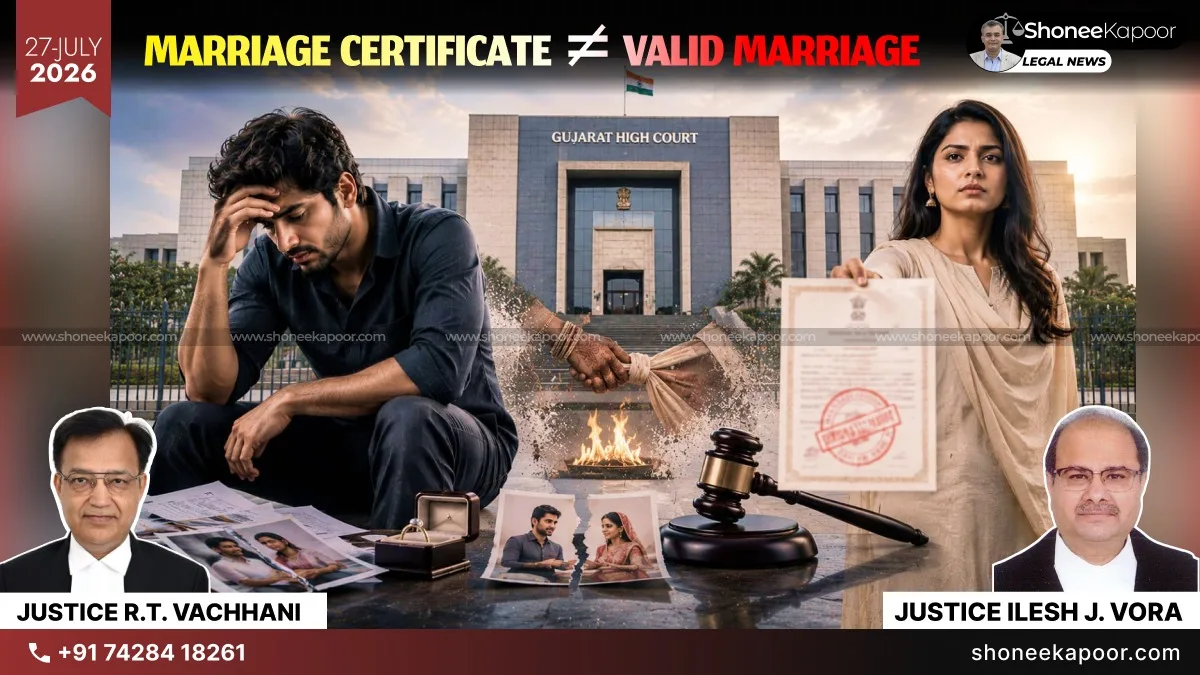
Can a woman claim the legal status of wife merely by producing a registered marriage certificate? The Gujarat High Court examined whether registration can create a Hindu marriage when no wedding ceremony, customary ritual or marital relationship ever existed.
AHMEDABAD: The Gujarat High Court protected a man from being forced into the legal status of a husband merely because a marriage certificate had been issued in his name.The Court held that registration cannot create a valid Hindu marriage where the essential marriage rites and ceremonies were never performed.
A Division Bench of Justice Ilesh J. Vora and Justice R.T. Vachhani declared the alleged marriage between Kaushal Pramodbhai Sonar and Khushi Sanjay Shah null and void from the beginning.
The man was living in the United Kingdom for work and studies. According to his case, he learnt about the alleged marriage only when the woman approached his parents in Ahmedabad and produced a marriage certificate claiming that she was his legally wedded wife.
He maintained that he had never married her, never performed any Hindu wedding ceremonies and had never lived with her as husband and wife.
The man further alleged that he had earlier worked in a company owned by the woman’s father. According to him, his signatures on the marriage-related documents were obtained through fraudulent inducement, including the promise of promotion or the threat of losing his job.
These allegations were raised by the man before the court. The High Court’s decisive finding, however, was based upon the woman’s own admission regarding the absence of a marriage ceremony.
In her written statement before the Family Court, Ahmedabad, the woman admitted that no marriage rites or rituals had been performed between the parties.
She also admitted that no lawful marriage had been solemnised and that the parties did not share the relationship of husband and wife.
Based on these admissions, the man requested the Family Court to pass a decree without forcing him to undergo a complete trial.However, the Family Court rejected his application on November 13, 2025.
The Family Court took the view that the existence of a registered marriage certificate raised a presumption of a valid marriage and that the dispute required a full trial.
The man challenged that decision before the Gujarat High Court.
The High Court found that the woman’s admission was clear, direct and related to the most important issue in the case—whether any marriage had actually taken place.
The Court observed that when the person relying upon a marriage certificate admits that no marriage ceremony ever occurred, the presumption created by registration stands rebutted.
The Bench held that there was no reason to force the man into a lengthy matrimonial trial when the woman herself had admitted that the foundation of the alleged marriage did not exist.
The Court stated:
“When the respondent herself has admitted that the essential marriage ceremonies were never performed, there was no justification or useful purpose in directing the parties to undergo a lengthy and protracted trial.”
The High Court examined Section 7 of the Hindu Marriage Act, 1955, which governs the ceremonies required for a Hindu marriage.Under this provision, a Hindu marriage must be solemnised according to the customary rites and ceremonies followed by either party.
Where the applicable customs include Saptapadi, the marriage becomes complete and legally binding only after the bride and groom jointly take the seventh step before the sacred fire.
The Court explained that the word “solemnized” means that the marriage must actually be performed in the proper manner and through the required ceremonies.
Merely signing papers or obtaining a government certificate cannot replace the legal requirement of solemnisation.
The Bench observed:
“Unless the marriage is performed with the necessary customary rites and ceremonies, it cannot be treated as a marriage that has been solemnized under the Act.”
It clarified that registration only helps in proving a marriage that has already been validly solemnised under Section 7.
Registration records an existing marriage. It does not manufacture a marriage where none has taken place.
The High Court stated:
“If no such marriage has actually taken place, any registration made or certificate issued will have no legal effect.”
The Court further clarified that such registration cannot create the legal status of husband and wife between two persons.
The ruling is particularly important because a marriage certificate can expose a man to serious matrimonial, financial, civil and criminal consequences.
A person shown as a husband in official records may be forced to defend maintenance claims, domestic violence proceedings, matrimonial litigation, inheritance disputes and other legal demands.
In the present case, the man had already been forced to approach the Family Court and then the High Court to establish that a marriage admitted to have never been solemnised could not legally bind him.
The High Court found that the Family Court had wrongly treated the certificate as creating an almost unquestionable presumption of marriage.
The Court held:
“The existence of a marriage certificate or its registration cannot override, contradict, or nullify the legal effect of her clear admission that no marriage was ever solemnized.”
It stated that a Hindu marriage is a “samskara” and a sacrament carrying deep social, spiritual and legal importance.
The Court said marriage is not merely an occasion for “song and dance” or “wining and dining”.
It further observed that marriage is not a commercial transaction. It is a solemn relationship through which two individuals enter into a dignified, equal, consensual and healthy union for building a family.
The Court referred to the traditional concept of a wife as “ardhangini”, while also recognising her as an equal individual with her own separate identity.
However, the Court made it clear that this sacred, social and legal status can arise only when a valid marriage has actually been solemnised.
Where no ceremony took place, the relationship cannot acquire the legal status of marriage merely because a document was registered.
The High Court also relied upon the Supreme Court judgment in Rathnamma & Others v. Sujathamma & Others, Civil Appeal No. 3050 of 2010.
In that case, the Supreme Court had held that the mere registration of a marriage agreement is not sufficient to prove a valid marriage.
Applying that principle, the Gujarat High Court held that the registration and certificate in the present case could not establish a lawful marriage when the woman herself admitted that no rites or rituals were performed.
The Court also noted that the man was living in the United Kingdom, that no cohabitation had taken place between the parties and that the woman’s admission supported his stand that no valid marriage had ever occurred.
The Bench held that the Family Court should have acted upon the clear admission instead of forcing the man to undergo a long and unnecessary trial.
The High Court observed that refusing to act upon the admission had caused injustice to the man and unnecessarily prolonged the litigation.
The Court consequently quashed the Family Court order dated November 13, 2025 and declared the alleged marriage “null and void ab initio”, meaning that it was legally void from the very beginning.
The Bench stated that no marital right or liability could arise from such an alleged marriage.
The man was also granted liberty to approach the competent authority for cancellation of the marriage registration and the marriage certificate.
No order was passed regarding costs.
The ruling sends a necessary message to matrimonial courts and registration authorities: a government certificate cannot be allowed to impose the legal identity of a husband upon a man when no marriage was ever solemnised.
A marriage certificate is evidence of marriage. It cannot become a weapon for creating a marriage on paper and forcing one party to spend years proving that the wedding never occurred.
EXPLANATORY TABLE OF LAWS AND SECTIONS
| LAW / SECTION | WHAT IT MEANS | APPLICATION IN THIS CASE |
| Section 5, Hindu Marriage Act, 1955 | Lists the basic legal conditions for a valid Hindu marriage, including monogamy, mental capacity, minimum age and restrictions on prohibited relationships. | The man’s original petition referred to Section 5 while challenging the legal validity of the alleged marriage. However, the High Court primarily decided the matter on the absence of solemnisation under Section 7. |
| Section 7(1), Hindu Marriage Act, 1955 | A Hindu marriage must be solemnised according to the customary rites and ceremonies followed by either party. | The woman admitted that no marriage rites or ceremonies were performed. Therefore, the essential legal requirement for a valid Hindu marriage was absent. |
| Section 7(2), Hindu Marriage Act, 1955 | Where the customary ceremony includes Saptapadi, the marriage becomes complete and binding when the seventh step is taken before the sacred fire. | No Saptapadi or other customary wedding ceremony was shown to have taken place. The alleged marriage was therefore never completed under Hindu law. |
| Section 8(1), Hindu Marriage Act, 1955 | Permits States to make rules for recording Hindu marriages in a marriage register to help prove an existing marriage. | The Court held that registration assists in proving a marriage that has already been validly solemnised. It cannot create a marriage by itself. |
| Section 8(4), Hindu Marriage Act, 1955 | Makes entries in the Hindu Marriage Register and certified extracts admissible as evidence. | The marriage certificate had evidentiary value, but that value was defeated by the woman’s clear admission that no marriage ceremony had occurred. |
| Section 8(5), Hindu Marriage Act, 1955 | States that failure to register a Hindu marriage does not affect the validity of a marriage that was otherwise properly solemnised. | This shows that solemnisation is the foundation of marriage, while registration is secondary. Registration cannot replace the wedding ceremony required by Section 7. |
| Section 12, Hindu Marriage Act, 1955 | Provides grounds on which a voidable marriage may be annulled, including lack of valid consent, incapacity or consent obtained by fraud in specified circumstances. | The man had alleged that his signatures were fraudulently obtained. However, the High Court found that no marriage existed at all because it was never solemnised. |
| Order XII Rule 6, Code of Civil Procedure, 1908 – Decree on Admission | Allows a court to pass a judgment or decree where a party has made a clear and unambiguous admission regarding an important fact. | The woman admitted that no rites were performed and no lawful marriage was solemnised. The High Court held that the Family Court should have acted upon this admission instead of ordering a full trial. |
| Section 21, Hindu Marriage Act, 1955 | Makes the Code of Civil Procedure applicable to proceedings under the Hindu Marriage Act, subject to the Act and applicable rules. | It enabled the court to apply the procedural rule concerning a decree based on admissions. |
| Section 19, Family Courts Act, 1984 | Provides a right of appeal to the High Court against specified judgments and orders of a Family Court. | The man used this appellate remedy to challenge the Family Court order refusing to declare the alleged marriage void. |
| Doctrine of Null and Void Ab Initio | Means that a transaction or relationship is legally invalid from the very beginning and is treated as though it never legally existed. | The High Court declared the alleged marriage void from inception because the essential ceremonies were never performed. |
CASE DETAILS
| PARTICULAR | DETAILS |
| Court | High Court of Gujarat at Ahmedabad |
| Case Title | Kaushal Pramodbhai Sonar v. Khushi Sanjay Shah |
| Case Number | R/First Appeal No. 429 of 2026 |
| Neutral Citation | 2026:GUJHC:38968-DB |
| Judgment Authored By | Justice R.T. Vachhani |
| Bench | Justice Ilesh J. Vora and Justice R.T. Vachhani |
| Appellant | Kaushal Pramodbhai Sonar |
| Respondent | Khushi Sanjay Shah |
| Counsel for Appellant | Mr. Rahil P. Jain |
| Counsel for Respondent | Mr. Anurag R. Rathor |
KEY TAKEAWAYS
- A marriage certificate alone cannot legally make a man someone’s husband.
- Mandatory marriage ceremonies must be proved before marital rights and liabilities are imposed.
- Registration records a valid marriage; it cannot manufacture a marriage that never occurred.
- The man was forced to approach two courts despite the woman admitting that no lawful marriage had been solemnised.
- In matrimonial litigation, a piece of paper must never be allowed to become a weapon for creating husbandhood, liability and years of legal harassment.
This Could Change Your Case-Get FREE Legal Advice-Click Here!
Disclaimer: The views and opinions expressed in this article are those of the Indian courts and do not necessarily reflect the official policy or position of “ShoneeKapoor.com” or its affiliates. This article is intended for informational and educational purposes only. The content provided is not legal advice, and viewers should not act upon this information without seeking professional counsel. Viewer discretion is advised.
