
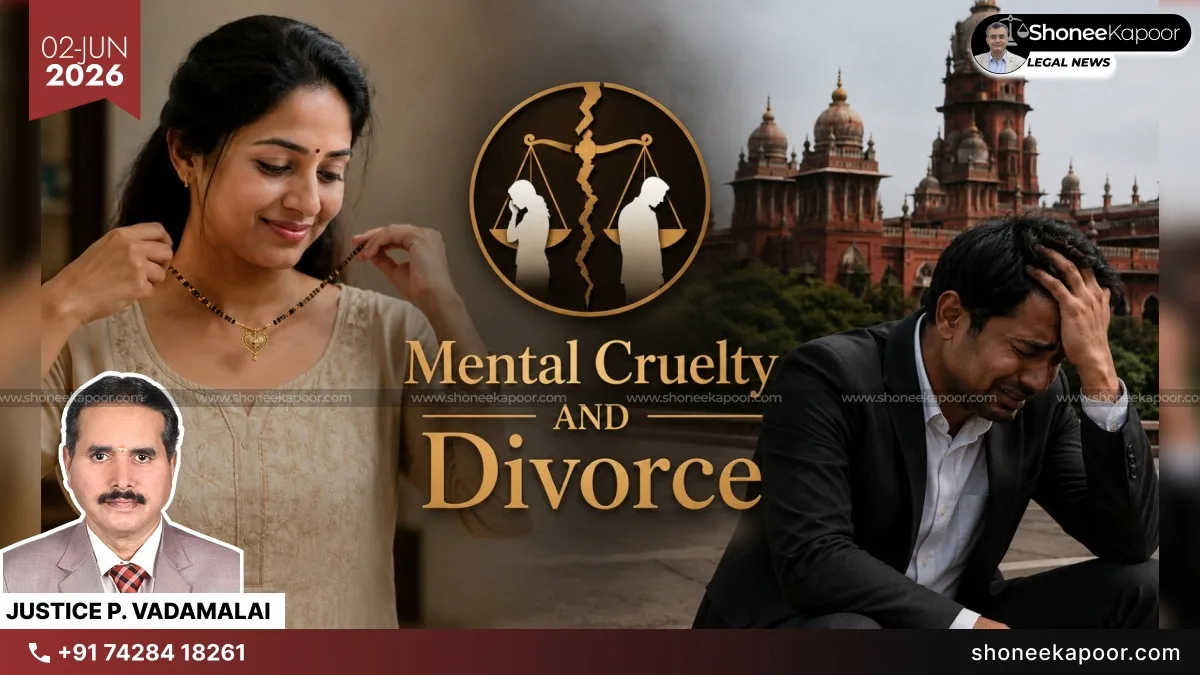
Can removing a mangalsutra become a valid ground for divorce? Madras High Court answers while dismissing a wife’s appeal after decades of marital disputes.
MADURAI: The Madras High Court has upheld a divorce granted to a husband, holding that the removal of a thali (mangalsutra) by a Hindu wife amounts to mental cruelty.
Justice P. Vadamalai dismissed the wife’s second appeal and confirmed the findings of the lower courts.
The couple married in 1977 and had a son and a daughter. The husband claimed that from the beginning of the marriage, the wife frequently accused him of having relationships with other women, insulted him publicly, wrote complaints to his superior officers in the Army, and filed police complaints against him. He further alleged that the wife had converted to Christianity, deserted him, and that there was no possibility of reconciliation.
The wife denied these allegations and accused the husband of maintaining relationships with other women. She alleged that he confined her and the children inside the house and set it on fire. She also claimed that he later started living with another woman and pressured her to consent to a second marriage. According to her, when she refused, he cut off her right thumb, leading to criminal proceedings against him.
While examining the evidence, the High Court noted that the wife failed to produce material proving her allegations regarding the husband’s alleged relationships with other women. At the same time, she admitted during her evidence that she had written complaints to the husband’s superior officers regarding such allegations.
The Court observed that making defamatory complaints against a spouse to his or her employer or superior authorities can itself amount to cruelty and may justify a decree of . The Court further noted that despite the parties living together for some time after those complaints, disputes continued and multiple cases were filed thereafter.
The Court also considered the issue of the wife removing her thali. Referring to her own evidence, the Court recorded:
“The next ground for divorce is that the respondent/wife has removed the Thali. It is the evidence of the respondent/wife as R.W.1 that she clearly admitted that she removed ‘Thali” and does not wear gold ornaments. So, the allegation of conversion to Christianity by the respondent/wife cannot be brushed aside, as there is no substance…,”
The Court relied on an earlier Division Bench judgment, which had observed:
“It is known fact that no Hindu married woman would remove the “Thali” at any point of time during the lifetime of her husband. “Thali” around the neck of a wife is a sacred thing which symbolises the continuance of married life and it is removed only after the death of Husband. Therefore, the removal of “Thali” by the petitioner/wife can be said to be an act, which reflected Mental Cruelty of highest order as it could have caused agony and hurted the sentiments of the respondent”.
After examining the evidence regarding the wife’s religious practices, her daughter’s name, and documents placed on record, Justice Vadamalai observed:
“From the above, it is very clear that the respondent/wife adopted Christianity as her daughter’s name and her marriage to a Christian is revealed from Ex.P.1 and Ex.P.2 and hence, the allegation of conversion of religion by the respondent/wife cannot be thrown away upon consideration of the entire evidence on record. This Court holds that the removal of Thali would reflect mental cruelty”.
The wife argued that divorce could not be granted on the ground of irretrievable breakdown of marriage because such a ground is generally exercised by the Supreme Court under its constitutional powers. While acknowledging the legal position, the High Court clarified that the complete breakdown of a marriage can still be considered while deciding whether cruelty has been established.
The Court stated:
“A perusal of the rulings relied on by the learned counsel for the respondent/wife reveals that the argument of the respondent/wife’s side is somewhat correct one, but at the same time, it cannot be construed that the Courts below and the High Court could not consider the fact of the marriage having irretrievably broken down while seeking divorce on the ground of cruelty,”
After reviewing the entire record, the High Court found that the husband had successfully established cruelty. The Court held that the findings of the subordinate court and the first appellate court were correct and did not require interference.
The appeal was therefore dismissed, and the decree of divorce granted to the husband was upheld.
Important Legal Principles Laid Down
| ISSUE | COURT’S FINDING |
| Removal of Thali/Mangalsutra | Can amount to mental cruelty in appropriate facts. |
| Complaints to Husband’s Superiors | Defamatory complaints affecting reputation may constitute mental cruelty. |
| Long Separation | Can be considered while assessing cruelty. |
| Conversion Allegation | Court held allegation could not be completely brushed aside on available evidence. |
| Irretrievable Breakdown | Not an independent ground available to High Courts, but circumstances may be considered while deciding cruelty. |
| False/Unproved Allegations Against Spouse | May amount to mental cruelty. |
Explanatory Table Of All Laws & Sections Involved
| LAW / SECTION | PURPOSE | HOW IT APPLIED IN THIS CASE |
| Section 13(1)(ia), Hindu Marriage Act, 1955 | Divorce on ground of Cruelty | Husband sought divorce alleging mental cruelty by wife. |
| Section 13(1)(ib), Hindu Marriage Act, 1955 | Divorce on ground of Desertion | Husband alleged wife deserted him. |
| Section 13(1)(ii), Hindu Marriage Act, 1955 | Divorce on ground of Conversion | Husband alleged wife converted from Hinduism to Christianity. |
| Section 23(1), Hindu Marriage Act, 1955 | Conditions for granting matrimonial relief | Wife argued husband had condoned earlier acts and therefore divorce should not be granted. |
| Section 23(1)(b), Hindu Marriage Act, 1955 | Condonation of matrimonial offences | Wife argued old incidents stood condoned when parties resumed cohabitation after 1991. |
| Section 9, Hindu Marriage Act, 1955 | Restitution of Conjugal Rights | Court noted wife never filed a petition seeking restoration of marital life despite decades of separation. |
| Section 28, Hindu Marriage Act, 1955 | Appeals under the Act | Present appeal filed under this provision. |
| Section 100, Civil Procedure Code | Second Appeal on substantial questions of law | Appeal before High Court was maintainable through this provision. |
| Article 142, Constitution of India | Supreme Court’s power to do complete justice | Wife argued only Supreme Court can grant divorce solely on irretrievable breakdown of marriage. |
Case Details
| PARTICULARS | DETAILS |
| Case Title | Abc Vs Xyz |
| Case Number | C.M.S.A.(MD) No.44 of 2021 |
| Judge/Bench | Justice P. Vadamalai |
| Reserved On | 05.02.2026 |
| Pronounced On | 01.06.2026 |
| Neutral Citation | 2026:MHC:1807 |
| Trial Court Case | HMOP No.157 of 2014 |
| Trial Court | Principal Sub Court, Tenkasi |
| First Appeal | CMA No.53 of 2018 |
| First Appellate Court | Additional District & Sessions Court (FTC), Tenkasi |
| Result | Wife’s appeal dismissed; divorce confirmed |
Counsels
| PARTY | COUNSEL |
| Appellant (Wife) | Mr. S. Ramesh @ Ramiah |
| Respondent (Husband) | Mr. M.P. Senthil for Mr. A. Mohamed Haneef |
Key Takeaways
- Repeated allegations against a husband without proof can destroy his reputation, career, and peace, and courts are increasingly recognizing this as mental cruelty.
- Complaints made to a husband’s employer or superior officers are not harmless accusations; they can have life-changing consequences and may justify divorce.
- Marriage cannot be used as a shield to endlessly accuse, humiliate, and litigate against a spouse while expecting the relationship to continue.
- Courts are acknowledging that decades of separation, continuous disputes, and refusal to end a dead marriage can itself become cruelty.
- Emotional abuse against men often goes unnoticed, but this judgment recognizes that mental cruelty is not gender-specific and husbands can also be victims.
This Could Change Your Case-Get FREE Legal Advice-Click Here!
Disclaimer: The views and opinions expressed in this article are those of the Indian courts and do not necessarily reflect the official policy or position of “ShoneeKapoor.com” or its affiliates. This article is intended for informational and educational purposes only. The content provided is not legal advice, and viewers should not act upon this information without seeking professional counsel. Viewer discretion is advised.
