
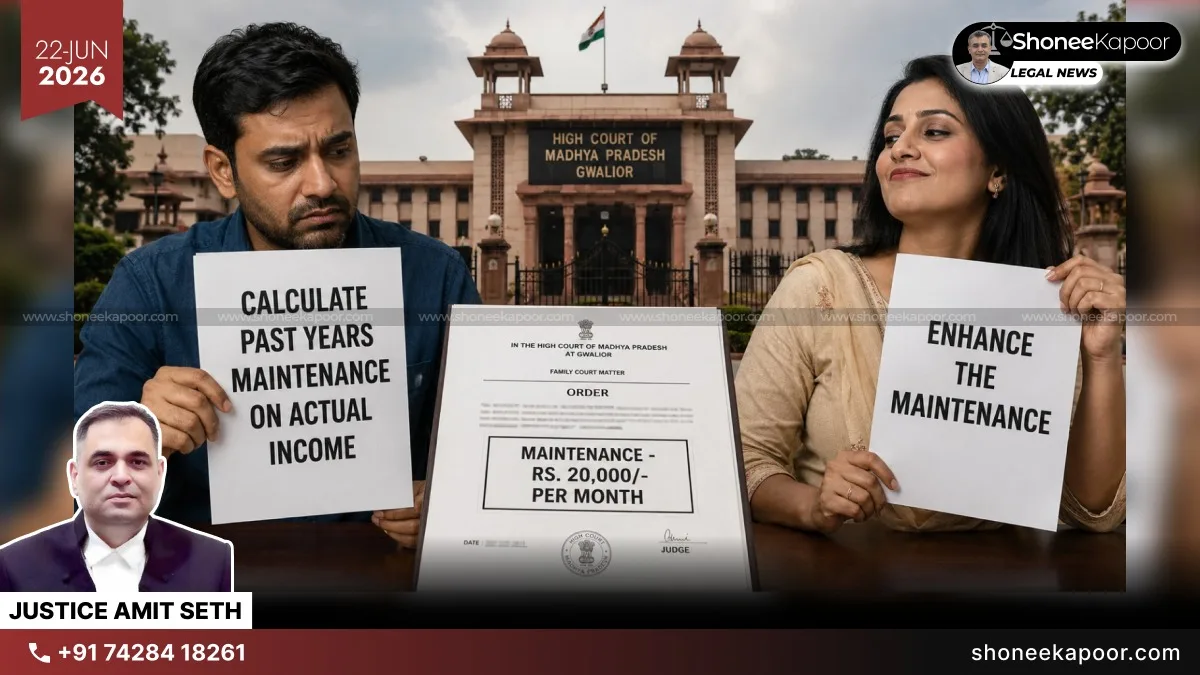
Can maintenance arrears be calculated on assumptions instead of real income? Madhya Pradesh High Court held that past maintenance arrears must reflect the husband’s actual earning capacity for each financial year, not a flat amount imposed blindly.
MADHYA PRADESH: The Madhya Pradesh High Court at Gwalior, through Justice Amit Seth, dealt with a maintenance dispute in which both the husband and wife challenged the Family Court order granting Rs. 20,000 per month in maintenance to the wife.
The wife had filed a case under Section 125 Cr.P.C., alleging dowry demand, cruelty and no independent income. The husband denied the allegations and said she was living separately without sufficient reason.
The Family Court had directed the husband to pay Rs.20,000 per month from 04.02.2016, the date of filing of the maintenance case. The husband challenged this part, saying his income in 2016 was much lower.
His argument was that arrears cannot be calculated on the basis of his later salary for the years when he was earning much less. The wife, however, sought enhancement, saying the husband’s salary had increased.
The High Court observed that maintenance is meant to prevent “vagrancy and destitution” and to ensure a standard of living which is “neither luxurious nor penurious.”
The Court said there is no fixed formula for maintenance. The husband’s income, wife’s needs, family status and other circumstances must be considered.
The Court also noted the principle that:
“25% of the husband’s net salary would be just and proper”
But clarified that every case depends on its own facts.
The High Court found that Rs.20,000 per month was reasonable on the husband’s later admitted net monthly salary of Rs.70,499. On that income, it came to around 28.36% of his net salary.
But the Court also accepted that his earlier income was much lower. His net salary around 2016 was about Rs.29,711. So applying Rs.20,000 uniformly from 2016 would create a very heavy burden for earlier years.
The Court relied on the principle that maintenance must be “reasonable and realistic” and should not become “oppressive and unbearable” for the person paying it.
The High Court held that maintenance can be payable from the date of filing of the application. But the amount for past years must be calculated according to the husband’s actual income during those years.
The Court directed that arrears from 04.02.2016 to 31.03.2024 should be recalculated proportionately as per the husband’s net monthly salary for each financial year.
For the period from 01.04.2024 to 30.12.2024, maintenance would remain Rs.20,000 per month. The same amount would continue in future unless modified by a competent court.
The husband was directed to produce his Income Tax Returns from financial year 2015-2016 to 2023-2024 before the Executing Court within 30 days.
The Court also said that if the husband fails to produce the income details within time, the wife can recover arrears at Rs.20,000 per month from 04.02.2016.
The wife’s plea for enhancement was rejected, though she was given liberty to seek modification later if circumstances change, including any increase in the husband’s income.
The husband also sought removal of certain observations about cruelty because a 498A case was pending. The High Court refused to remove them but clarified that findings in Section 125 Cr.P.C. proceedings are only for maintenance and will not bind the criminal trial.
In the end, the husband got partial relief on recalculation of past arrears, while the wife’s plea for higher maintenance was dismissed.
EXPLANATORY TABLE: LAWS AND SECTIONS INVOLVED
| Law / Section | Purpose | How It Applied In This Case |
| Section 125 Cr.P.C. | Provision for maintenance to wife, children and parents who cannot maintain themselves | Wife filed the maintenance case under this provision. Family Court awarded Rs.20,000 per month. |
| Section 125(2) Cr.P.C. | Deals with the date from which maintenance may be ordered | The High Court discussed whether maintenance should run from the date of filing or from the date of order. |
| Sections 397 and 401 Cr.P.C. | Revisional powers of High Court | The parties challenged the Family Court order through criminal revisions before the High Court. |
| Section 19(4), Family Courts Act | Provides remedy of revision against certain Family Court orders | Used as part of the legal basis for challenging the Family Court’s maintenance order. |
| Section 438 read with Section 442 BNSS, 2023 | Provisions mentioned in the order while describing the criminal revisions | The order records that the revisions were filed under these BNSS provisions along with Family Courts Act and Cr.P.C. provisions. |
| Section 498-A IPC | Cruelty by husband or relatives of husband | A 498A criminal case was pending. Husband wanted cruelty observations in maintenance proceedings removed, fearing they may affect the criminal trial. |
| Order 47 Rule 1 CPC | Review jurisdiction under Civil Procedure Code | Mentioned in the Supreme Court judgment of Kalyan Dey Chowdhury, which was relied upon for maintenance calculation principles. |
CASE DETAILS
- Case Title: Rakesh Kashyap v. Smt Ragini Yadav
- Connected Case: Smt Ragini Yadav v. Rakesh Kashyap
- Court: High Court of Madhya Pradesh at Gwalior
- Bench: Hon’ble Shri Justice Amit Seth
- Case Numbers: Criminal Revision No.1050/2025 and Criminal Revision No.1158/2025
- Neutral Citation: 2026:MPHC-GWL:13841
- Date Of Judgment: 13.05.2026
- Counsels:
- For Husband: Shri Prashant Sharma and Shri Upendra Yadav
- For Wife: Shri Ashok Kumar Ahirwar
KEY TAKEAWAYS
- Maintenance cannot be calculated like a punishment; it must match the real income of the person paying it.
- A husband’s present salary should not be used blindly to create arrears for years when he was earning much less.
- Past income, present capacity and actual financial reality must matter in every maintenance case.
- Maintenance must be fair and realistic, not so heavy that it becomes oppressive for the man.
- Findings in maintenance proceedings are not final proof of cruelty or guilt in a criminal trial.
This Could Change Your Case-Get FREE Legal Advice-Click Here!
Disclaimer: The views and opinions expressed in this article are those of the Indian courts and do not necessarily reflect the official policy or position of “ShoneeKapoor.com” or its affiliates. This article is intended for informational and educational purposes only. The content provided is not legal advice, and viewers should not act upon this information without seeking professional counsel. Viewer discretion is advised.
