
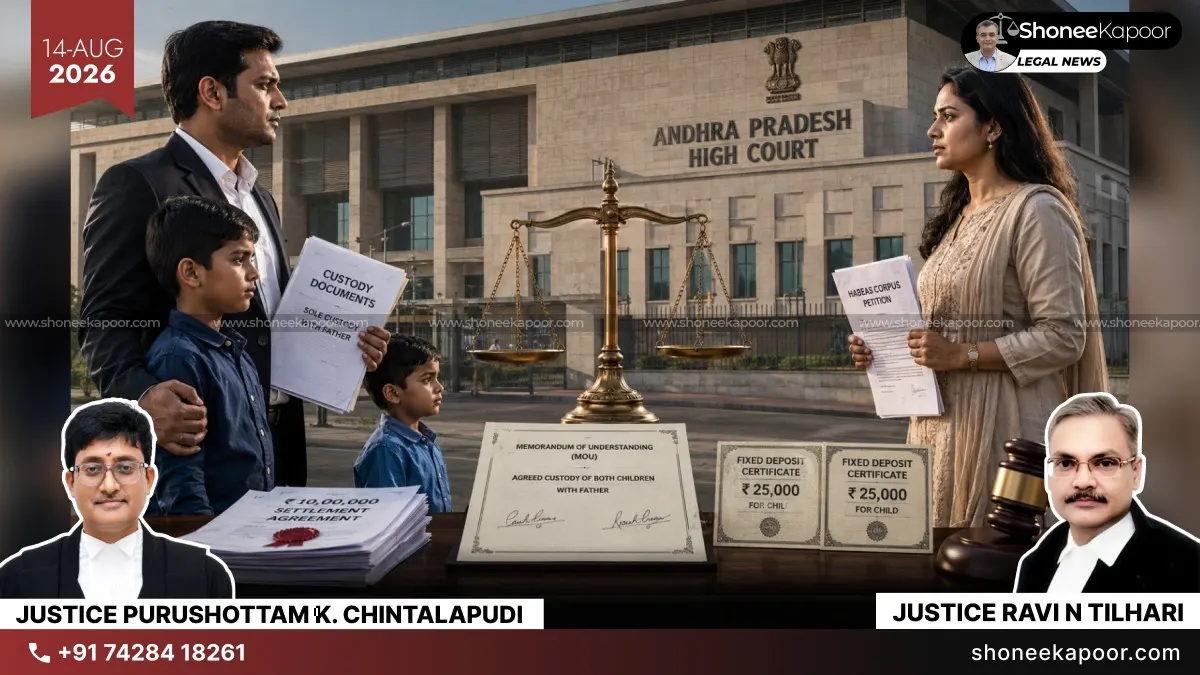
Can children living with their father be called under “illegal custody” when the mother had herself agreed to give him sole custody? The Andhra Pradesh High Court found suppression of crucial facts and imposed ₹50,000 costs on the mother.
ANDHRA PRADESH: The Andhra Pradesh High Court has dismissed a habeas corpus petition filed by a mother seeking custody of her two minor sons from their father, after finding that she had earlier agreed through a Memorandum of Understanding (MoU) that the children would remain solely with the husband. The Court also imposed ₹50,000 costs for suppression of material facts.
The Division Bench of Justice Ravi Nath Tilhari and Justice Purushottam Kumar Chintalapudi was dealing with Writ Petition No. 18034 of 2026, which arose from a letter petition to the Chief Justice on June 28, 2026.
The mother alleged that her husband had forcibly taken their two minor sons from her custody while allegedly trying to avoid investigation in a criminal case. She sought a writ of habeas corpus to trace the children and restore their custody to her.
However, during the proceedings, important facts from earlier litigation came before the Court.
The husband had earlier approached the Telangana High Court in Criminal Petition No. 9564 of 2025 seeking quashing of an FIR registered against him under Sections 85 and 115(2) of the Bharatiya Nyaya Sanhita, 2023, and Sections 3 and 4 of the Dowry Prohibition Act, 1961. The Telangana High Court had quashed that FIR on September 18, 2025.
More importantly, the earlier proceedings recorded that the husband and wife had signed an MoU dated March 26, 2025, for dissolution of their marriage by mutual consent. Under the MoU, they specifically agreed that custody and care of both children would remain solely with the father.
The MoU also recorded a ₹10 lakh financial settlement, along with ₹30,000 monthly maintenance for 12 months. During the present proceedings, the mother admitted that she had already received ₹5 lakh from the husband under the settlement.
The earlier court record further showed that the mother had lodged another FIR against a different person under Sections 64(2)(m) and 318(4) BNS, in which the record referred to her relationship with that person. These earlier proceedings and the custody MoU had not been disclosed in her letter petition before the Andhra Pradesh High Court.
An unusual situation also arose during the hearing. In the morning session, the mother stated that she could not understand or read English, following which the Court arranged a lady Legal Aid Counsel for her. In the afternoon session, however, she read the English MoU before the Bench and produced copies of the MoU and the Telangana High Court order. When asked why these documents had not been disclosed earlier, she said she did not consider them relevant.
The High Court held that where the parents had themselves agreed that the children would remain solely with the father, their stay with him could not be treated as illegal custody.
The Court held:
“Once it was agreed mutually between the petitioner and the R5 that the custody of the children shall remain solely with the husband, the children cannot be said to be in any illegal custody of the R5-father.”
The Bench further held:
“The Habeas Corpus petition is not maintainable. The petitioner has misused the process of this Court by suppression of the material facts.”
The mother apologised before the Court, but the Bench refused to accept the apology and observed:
“We are not impressed. It is not a case where an apology be accepted.”
The High Court consequently dismissed the petition and directed the mother to deposit ₹50,000 as costs with the Registrar (Judicial) within three weeks.
The Court further directed that the amount should be divided equally and invested in two fixed deposits of ₹25,000 each in the names of the two minor children, payable to them after they attain majority.
EXPLANATORY TABLE OF LAWS AND SECTIONS
| Law / Section | What It Means | Relevance in This Case |
| Habeas Corpus / Article 226, Constitution of India | High Courts can issue writs against illegal detention or custody. In child-custody matters, the legality of custody and the child’s welfare are important considerations. | Mother sought production and custody of the two children. The Court found their custody with the father was not illegal because it had been mutually agreed. |
| Section 528, BNSS, 2023 | Preserves the inherent powers of the High Court to prevent abuse of court process and secure the ends of justice. | Husband had earlier invoked this provision before the Telangana High Court for quashing criminal proceedings. |
| Section 85, BNS, 2023 | Punishes cruelty by a husband or his relatives towards a married woman. | One of the provisions in the earlier FIR against the husband, which was later quashed. |
| Section 115(2), BNS, 2023 | Deals with voluntarily causing hurt in circumstances covered by the provision. | Invoked in the earlier FIR against the husband. |
| Sections 3 & 4, Dowry Prohibition Act, 1961 | Section 3 deals with giving or taking dowry; Section 4 deals with demanding dowry. | These provisions were also invoked in the earlier proceedings against the husband that were quashed. |
| Section 64(2)(m), BNS, 2023 | Covers an aggravated category of rape specified under Section 64(2). | Mentioned in another FIR lodged by the petitioner against a different person. |
| Section 318(4), BNS, 2023 | Provides punishment for cheating where dishonest inducement results in the delivery of property or the alteration/destruction of a valuable security. | Also mentioned in the separate FIR referred to in the earlier court record. |
CASE DETAILS
| Particulars | Details |
| Case Title | In Re… (VS v. The State of Andhra Pradesh and Others) |
| Court | High Court of Andhra Pradesh at Amaravati |
| Case Number | Writ Petition No. 18034 of 2026 |
| Date of Judgment | 28 July 2026 |
| Bench | Justice Ravi Nath Tilhari and Justice Purushottam Kumar Chintalapudi |
| Counsel / State Side Mentioned in Report | J. Krishna Praneeth, Assistant Government Pleader |
| Legal Aid Counsel for Petitioner | Smt. Santhi Sree Vallabhaneni |
KEY TAKEAWAYS
- A father having custody of his own children is not “illegal custody” just because the mother later changes her stand.
- A mutually agreed custody arrangement cannot be conveniently hidden when approaching the Court for a different relief.
- The High Court called out suppression of material facts and imposed ₹50,000 costs instead of rewarding misuse of legal process.
- Men in matrimonial disputes often face criminal allegations first and scrutiny later; here, the earlier criminal case against the husband had already been quashed.
- Fatherhood does not become secondary to motherhood. A father’s custody, parenting rights and legal position deserve the same judicial seriousness.
This Could Change Your Case-Get FREE Legal Advice-Click Here!
Disclaimer: The views and opinions expressed in this article are those of the Indian courts and do not necessarily reflect the official policy or position of “ShoneeKapoor.com” or its affiliates. This article is intended for informational and educational purposes only. The content provided is not legal advice, and viewers should not act upon this information without seeking professional counsel. Viewer discretion is advised.
