
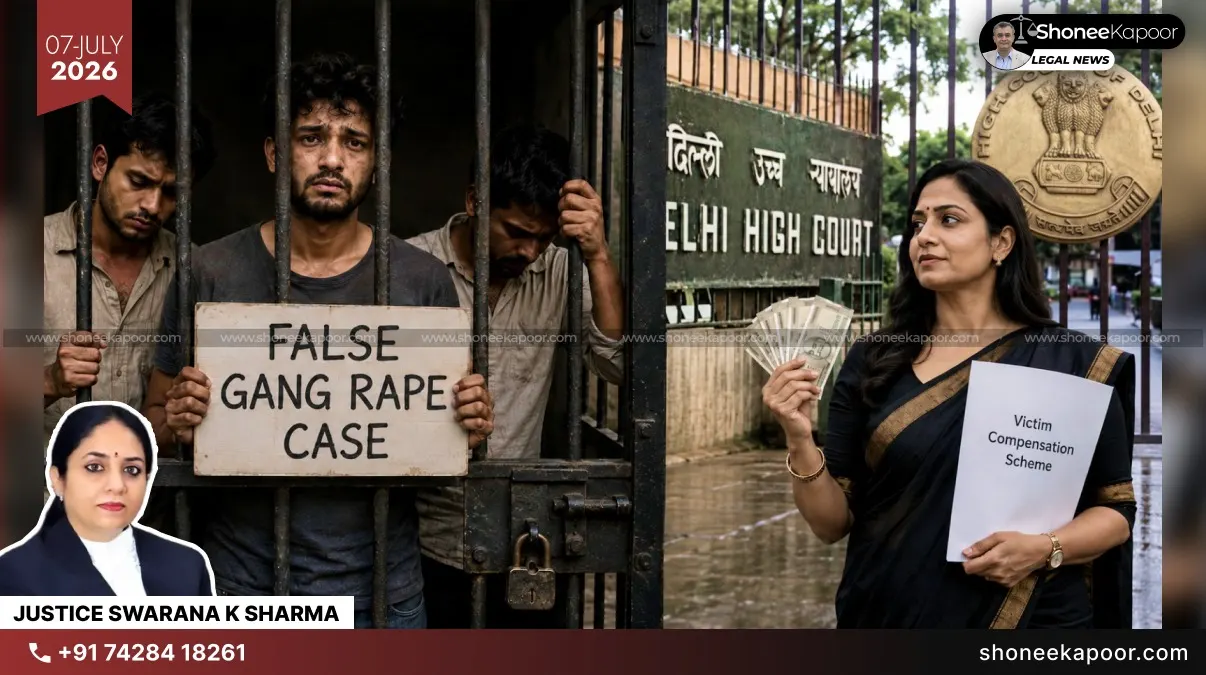
Can victim compensation be kept after rape allegations collapse? Delhi High Court directed that DSLSA must examine recovery where the victim turns hostile, withdraws allegations, or exonerates the accused.
NEW DELHI: The Delhi High Court, through Justice Swarana Kanta Sharma, has upheld the discharge of accused persons in a case under Sections 328 and 376 IPC, after the woman herself stated before the Magistrate that no rape had taken place and the relationship was consensual.
The case began with serious allegations that the woman was taken to a flat on the pretext of employment and sexually assaulted by three men. An FIR was registered, medical examination was done, and investigation proceeded.
However, in her statement under Section 164 CrPC, the woman clearly stated that she knew one of the accused, the physical relationship was consensual, and the other two accused had committed no offence. She also said that she did not want to pursue the complaint further.
The State argued that the accused should still face trial because the first complaint contained serious allegations. But the High Court noted that the statement before the Magistrate was voluntary, clear, and without any allegation of pressure or coercion.
The Court explained that at the stage of charge, the Court does not decide final guilt. It only checks whether strong suspicion exists against the accused.
It found that the prosecution case had been substantially weakened. Since the woman had denied rape before the Magistrate and later confirmed that statement before the Trial Court, no strong or grave suspicion remained against the accused.
The Court held that forcing the accused to face trial in such circumstances would amount to unwarranted prosecution. The discharge order was therefore upheld.
The Court then made important observations on false sexual offence cases. It said:
“Loss of reputation, incarceration, social stigma, and psychological trauma suffered by an accused who is ultimately found to have been falsely implicated may leave scars that remain unhealed for a lifetime, just as the violation of dignity and bodily integrity leaves deep and lasting wounds in genuine cases of sexual assault.”
The Court also reminded that criminal justice must be fair to all sides:
“The duty of the Court is to ensure a fair trial, and fairness in criminal jurisprudence does not mean justice to the victim alone, but justice to all parties who stand before the Court.”
The judgment also flagged misuse of victim compensation. The Court noted that in some sexual offence cases, interim compensation is granted after FIR registration, but later the complainant turns hostile, withdraws allegations, compromises the matter, or exonerates the accused.
The Court referred to the DSLSA procedure and quoted:
“Such a complainant/beneficiary should be made accountable for the interim compensation disbursed, on the basis of initial averments made in the FIR.”
The High Court directed that in sexual offence cases where compensation has been awarded, the Trial Court must send the order and relevant record to DSLSA if the case is quashed on compromise, or if the victim turns hostile, withdraws allegations, or completely exonerates the accused.
The Court also directed that in quashing petitions involving sexual offences based on compromise or settlement, it must be disclosed whether the victim has received compensation under the Victim Compensation Scheme.
EXPLANATORY TABLE: LAWS AND SECTIONS INVOLVED
| Law / Section | Purpose | Role In This Case |
| Section 328 IPC | Giving poison, intoxicant, or harmful substance to commit an offence | Alleged in FIR and charge-sheet, but accused were discharged |
| Section 376 IPC | Punishment for rape | Main allegation, later denied in Section 164 CrPC statement |
| Section 164 CrPC | Statement recorded before Magistrate | Key statement where woman said relationship was consensual |
| Section 161 CrPC | Statement recorded by police | Earlier police version was compared with Magistrate statement |
| Section 182 IPC | False information to public servant | Court noted it may apply in false cases |
| Section 211 IPC | False criminal case or false charge | Court left legal action open to accused or State |
| Section 357A CrPC | Victim compensation provision | Used for discussing compensation recovery |
| Delhi Victim Compensation Scheme, 2018 | Scheme for financial aid to victims | Court said misuse must be checked |
| DSLSA / DLSA Procedure | Legal Services Authority process | Recovery to be examined if allegations collapse |
| Sections 354A to 354D IPC | Sexual harassment-related offences | Mentioned as covered offences in compensation scheme |
| Section 326A IPC | Acid attack | Mentioned in compensation scheme |
| Sections 376A to 376E IPC | Aggravated sexual offences | Mentioned in compensation scheme |
| Section 304B IPC | Dowry death | Mentioned in compensation scheme |
| Section 498A IPC | Cruelty by husband or relatives | Mentioned in compensation scheme where physical injury is involved |
CASE DETAILS
- Case Title: The State of GNCT of Delhi v. Toshib alias Paritosh & Ors.
- Court: High Court of Delhi at New Delhi
- Case Number: CRL.REV.P. 772/2024
- Bench: Justice Swarana Kanta Sharma
- Date Of Judgment: 15.12.2025
- Neutral Citation: 2026:DHC:11337
- Counsels:
- For State: Mr. Naresh Kumar Chahar, APP for the State, along with SI Sumeet Poonia
- For Respondents: Mr. Lokesh Kumar Mishra, Advocate
KEY TAKEAWAYS
- Delhi High Court made it clear that a man cannot be dragged into trial when the woman herself says before the Magistrate that the relationship was consensual.
- A false rape allegation is not a small mistake; it can destroy a man’s reputation, liberty, family, career, and mental peace.
- The Court recognised that justice is not only for the complainant; criminal law must be fair to every person standing before the Court.
- False sexual offence cases also damage genuine victims because society starts doubting even real complaints.
- Victim compensation cannot become free public money; if allegations collapse, recovery and accountability must be examined.
This Could Change Your Case-Get FREE Legal Advice-Click Here!
Disclaimer: The views and opinions expressed in this article are those of the Indian courts and do not necessarily reflect the official policy or position of “ShoneeKapoor.com” or its affiliates. This article is intended for informational and educational purposes only. The content provided is not legal advice, and viewers should not act upon this information without seeking professional counsel. Viewer discretion is advised.
