
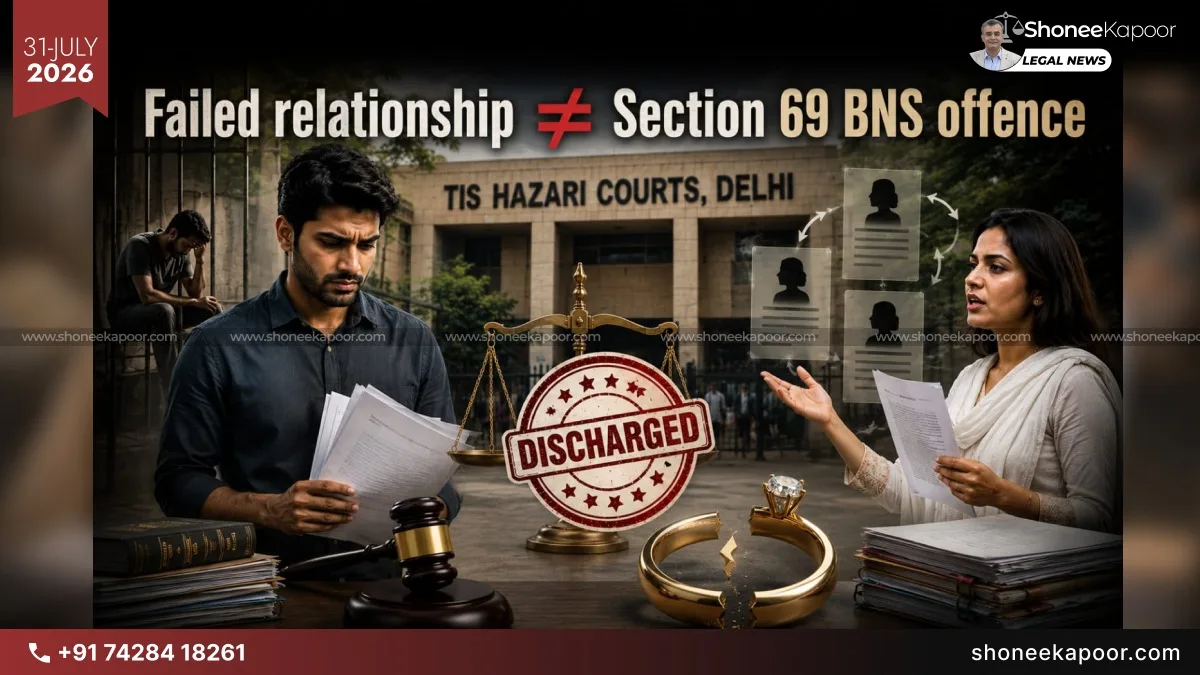
Can a man be forced to face trial when the complainant gives three contradictory versions about the alleged promise of marriage? Delhi Sessions Court discharged the accused U/S 69 BNS and 209 BNS
NEW DELHI: The Delhi Sessions Court in an order interpreting Section 69 of the Bharatiya Nyaya Sanhita, 2023, discharged Man from allegations of establishing physical relations through a false promise of marriage.
The order was passed on 29 July 2026 by Ms. Shreya Arora Mehta, Additional Sessions Judge, Special Fast Track Court-02, Central District, Tis Hazari Courts, Delhi.
The case arose from FIR No. 421/2025, registered at Police Station under Sections 69 and 209 BNS. The prosecution alleged that the accused developed a relationship with the 19-year-old prosecutrix and established physical relations after promising to marry her.
The defence argued that the prosecution’s own documents contained major contradictions regarding the most essential ingredient of Section 69 BNS: whether the alleged promise of marriage was made before the physical relationship and whether it induced consent.
The Court examined the complaint, FIR, statement recorded under Section 183 BNSS, medical history in the MLC and other documents filed with the charge sheet.
It found that the prosecutrix had given three materially different and mutually destructive versions.
In the complaint and FIR, she stated that the accused first promised to marry her and thereafter established physical relations. Under this version, the promise preceded the physical relationship.
However, in her judicial statement under Section 183 BNSS, she stated that physical relations had already taken place and that the alleged promise of marriage was made only afterwards, when she threatened to lodge a complaint.
The MLC contained a third version. According to the medical history, physical relations allegedly took place without consent, the promise of marriage was made afterwards and the parties subsequently became “good friends” and entered a relationship.
The Court held that these contradictions were not minor. They directly affected the foundation of the offence under Section 69 BNS.
A promise allegedly made after the first physical relationship could not have induced consent for an act that had already taken place. Therefore, the prosecution failed to show that the alleged deceit existed at the beginning of the relationship.
The Court observed that while considering charge, it is not required to conduct a full trial. However, it must examine whether the prosecution material creates “grave suspicion” against the accused.
It further stated that the Court cannot act as a mere “post office” and blindly accept the prosecution’s decision to send an accused for trial.
The material also indicated that the relationship continued over a considerable period. The prosecutrix stated that the accused had booked the hotel room at her request, and her MLC recorded that the last physical relationship was “by her own consent.”
The Court noted that the prosecutrix was an adult, educated and a law undergraduate. It explained that a false promise of marriage must be dishonest from the very beginning and must directly influence the woman’s consent.
A relationship that later fails cannot automatically be converted into a criminal offence. Subsequent differences or refusal to marry cannot retrospectively prove that the original promise was fraudulent.
The Court found no independent message, document, communication or witness showing that the accused had made a dishonest promise of marriage at the inception of the relationship.
The common friend only confirmed that the accused and prosecutrix knew each other and were in a relationship. He did not support the allegation of a false promise or non-consensual physical relations.
Similarly, the hotel manager merely confirmed that both parties had stayed at the hotel. His statement did not establish the nature of consent or prove any promise of marriage.
The Court also noted that the prosecutrix’s mother, described as an important witness regarding events before the first alleged incident, had not been examined during the investigation.
Referring to the case of Raju v. State of Madhya Pradesh, the Court recognised that while rape causes serious harm to a victim, a false allegation can also cause distress, humiliation and damage to the accused.
The accused was also charged under Section 209 BNS for allegedly failing to appear during proclamation proceedings.
The record showed that his anticipatory bail applications had initially been dismissed and proclamation proceedings were initiated. However, the Supreme Court granted him interim protection from arrest. He then joined the investigation, appeared before the police, submitted to interrogation and underwent medical examination.
The charge sheet itself recorded:
“PO declared and accused joined the investigation as per the order of Hon’ble Supreme Court of India.”
The Court found that his non-appearance was connected with the pendency of his anticipatory bail proceedings before the Supreme Court and was not shown to be a deliberate attempt to evade the law.
The Court therefore held that the essential ingredients of Section 209 BNS were also not established.
After examining the complete material, the Court concluded that the prosecution’s contradictions were fundamental and that no “grave suspicion” arose against the accused.
It held that forcing him to face trial despite irreconcilable statements and absence of independent corroboration would cause unnecessary harassment and amount to an abuse of the process of law.Accordingly, the Court discharged Man from offences under Sections 69 and 209 BNS. It directed him to furnish a personal bond of ₹50,000 with one surety of the same amount under Section 481 BNSS.
EXPLANATORY TABLE OF LAWS AND SECTION
| Law/Section | Meaning | Relevance |
| Section 69 BNS | Punishes sexual intercourse obtained through deceitful means, including a false promise of marriage made without intention to fulfil it. | The Court found no prima facie proof that the alleged promise existed from the beginning or induced consent. |
| Section 209 BNS | Punishes deliberate failure to appear after a proclamation. | The accused had Supreme Court protection and joined the investigation; deliberate evasion was not established. |
| Section 183 BNSS | Permits a Magistrate to record a statement during investigation. | The prosecutrix’s judicial statement contradicted her complaint and MLC. |
| Section 251 BNSS | Governs discharge and framing of charge before a Sessions Court. | The Court found insufficient grounds to frame charges. |
| Section 481 BNSS | Requires appearance bonds after conclusion of proceedings. | The accused was directed to furnish a ₹50,000 bond with one surety. |
| Sections 94 and 193(9) BNSS | Deal with production of material and further investigation. | The prosecutrix’s application for CCTV footage and further investigation was dismissed. |
CASE DETAILS
| Particular | Details |
| Case Title | State v. X |
| Case Number | Case No. 822/25 |
| Court | ASJ, Special Fast Track Court-02, Central District, Tis Hazari Courts, Delhi |
| Bench | Ms. Shreya Arora Mehta |
| Decision Date | 29 July 2026 |
| Counsel for Accused | Tripaksha Litigation Through Abhimanyu Kumar, Advocate and Yash Saxena, Advocate |
KEY TAKEAWAYS
- A failed relationship cannot automatically become a criminal case against a man.
- Major contradictions in the complainant’s statements cannot be ignored while framing charges.
- An FIR is only the beginning of an investigation, not proof that the accused is guilty.
- Men sould not be forced to face years of trial when the basic ingredients of the offence are missing.
- Courts must protect men from misuse of serious criminal provisions and ensure that the legal process does not itself become punishment.
This Could Change Your Case-Get FREE Legal Advice-Click Here!
Disclaimer: The views and opinions expressed in this article are those of the Indian courts and do not necessarily reflect the official policy or position of “ShoneeKapoor.com” or its affiliates. This article is intended for informational and educational purposes only. The content provided is not legal advice, and viewers should not act upon this information without seeking professional counsel. Viewer discretion is advised.
