
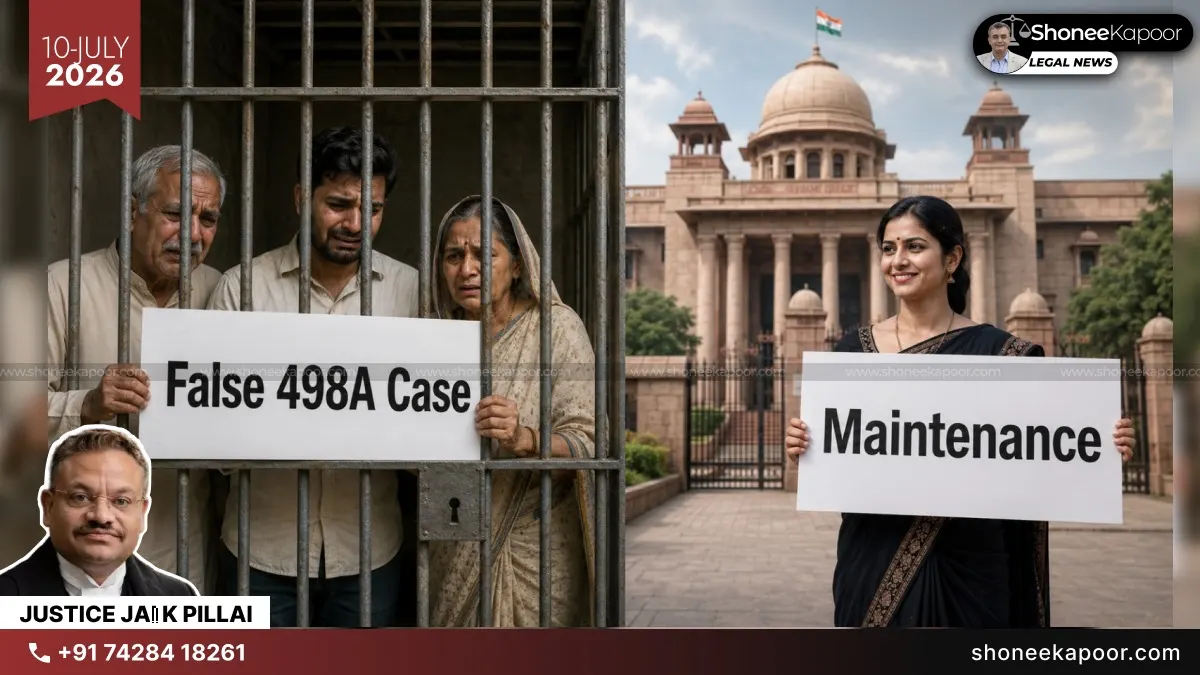
Can a wife live separately and claim maintenance only because her husband gives attention to his parents and family? The Madhya Pradesh High Court said such a reason is not enough, especially when the wife failed to prove cruelty and the husband had already faced and cleared serious allegations.
JABALPUR: The Madhya Pradesh High Court has held that a wife cannot live separately and claim maintenance merely because her husband gives attention, care, or time to his parents and other family members. The Court said that such conduct of the husband cannot become a legally valid reason for separate residence under Section 125 CrPC.
The case was heard by Justice Jai Kumar Pillai. The Court found that the Family Court had committed a “patent error” by treating the husband’s attention towards his family members and lack of harmony between the wife and her in-laws as sufficient ground for the wife to live separately and claim maintenance.
The Court observed:
“In the realm of matrimonial jurisprudence, a lack of harmony with in-laws or a husband dedicating attention and care to his parents and family members cannot, under any circumstance, be construed as a justifiable or sufficient ground for a wife to abandon the matrimonial home and subsequently claim maintenance”.
The High Court referred to Section 125(4) CrPC and said that a wife is not entitled to maintenance if she refuses to live with her husband without sufficient reason.
The Court explained:
“Sufficient reason may include – complete neglect, deprivation of fundamental rights by the husband, failure to protect the wife from severe cruelty, or subjecting her to continuous physical or mental abuse”.
The Bench further added:
“The expectation that a husband must severe ties with or withdraw attention from his parents to appease his wife is legally recognized as unreasonable”.
The matter came before the High Court through a criminal revision filed by the husband against the Family Court’s order. The Family Court had directed him to pay ₹10,000 per month to the wife and ₹5,000 each to the two minor children under Section 125 CrPC.
As per the case record, disputes arose between the husband and wife, after which the wife went back to her parental home. She then filed a maintenance application. The husband argued that the wife had left the matrimonial home voluntarily and had even failed to inform him about the birth of their child.
The husband also claimed that he had borne the hospital expenses, but after delivery, the wife again returned to her parents’ house without informing him. The record showed that the husband had approached the Women’s Counselling Centre. Later, the wife returned to the matrimonial home only after a condition was accepted that a wall would be built between the houses, effectively creating a separate kitchen.
For some time, the relationship remained peaceful, but disputes again started. The wife also filed a cruelty case under Section 498A IPC against the husband and his family members. However, the husband’s family members were acquitted by the High Court on September 26, 2016, and the husband was acquitted by the trial court on August 10, 2019.
The husband’s counsel argued that the Family Court had granted maintenance to the wife only on presumptions. It was submitted that under Section 125(4) CrPC, a wife who lives separately without sufficient cause is not entitled to maintenance. The husband also argued that the wife was running a beauty parlour and had her own independent income.
It was further argued that the wife failed to bring credible evidence to justify her separate residence, especially when the husband had been acquitted in the Section 498A IPC case. This showed the serious prejudice a man and his family can face when criminal allegations are made but later fail in court.
On the other hand, the wife alleged that soon after marriage, the husband and his family members started quarrelling with her over small issues and mentally and physically tortured her. She also claimed that during her second pregnancy, the husband and his family demanded ₹3 lakh and later threw her out of the house along with her child, forcing her to lodge the FIR.
The High Court noted that under Section 19(4) of the Family Courts Act, revisional jurisdiction is limited. Normally, the High Court does not reappreciate or re-evaluate evidence unless gross miscarriage of justice is shown.
The Court also observed that “subjective satisfaction of the trial court based on evidence cannot be lightly interfered with”.
However, the Court found that this case required interference because the wife had failed to establish any legally valid reason to live separately from the husband. The Court also noted that the wife had made “deeply scandalous allegations of an illicit relationship” between the husband and his sister-in-law.
The High Court said that such allegations against the husband’s character are recognised as the “most severe form of mental cruelty“. This aspect was important because the Court found that the wife was not merely living separately, but had also made serious allegations which were not proved.
The Court held that the wife had failed to prove any justifiable reason for staying away from the husband. Therefore, her case fell within the disqualification under Section 125(4) CrPC.
Accordingly, the High Court partly allowed the husband’s revision. The maintenance granted to the wife was quashed. However, the Court enhanced the maintenance granted to the minor children, making it clear that while the wife may lose her right due to unjustified separate residence, the children’s right to maintenance remains protected.
EXPLANATORY TABLE: LAWS AND SECTIONS MENTIONED IN THIS CASE
| LAW / SECTION | WHAT IT MEANS | HOW IT WAS USED IN THIS CASE |
| Section 125 CrPC | Provides maintenance to wife, children and parents when they cannot maintain themselves. | Wife and two children filed maintenance application before Family Court. Family Court granted ₹10,000 to wife and ₹5,000 each to two children. |
| Section 125(4) CrPC | A wife is not entitled to maintenance if she lives in adultery, refuses to live with husband without sufficient reason, or both are living separately by mutual consent. | The High Court applied this section and held that the wife had no sufficient reason to live separately, so her maintenance was set aside. |
| Section 19(4), Family Courts Act, 1984 | Gives revisional power to High Court against certain Family Court orders. | Husband filed criminal revision under this provision challenging the Family Court’s maintenance order. |
| Code of Criminal Procedure, 1973 | Criminal procedural law governing maintenance proceedings under Section 125 CrPC. | The revision was filed under Section 19(4) Family Courts Act read with relevant CrPC provisions. |
| Section 498-A IPC | Deals with cruelty by husband or his relatives against wife. | Wife had filed 498A case against husband and his family. Family members were discharged/acquitted by High Court, and husband was acquitted by trial court. |
| Section 34 IPC | Common intention; used when several persons allegedly act together. | Wife’s 498A case was registered against husband and family members under Section 498A read with Section 34 IPC. |
| Section 13(1)(i-a), Hindu Marriage Act | Divorce on the ground of cruelty. | Mentioned through Supreme Court judgment on mental cruelty and character assassination in matrimonial disputes. |
CASE DETAILS
| DETAIL | INFORMATION |
| Case Title | Lokesh Versus Smt. Annapurna And Others |
| Court | High Court of Madhya Pradesh, Bench at Indore |
| Case Number | Criminal Revision No. 1229 of 2022 |
| Neutral Citation | 2026:MPHC-IND:18129 |
| Bench | Hon’ble Shri Justice Jai Kumar Pillai |
| Petitioner / Revisionist | Lokesh, husband |
| Respondents / Non-Applicants | Smt. Annapurna and others |
| Counsel for Petitioner | Shri Nilesh Dave, Advocate |
| Counsel for Respondents | Shri Neelesh Agrawal, Advocate |
| Reserved On | 02/07/2026 |
| Posted / Pronounced On | 08/07/2026 |
| Impugned Order | Final order dated 08/03/2022 passed by Principal Judge, Family Court, Ratlam in MJCR No. 48/2016 |
| Family Court Order | ₹10,000 per month to wife and ₹5,000 each to two children, total ₹20,000 per month |
| High Court Final Order | Wife’s maintenance set aside; children’s maintenance enhanced to ₹7,500 each per month |
| Final Result | Husband’s criminal revision partly allowed |
IMPORTANT CASE LAW MENTIONED
| CASE LAW | LEGAL POINT USED |
| Narendra v. K. Meena, (2016) 9 SCC 455 | Wife insisting that husband separate from parents is generally unreasonable; son maintaining parents is normal in Indian culture. |
| Pankaj Mahajan v. Dimple, (2011) 12 SCC 1 | Repeated threats to commit suicide amount to cruelty. |
| Vijaykumar Ramchandra Bhate v. Neela Vijaykumar Bhate, (2003) 6 SCC 334 | Character assassination and allegations of extra-marital relationship can amount to grave mental cruelty. |
| Rina Kumari v. Dinesh Kumar Mahto, (2025) 3 SCC 33 | Explained when Section 125(4) CrPC disqualification applies if wife refuses to live with husband without sufficient reason. |
| Rohtash Singh v. Ramendri, (2000) 3 SCC 180 | Discussed maintenance rights after divorce and effect of desertion during subsistence of marriage. |
KEY TAKEAWAYS
- A husband loving, supporting, or caring for his parents is not cruelty. Marriage does not mean a man must abandon the people who raised him.
- Section 125 CrPC cannot become a reward for a wife who lives separately without a legally valid reason.
- The husband and his family first faced a 498A case, got acquitted, and still had to fight maintenance. This is the silent punishment men face even after acquittal.
- The Court clearly applied Section 125(4) CrPC and held that unjustified refusal to live with the husband can disqualify the wife from maintenance.
- Wife’s maintenance was set aside, but children’s maintenance was enhanced. This shows the Court separated the wife’s conduct from the children’s rights.
This Could Change Your Case-Get FREE Legal Advice-Click Here!
Disclaimer: The views and opinions expressed in this article are those of the Indian courts and do not necessarily reflect the official policy or position of “ShoneeKapoor.com” or its affiliates. This article is intended for informational and educational purposes only. The content provided is not legal advice, and viewers should not act upon this information without seeking professional counsel. Viewer discretion is advised.
