
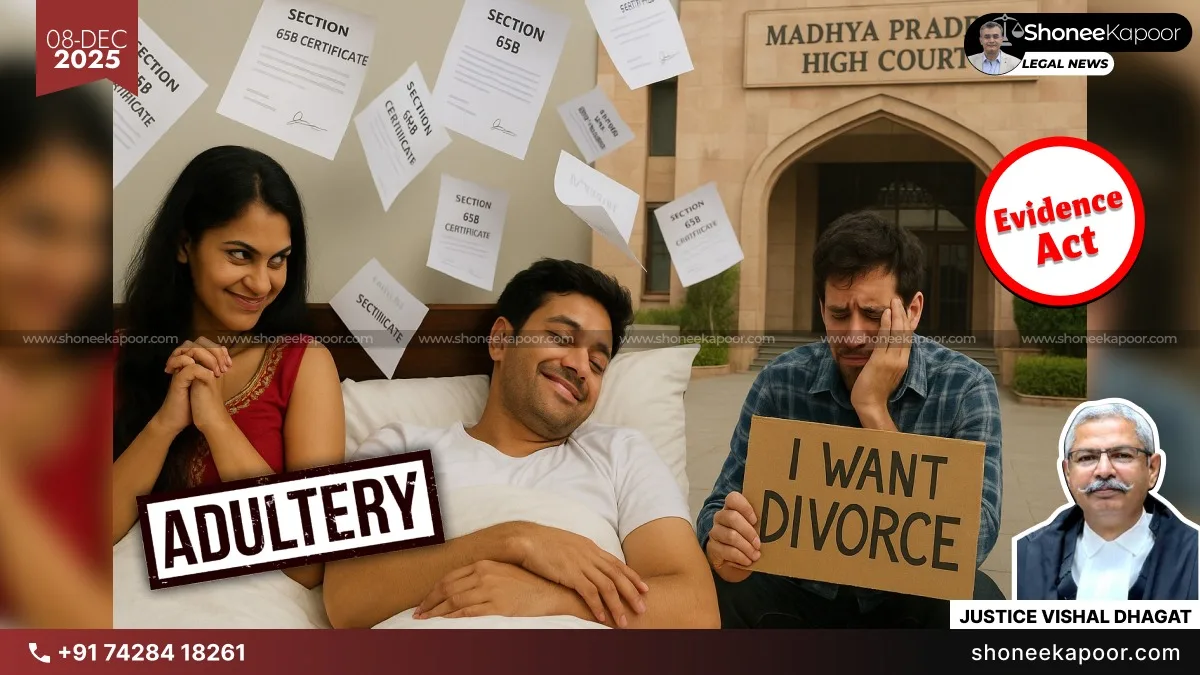
The Madhya Pradesh High Court confirmed a divorce decree based on photographs showing the wife’s adultery, ruling that a Section 65B certificate is not compulsory in matrimonial disputes. The Court held that Family Courts can accept any evidence that helps discover the truth, even if it does not meet strict Evidence Act standards.
JABALPUR: The Madhya Pradesh High Court upheld a divorce granted to a husband after the Family Court accepted photographs showing the wife’s alleged adultery, even though the husband had not produced a Section 65B certificate under the Indian Evidence Act. The Court made it clear that strict rules of evidence do not apply in matrimonial cases.
The appeal was filed by the wife against the decision of the Family Court, Balaghat, which had dissolved her marriage with the husband on 17.11.2021. She argued that the photographs used to prove adultery were secondary electronic evidence and should not have been considered without a mandatory 65B certificate.
Her lawyer relied heavily on the Supreme Court judgment Arjun Panditrao Khotkar v. Kailash Kushanrao Gorantyal (2020), which says Section 65B compliance is compulsory for electronic records. However, the High Court clarified that this ruling did not apply to matrimonial disputes, where the court has wider discretion under the Family Courts Act.
While discussing this, the High Court quoted Section 14 of the Family Courts Act, stating:
“As per Section 14 of Family Courts Act, a Family Court may receive as evidence any report, statement, documents, information or matter that may, in its opinion, assist it to deal effectually with a dispute, whether or not the same would be otherwise relevant or admissible under the Indian Evidence Act, 1872.”
“Since, Indian Evidence Act is not strictly applicable in matrimonial cases and further Court had been given authority to receive any report, statement, documents in evidence to find out the truth. Thus, this Court do not find any error in the judgment passed by Family Court by placing reliance on the said photographs.”
The Court rejected the wife’s argument that Section 14 cannot apply because the case was not a ‘matrimonial dispute’. The judges emphasised that Family Courts are meant to discover the truth with flexibility, not get trapped in technicalities.
Wife’s Defence Rejected — Her Statements Raised More Suspicion
The wife did not clearly deny that she was present in the photographs. Instead, she merely claimed that the pictures were “created using some trick”, without giving any explanation about who created them or how they were made.
During her cross-examination, she admitted that the photographs were first in her mobile phone, and later transferred to her husband’s phone. She also admitted that the husband broke her mobile afterwards.
The Court found this behaviour natural and said:
“Breaking of mobile of appellant appears to be natural. Husband had evidence of wife’s adultery on her mobile phone. He transferred said pictures in his mobile phone. No person will like her wife to be in continuation of adultery, therefore, husband (respondent herein) broke mobile phone of wife (appellant herein) in anger and to stop her communication with paramour.”
The photographer who developed the photographs was also examined, strengthening the husband’s case.
High Court Concludes: Divorce Rightly Granted
After reviewing the complete evidence, the High Court observed that there was no merit in the wife’s appeal. Her vague denial, her own admissions, and the supporting testimony collectively proved adultery.
The Court concluded:
“Considering the evidence available on record and admission on part of respondent and also taken into consideration evidence of Shailendra Gurubele (AW-5) who had prepared the photographs, this Court do not find any merits in submissions made by counsel appearing for the appellant.”
“Consequently, this first appeal filed by wife is dismissed.”
Why This Judgment Matters
- Reinforces that Family Courts have wide discretion and are not bound by strict evidence rules.
- Clarifies that Section 65B certificate is not mandatory in matrimonial cases.
- Strengthens the husband’s ability to prove adultery using photographs, videos, chats, and other digital evidence without getting stuck in technical objections.
- Shows courts prefer substance over technical formality when deciding sensitive family matters.
Explanatory Table Of All Laws & Sections Mentioned
| Section 13 – Hindu Marriage Act, 1955 | Provides grounds for divorce, including adultery. | Husband filed for divorce under this section, alleging wife committed adultery. |
| Section 65B – Indian Evidence Act, 1872 | Mandatory certificate required for electronic evidence like photos, videos, mobile data. Ensures authenticity. | Wife argued photographs of adultery were inadmissible because husband did not file a 65B certificate. Court rejected this argument. |
| Indian Evidence Act (General Applicability) | Governs admissibility and proof of evidence in Indian courts. | Court said the Evidence Act is not strictly applicable in matrimonial cases before a Family Court. |
| Section 14 – Family Courts Act, 1984 | Allows Family Courts to accept any evidence — report, document, statement — even if technically inadmissible under the Evidence Act. | High Court relied heavily on this, saying Family Court rightly accepted photographs without 65B certificate. |
| Section 19 – Family Courts Act, 1984 | Deals with appeals from Family Court judgments. | Wife filed her appeal before the High Court under this section. |
| Case Cited by Wife: Arjun Panditrao Khotkar v. Kailash Kushanrao | Landmark Supreme Court case holding 65B certificate mandatory for electronic evidence. | High Court held this judgment does NOT apply to matrimonial disputes because Section 14 gives Family Courts wider discretion. |
Case Details
- Case Title: L P vs. RD First Appeal No. 866 of 2021 High Court of Madhya Pradesh, Jabalpur
- Date of Judgment: 11 November 2025
- Family Court Case Details: RCS-HM No. 68/2020 Principal Judge, Family Court, Balaghat (MP) Divorce decree dated: 17.11.2021
- Ground of Divorce: Adultery (proved through photographs)
- Bench (Judges)
- HON’BLE JUSTICE VISHAL DHAGAT
- HON’BLE JUSTICE B. P. SHARMA
- Counsels
- For the Appellant (Wife): Shri Eshaan Datt
- For the Respondent (Husband): None present
(Noted in the order)
Important Factual Findings
- Wife admitted photographs were originally in her own mobile phone.
- Husband transferred the photos to his device.
- Husband broke her mobile – Court called this “natural conduct” of a man discovering adultery.
- Wife claimed the photos were “trick images” but gave no explanation of who created them or how.
- Photographer who developed the photos was examined.
- High Court held there was no merit in wife’s appeal.
Key Takeaways
- MP High Court confirmed that a 65B certificate is not mandatory for electronic evidence in matrimonial disputes.
- Family Courts can rely on any material that helps them find the truth, even if the Evidence Act would normally reject it.
- The wife failed to deny the photographs convincingly, and her vague excuses were not accepted.
- The Court noted the husband’s reaction, including breaking the phone, as natural conduct after discovering adultery.
- The judgment shows that men should not lose their cases on technicalities when strong evidence supports their truth.
This Could Change Your Case-Get FREE Legal Advice-Click Here!
Disclaimer: The views and opinions expressed in this article are those of the Indian courts and do not necessarily reflect the official policy or position of “ShoneeKapoor.com” or its affiliates. This article is intended for informational and educational purposes only. The content provided is not legal advice, and viewers should not act upon this information without seeking professional counsel. Viewer discretion is advised.
