
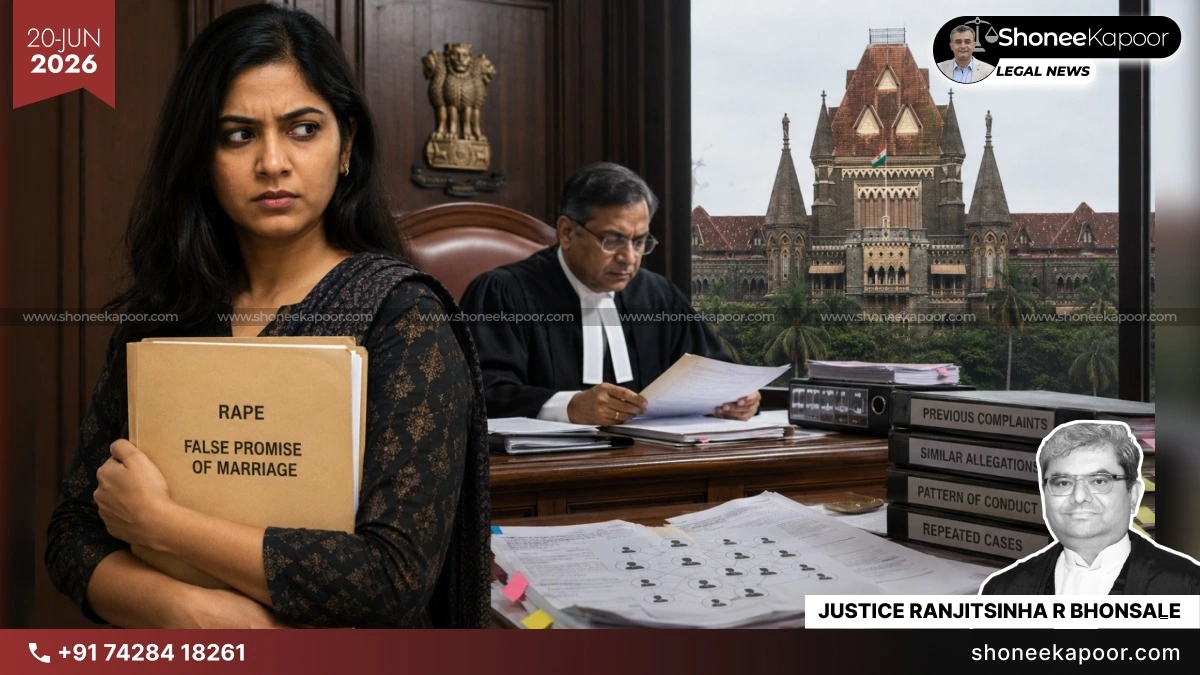
The Bombay High Court called the case a misuse of criminal law and quashed the FIR. The Court also ordered that police stations be informed about her complaint history.
MUMBAI: The Bombay High Court, through Justice Ranjitsinha Raja Bhonsale, has quashed a rape FIR filed against a man, after holding that the case was not fit to continue under Section 376 IPC.
The FIR was registered at Sahar Police Station, Mumbai. The complainant had booked a Malaysia-Singapore tour with a Tours and Travels Agency, where the petitioner was working as the tour manager. She alleged that during the tour, he promised marriage and had physical relations with her.
After returning to Mumbai, she claimed that the petitioner refused to marry her and then filed the FIR alleging rape on false promise of marriage. The petitioner denied the allegations and argued that the complainant had threatened him when he did not agree to marry her.
The Court examined the complainant’s past conduct and found that she had filed several FIRs against different persons, including bank officials, police officers, businessmen and tour managers. Many of these cases involved allegations under Sections 376, 354, 354A and 498A IPC.
The Court also noted that the complainant had been married at least twice and had filed 498A cases connected with those marriages. Some earlier cases had ended in acquittal or quashing, and in many proceedings she had not appeared after filing the complaints.
The Court made a strong observation on the complainant’s conduct and recorded:
“The complainant is 34 year old working women, who has travelled extensively. She herself is a married women and had relationship with the Petitioner and similarly with other men as alleged in the FIRs. Her conduct of makes her entire case doubtful and improbable. The facts would indicate that, she is in habit of making false and baseless complaints in respect of Section 376, 354 and 354A of the Indian Penal Code,”
The Bombay High Court found that the present FIR could not be seen in isolation. The repeated pattern of similar complaints, previous marriages, absence from proceedings and the facts of this case made the prosecution doubtful.
The Court said that every failed promise of marriage does not become rape. For Section 376 IPC to apply, it must be shown that the accused had no intention to marry from the very beginning and used the promise only to obtain consent for physical relations.
In this case, even according to the complainant, both parties had gone to the Marriage Registrar’s office under the Special Marriage Act, where they were told that the marriage process would take one month. The Court found that this showed some effort towards marriage, and later failure of the relationship could not automatically prove rape.
The Court held that the offence was “not at all made out” against the petitioner and called the case a “malafide and malicious misuse” of criminal law.
The Bombay High Court therefore allowed the petition and quashed the FIR. It also directed the Director General of Police, Maharashtra, to circulate the complainant’s details and past complaints to police stations in Maharashtra.
The Court further directed that if she files any future complaint seeking registration of an FIR, police must act strictly according to law and conduct a preliminary inquiry before registering the crime.
EXPLANATORY TABLE: LAWS AND SECTIONS INVOLVED
| Law / Section | Purpose | Importance In This Case |
| Article 226, Constitution of India | Gives High Court power to issue writs and prevent injustice. | The petitioner used this power to approach the Bombay High Court for quashing the FIR. |
| Section 482, CrPC | Inherent power of High Court to prevent abuse of process and secure justice. | The Court used this power to quash the criminal proceedings after finding misuse of law. |
| Section 376, IPC | Rape. | This was the main offence alleged against the petitioner in the 2019 FIR. The Court held that the offence was not made out. |
| Section 376(2)(n), IPC | Repeated rape on the same woman. | Discussed through Supreme Court precedent while explaining false promise of marriage cases. |
| Section 354, IPC | Assault or criminal force to outrage modesty of a woman. | Important because the Court noted similar past complaints under this provision while examining the complainant’s conduct. |
| Section 354A, IPC | Sexual harassment. | Important because the Court found a pattern of complaints under Sections 376, 354 and 354A IPC. |
| Section 498A, IPC | Cruelty by husband or his relatives. | Important because the complainant had filed 498A cases in relation to her earlier marriages, showing her marital background. |
| Section 506, IPC | Criminal intimidation. | Important because the petitioner claimed he had filed an NC after the complainant allegedly threatened him when he refused to marry. |
| Section 90, IPC | Consent given under misconception of fact may not be valid consent. | Relevant because in false promise of marriage cases, the Court examines whether consent was obtained by deception from the beginning. |
| Section 4(i), Special Marriage Act, 1954 | Marriage cannot be performed if either party has a living spouse. | Relevant through the Supreme Court precedent discussed by the Court on marriage eligibility and false promise of marriage. |
| Section 5(i), Hindu Marriage Act, 1955 | A Hindu marriage is valid only if neither party has a living spouse. | Relevant because the complainant’s earlier marriage status was considered important in assessing the false promise allegation. |
CASE DETAILS
- Case Title: Manoj Balasaheb Dhanavade v. State of Maharashtra & Anr.
- Court: High Court of Judicature at Bombay
- Jurisdiction: Criminal Appellate Jurisdiction
- Case Number: Criminal Writ Petition No. 2248 of 2023
- Bench: Justice Ranjitsinha Raja Bhonsale
- Date of Decision: 20 February 2026
- Counsels:
- For Petitioner: Mr. Arjun Kadam, Advocate
- For State: Mr. S. V. Walve, APP
KEY TAKEAWAYS
- A failed relationship cannot automatically be converted into a rape case when the facts do not show dishonest intention from the beginning.
- The Court looked beyond emotional allegations and examined the complainant’s repeated pattern of FIRs against different men.
- Previous marriages, past 498A cases, similar Section 376/354 complaints and absence from proceedings became crucial in testing credibility.
- The Court clearly treated this as misuse of criminal law and held that the offence under Section 376 IPC was not made out.
- This judgment is a reminder that men also need protection from malicious cases, because one false FIR can destroy reputation, liberty and life.
This Could Change Your Case-Get FREE Legal Advice-Click Here!
Disclaimer: The views and opinions expressed in this article are those of the Indian courts and do not necessarily reflect the official policy or position of “ShoneeKapoor.com” or its affiliates. This article is intended for informational and educational purposes only. The content provided is not legal advice, and viewers should not act upon this information without seeking professional counsel. Viewer discretion is advised.
