
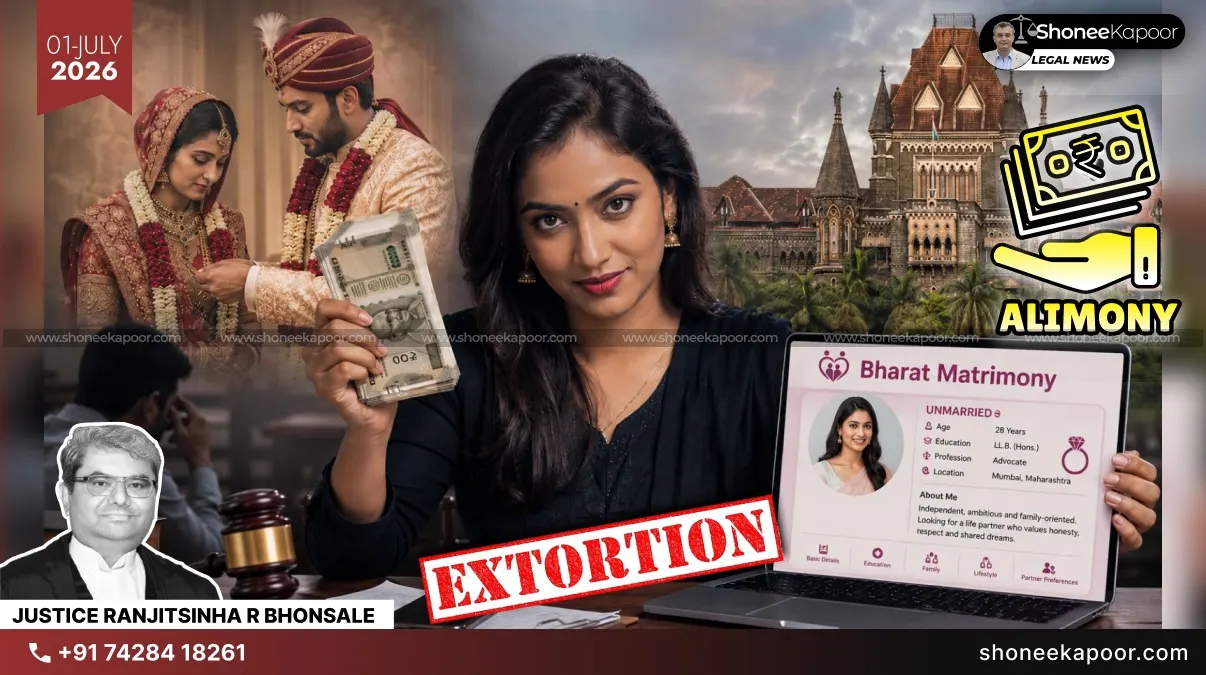
Can a woman demand alimony from a second husband when her first marriage is still subsisting? Bombay High Court said Rs. 25 lakh demand from a second husband, while the first marriage was still valid, cannot simply be called alimony but blackmail and extortion.
MUMBAI: The Bombay High Court, through Justice Ranjitsinha Raja Bhonsale, refused to quash criminal proceedings against the wife in a matrimonial dispute from Pune, but partly allowed a criminal writ petition.
The FIR was registered at Dattawadi Police Station for offences under Sections 384, 417, 494, 495, 504, 506 read with Section 34 IPC.
The case started after the complainant, who was the mother of the second husband, alleged that the woman had married her son after meeting him through Bharat Matrimony, while her first marriage was still subsisting. The complainant said the woman had hidden her earlier marriage, declared herself unmarried, and later demanded money from the second husband.
According to the record, the woman’s first marriage had taken place in 2004. She separated from her first husband in 2007 and had also filed a 498A case and maintenance proceedings against him. In 2009, she was granted maintenance of Rs. 700 per month from the first husband. Later, in 2015, she married the second husband while the first marriage had not been legally dissolved.
The Court noted that in January 2015, she had declared herself as a spinster on Bharat Matrimony. On 26 September 2015, she married the second husband. On 30 September 2015, in the marriage registration application, she again declared her marital status as “unmarried”.
The complainant further alleged that the woman demanded Rs. 25 lakh from the second husband at his workplace in Australia. It was also alleged that she threatened to ruin his life, get his visa cancelled and file cases against him and his family.
The woman argued that her first marriage had taken place when she was a minor and that she believed no divorce decree was required. She also argued that a demand for alimony cannot be treated as extortion. Her side claimed that the FIR was a counterblast to the 498A case filed by her.
The High Court, however, found that the material on record showed a prima facie case against her. The Court observed that she had admitted her first marriage and had also contracted the second marriage while the first marriage was still valid and subsisting.
Rejecting the argument that the Rs. 25 lakh demand was only alimony, the Court said that the argument was “preposterous, totally untenable and surprising.” The Court further held that her conduct and that of other co-accused prima facie appeared to be “nothing short of blackmail and extortion” and “clear act of arm twisting and pressure tactics.”
The Court also noted that after the dispute, the woman had filed several proceedings, including cases under 498A IPC, the Domestic Violence Act, provisions relating to rape and other offences, and the SC/ST Act. The Court observed that:
“She had misused and abused a welfare legislation and used the same as a weapon and means to extract monies.”
The Court further said that the prosecutions initiated by her appeared motivated and mala fide. It observed that:
“Her conduct smacks of malafides, personal vendetta and is driven by the motive of wrongful gains.”
However, the Court gave relief to her mother and brother. It found that the allegations against them were general and vague. The Court said that relatives are often dragged into criminal cases on the basis of broad allegations.
Finally, the Bombay High Court quashed the FIR and chargesheet only against the mother and brother. But it refused to quash the case against the wife, holding that the prosecution against her and other co-accused shall continue.
EXPLANATORY TABLE: LAWS AND SECTIONS INVOLVED
| Law / Section | Purpose | Relevance In This Case |
| Article 226, Constitution of India | Gives High Court power to pass writ orders for justice. | Used by petitioners to seek quashing of FIR and chargesheet. |
| Section 482, CrPC | High Court’s inherent power to stop abuse of legal process. | Main provision used for asking the Court to quash criminal proceedings. |
| Section 384, IPC | Punishment for extortion by putting someone in fear. | Allegation was that Rs. 25 lakh was demanded from the second husband through threats. |
| Section 383, IPC | Defines what amounts to extortion. | Used to examine whether threat plus money demand made out extortion. |
| Section 417, IPC | Punishment for cheating. | Allegation was that facts were misrepresented before marriage. |
| Section 420, IPC | Cheating with dishonest intention to obtain benefit/property. | Mentioned in separate complaint regarding alleged false representation and documents. |
| Section 494, IPC | Bigamy; marrying again while first marriage is still valid. | Core allegation was that the woman married second time while first marriage was subsisting. |
| Section 495, IPC | Bigamy after hiding earlier marriage. | Allegation was that previous marriage was concealed from second husband and his family. |
| Section 504, IPC | Intentional insult to provoke breach of peace. | Included in criminal allegations between the parties. |
| Section 506, IPC | Criminal intimidation or threats. | Allegations included threats to ruin life, cancel visa and file cases. |
| Section 506(1), IPC | Criminal intimidation in a lesser form. | Mentioned in a later FIR filed against the second husband’s friend. |
| Section 509, IPC | Words or acts intended to insult modesty of a woman. | Mentioned in later proceedings against the second husband’s friend. |
| Section 34, IPC | Common intention by multiple persons. | Added to allege joint role of more than one accused. |
| Section 498A, IPC | Cruelty by husband or his relatives against wife. | Wife had filed 498A cases against first husband’s side and second husband’s side. |
| Section 376, IPC | Rape. | Mentioned in one later case filed by the wife. |
| Section 328, IPC | Causing hurt through poison, intoxicant or stupefying substance. | Mentioned in later proceedings filed by the wife. |
| Section 363, IPC | Kidnapping. | Mentioned in later FIR filed by the wife. |
| Sections 467 & 471, IPC | Forgery of important documents and using forged documents as genuine. | Mentioned in separate complaint relating to alleged fake documents. |
| Section 125, CrPC | Maintenance for wife, children or parents. | Wife had obtained Rs. 700 per month maintenance from her first husband. |
| Section 198, CrPC | Procedure for complaints in marriage-related offences. | Discussed through Supreme Court precedent on bigamy and concealment of marriage. |
| Section 11, Hindu Marriage Act | Declares certain marriages void. | Second marriage was declared null and void because first marriage was still existing. |
| Section 5(i), Hindu Marriage Act | A valid Hindu marriage requires that neither party has a living spouse. | Important because the woman allegedly had a living first husband when she remarried. |
| Section 13(1)(ia), Hindu Marriage Act | Divorce on ground of cruelty. | First husband had filed divorce proceedings using this ground. |
| Section 13(1)(ib), Hindu Marriage Act | Divorce on ground of desertion. | Also used in the first husband’s divorce case. |
| Protection of Women from Domestic Violence Act | Law for civil protection of women from domestic violence. | Wife filed DV proceedings against second husband and his family; the case was dismissed. |
CASE DETAILS
- Case Title: Mrs. Swati Raosaheb More & Ors. v. The State of Maharashtra & Anr.
- Court: High Court of Judicature at Bombay.
- Case Number: Criminal Writ Petition No. 2578 of 2018.
- Bench: Justice Ranjitsinha Raja Bhonsale.
- Date Of Judgment:10 June 2026.
- Counsels:
- For Petitioners: Ms. Radhika Samant with Pooja Bhide.
- For Respondent No. 1-State: Ms. S.S. Kaushik, APP.
- For Respondent No. 2: Mr. Himanshu Nagarkar with Kajal S.
KEY TAKEAWAYS
- Welfare laws are meant for justice, not for revenge, pressure tactics or money extraction.
- Courts must look seriously at cases where marriage, concealment and criminal cases are used as tools of pressure.
- No one should be allowed to misuse legal protection after hiding material facts from the other side.
- When law is used for blackmail and extortion, the real victims are men and their families.
- Men also deserve protection from motivated cases, because misuse of law can destroy lives before truth comes out.
This Could Change Your Case-Get FREE Legal Advice-Click Here!
Disclaimer: The views and opinions expressed in this article are those of the Indian courts and do not necessarily reflect the official policy or position of “ShoneeKapoor.com” or its affiliates. This article is intended for informational and educational purposes only. The content provided is not legal advice, and viewers should not act upon this information without seeking professional counsel. Viewer discretion is advised.
