
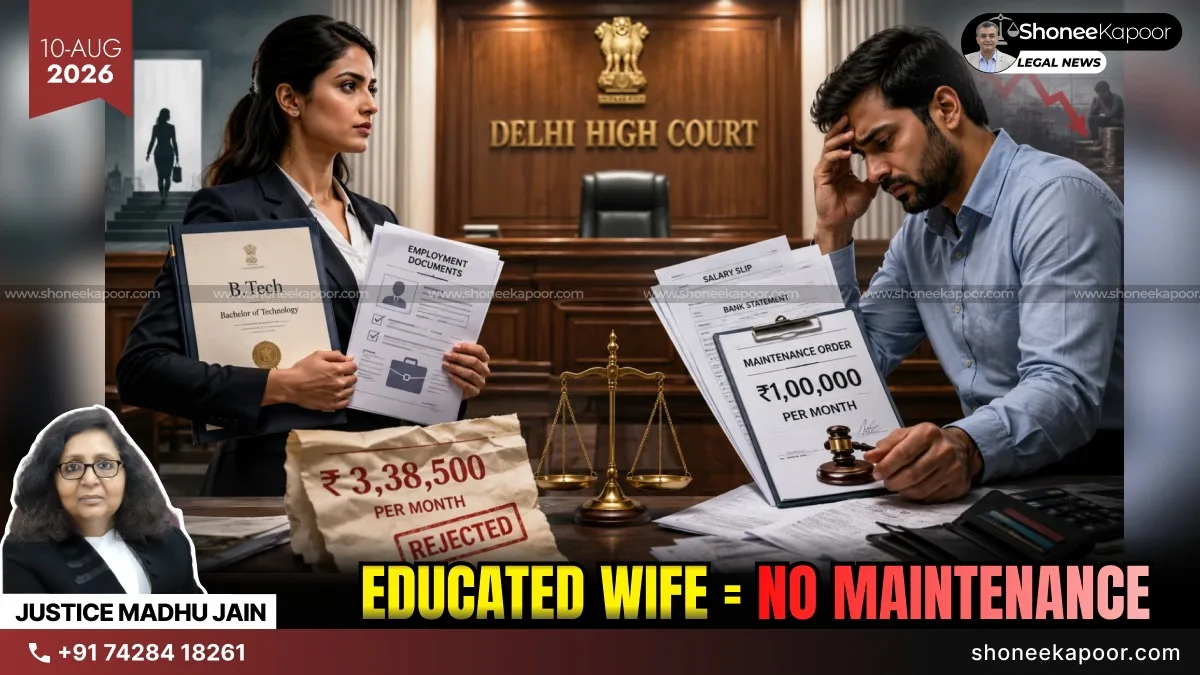
Can a professionally qualified wife keep receiving maintenance if she fails to find a job despite being told to seek employment? The Delhi High Court has now drawn an important line between earning capacity and actual income.
NEW DELHI: The Delhi High Court was dealing with two cross-revision petitions arising from an interim maintenance dispute between husband Dhirendra Kumar and wife Swati Saista under the Protection of Women from Domestic Violence Act, 2005.
The wife had challenged the appellate court’s direction requiring her to seek suitable employment within one year, place her genuine job-seeking efforts on record and have the question of maintenance reconsidered thereafter. She argued that merely being qualified or capable of earning could not be treated as proof that she was actually employed or earning an independent income.
The High Court held that while interim maintenance is provisional, courts are entitled to consider factors such as the claimant spouse’s age, educational qualifications, previous employment, health, family responsibilities and present employability. A professionally qualified spouse may therefore be expected to make genuine efforts towards becoming financially independent.
The Court observed:
“A professionally qualified spouse may, therefore, be required to make bona fide efforts towards securing suitable employment. Such a direction is neither beyond the jurisdiction nor outside the discretion of the Court. However, the capacity to earn cannot be equated with actual earnings.”
The Court also relied upon the Supreme Court decision in Shailja and Another v. Khobbanna, which distinguished between a spouse being capable of earning and actually earning.
Accordingly, the High Court upheld the direction requiring the wife, who held a B.Tech degree in Telecommunications and had previously worked, to make genuine efforts to obtain suitable employment. However, it clarified that she could not be forced to actually secure a job within a fixed period merely because she was qualified.
The Court held:
“The wife cannot be compelled to secure employment within the stipulated period. Her obligation is confined to making bona fide and reasonable efforts. Any reconsideration of maintenance shall depend upon her actual employment and income, the efforts made by her, her reasonable needs, the financial capacity and liabilities of the husband and the circumstances prevailing at the relevant time. Mere expiry of one year shall not result in automatic cessation of maintenance.”
On the financial aspect, the High Court upheld the original interim maintenance of ₹1 lakh per month from January 11, 2019 to November 7, 2021. The Court found that during this period the husband’s salary account, Form-16 and recurring employer-related credits supported an assessment of his monthly income in the range of approximately ₹4–5 lakh. The minor son was residing with and being maintained by the husband.
The wife had sought enhancement of maintenance from ₹1 lakh to ₹3.38 lakh per month, relying upon the husband’s gross income figures. The High Court rejected the enhancement plea, holding that gross annual income could not simply be treated as monthly disposable income without considering taxes, deductions, variable allowances, the husband’s reasonable needs and his responsibility towards the minor son.
The husband, meanwhile, had specifically pleaded that his regular salary had stopped and his services with Air India were eventually terminated. Subsequent proceedings under Section 25(2) of the DV Act confirmed that no regular salary had been credited after December 2020 and that no regular alternative source of income had been established. His notional income was assessed at ₹60,000 per month.
Considering this material, his responsibility towards the minor son and his existing liabilities, the High Court modified the maintenance payable for the period from November 8, 2021 to May 19, 2022 from ₹1 lakh to ₹15,000 per month.
From May 20, 2022 onwards, the parties would continue to be governed by the separate order passed under Section 25(2) of the DV Act, under which maintenance of ₹15,000 per month had already been awarded.
The husband’s revision was therefore partly allowed, while the wife’s revision seeking enhancement was dismissed. The Court also upheld the direction requiring her to make bona fide efforts towards employment, while making it clear that failure to actually secure a job would not, by itself, automatically end her maintenance.
EXPLANATORY TABLE OF LAWS AND SECTIONS
| Law / Section | What It Means | Application In This Case |
| Protection of Women from Domestic Violence Act, 2005 | Provides civil and monetary remedies to an aggrieved woman in a domestic relationship. | The dispute concerned interim maintenance awarded under the DV Act. |
| Section 25(2), DV Act | Permits alteration, modification or revocation of an order when circumstances change. | A separate order under this provision fixed interim maintenance at ₹15,000 per month from May 20, 2022 onwards. |
| Shailja & Anr. v. Khobbanna (2017) | Supreme Court distinguished between merely being capable of earning and actually earning. | Delhi High Court relied on this principle while considering the wife’s qualifications and employment prospects. |
| Interim Maintenance | Temporary financial support during pendency of matrimonial/domestic violence proceedings. | The Court examined whether maintenance could be linked to the wife’s efforts to obtain employment. |
| Revisional Jurisdiction | Enables a superior court to examine the legality or correctness of certain subordinate court orders. | Both husband and wife approached the High Court through cross-revision petitions concerning the maintenance orders. |
CASE DETAILS
| Case Particular | Details |
| Case Title | Dhirendra Kumar v. Swati Saista and connected Swati Saista v. Dhirendra Kumar |
| Court | High Court of Delhi at New Delhi |
| Case Numbers | CRL.REV.P. 363/2021 & CRL.REV.P. 43/2022 |
| Neutral Citation | 2026:DHC:6090 |
| Bench | Hon’ble Ms Justice Madhu Jain |
| Reserved On | 21 July 2026 |
| Pronounced On | 30 July 2026 |
| Husband’s Counsel | Mr. Ajit Kumar and Mr. Shivam Singh, Advocates |
| Wife / Amicus Curiae | Ms. Isha Khanna, Amicus Curiae, with Ms. Ruchika Malik and Mr. Shivam Parashar, Advocates |
| Original Proceedings | CC No. 1582/2019, MM, Mahila Court-02, South-West District, Dwarka Courts, New Delhi |
KEY TAKEAWAYS
- Qualified Wife Cannot Keep Husband As A Permanent Source Of Maintenance– If she is professionally qualified, the Court can require her to make genuine efforts to find suitable employment.
- A Degree Is Not Income, But It Cannot Be Ignored Either – The Delhi High Court made it clear that earning capacity is not the same as actual earnings, yet employability remains a relevant factor in maintenance.
- Maintenance Cannot Become An Automatic Monthly Extraction From The Husband – Courts must examine actual income, genuine job efforts, needs, liabilities and changed circumstances before continuing or modifying maintenance.
- When Husband’s Salary Collapsed, His Liability Had To Be Reconsidered – After his regular salary stopped, maintenance for the relevant period was reduced from ₹1 lakh to ₹15,000 per month.
- Maintenance Law Cannot Be A One-Way Financial Burden On Men – A qualified wife should seek self-reliance, while the husband’s income, child responsibility and liabilities must also be considered.
This Could Change Your Case-Get FREE Legal Advice-Click Here!
Disclaimer: The views and opinions expressed in this article are those of the Indian courts and do not necessarily reflect the official policy or position of “ShoneeKapoor.com” or its affiliates. This article is intended for informational and educational purposes only. The content provided is not legal advice, and viewers should not act upon this information without seeking professional counsel. Viewer discretion is advised.
