
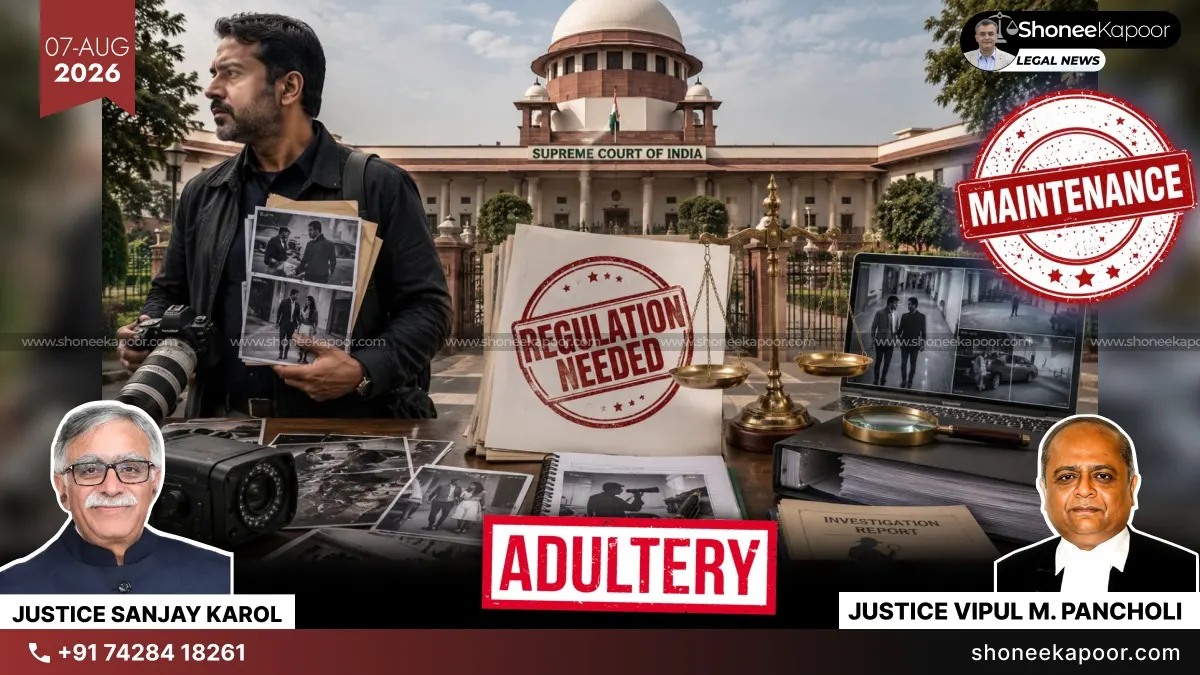
Can a husband be forced to continue paying maintenance when photographs and electronic records prima facie show that his wife is living in adultery? The Supreme Court has clarified when such evidence must be examined and why private detectives now need legal regulation.
NEW DELHI: The Supreme Court of India has ruled that a wife may be denied even interim maintenance under Section 125 CrPC if the husband produces clear and convincing material that, on its face, establishes that she is living in adultery.
A Division Bench of Justice Sanjay Karol and Justice Vipul M. Pancholi set aside a Rajasthan High Court judgment which had postponed the husband’s adultery objection until the final disposal of the maintenance proceedings.
The case arose from a matrimonial dispute between Himanshu Chordia and Arushi Jain, who married on July 7, 2014. After their relationship deteriorated, the wife left the matrimonial home with their child in May 2020 and filed proceedings seeking maintenance under Section 125 CrPC.
The husband filed an application under Section 125(4) CrPC, alleging that his wife was living in adulterous relationships and was therefore legally disqualified from receiving maintenance. He relied upon photographs, videos and other electronic material in support of his allegation.
The Trial Court refused to decide the adultery objection at that stage, observing:
“During the arguments, the Ld. Counsel for the petitioner said that the petitioner was at a different place on the date and time as mentioned in the petitioner’s documents. The petitioner has also presented some documents in support of her claim showing her presence at a different place than the documents. The respondent’s allegations regarding the petitioner’s adultery with Deepak Mundra are mainly based on photographs and CD. However, the court cannot conclude on the authenticity and originality of these documents at this stage.”
The Trial Court held that the authenticity of the photographs and electronic records could be examined only after evidence was formally proved in the main maintenance case. It subsequently awarded ₹25,000 per month each to the wife and the minor son as interim maintenance.
The Rajasthan High Court also declined to interfere. It held that the allegation of adultery involved disputed questions of fact and could be examined at the time of final adjudication under Section 125 CrPC.
The Supreme Court disagreed with this approach. It explained that merely filing an application under Section 125(4) does not automatically stop interim maintenance. However, the statutory exception cannot be kept undecided until the entire maintenance case concludes.
The Court observed:
“Put clearly, it has to be observed that an application for maintenance is stage one of the proceedings wherein by virtue of the second proviso, the court may, circumstances permitting, award interim maintenance.”
It clarified that the husband must produce clear and cogent evidence capable of establishing adultery at first sight if he wants maintenance to be denied immediately.
“To reiterate, if the application for maintenance is to be denied at the interim stage itself, the party having filed the application under Section 125(4) must present clear and cogent evidence that would ex-facie establish adultery on part of the claimant for maintenance.”
The Court distinguished between evidence which immediately demonstrates an adulterous relationship and evidence which requires detailed proof, forensic verification or examination of witnesses.
Where adultery is apparent from admitted or prima facie reliable material, interim maintenance may be stopped. Where the photographs, videos or electronic records are disputed and require formal proof, maintenance may continue while the court examines their authenticity.
The Bench held:
“Since the stipulation in the Section 125 (4) is that if adultery is proved, the wife would neither be entitled to interim nor final maintenance, we are of the view that if a husband files an application under Section 125(4) and is, at the first instance, able to establish the charge through evidence ex facie, then only, there can be said to be a bar to interim maintenance.”
The Court found that both the Trial Court and the High Court had committed an error by holding that the husband’s objection could be considered only during the final adjudication.
“The courts below clearly fell into error to hold that it was only at the stage of final adjudication that such a question could be decided. This view would render otiose what has been provided in the statute.”
The Supreme Court therefore remanded the matter to the Trial Court and directed it to decide the husband’s Section 125(4) application on its own merits.
The judgment is important because an unexamined allegation of adultery can leave a husband paying maintenance for years, even where he has produced substantial material questioning the claimant’s legal entitlement. The Court has now made it clear that a statutory defence cannot be postponed mechanically while the financial liability continues indefinitely.
At the same time, the Supreme Court expressed concern over the manner in which evidence is collected by private detectives in matrimonial disputes. The record reportedly contained approximately 92 videos and 237 photographs, leading the Court to question who had taken them, whether the person was authorised, how the material was stored and whether it could have been altered through modern technology.
The Bench noted that India presently has no complete statutory framework governing private detective agencies. It highlighted the need for rules concerning licensing, investigator accountability, privacy, electronic evidence, data storage and grievance redressal.
The Court referred to the Private Detective Agencies (Regulation) Bill, 2007, which proposed Central and State regulatory boards, licensing requirements, maintenance of records and restrictions on investigations reserved for statutory authorities. However, the Bill was never enacted.
Emphasising the need for accountability, the Court observed:
“While that may be true, we believe that regulation and accountability are equally important in the sphere of private investigation.”
The Court also clarified that evidence collected by private investigators does not automatically become admissible. Electronic photographs and videos must satisfy the rules governing relevance, authenticity and certification, including the requirements applicable to electronic evidence.
A copy of the judgment was directed to be sent to the Secretary, Ministry of Law and Justice, and the Chairman, Law Commission of India, to examine whether a regulatory framework should be introduced for private investigators.
The appeal was allowed, the Rajasthan High Court judgment dated February 4, 2025 was set aside and the husband’s application was restored for fresh consideration.
EXPLANATORY TABLE OF LAWS AND SECTIONS
| Law / Section | What It Means | Application In This Case |
| Section 125(1), CrPC | Permits a wife, child or parent unable to maintain themselves to seek maintenance from a person having sufficient means. | The wife filed the main maintenance case under this provision. |
| Second Proviso to Section 125(1), CrPC | Allows the court to award interim maintenance and litigation expenses while the main case remains pending. | The Trial Court awarded ₹25,000 each to the wife and minor child. |
| Section 125(4), CrPC | Disqualifies a wife from receiving maintenance if she is living in adultery, refuses to live with her husband without sufficient reason or lives separately by mutual consent. | The husband relied on this provision to oppose the wife’s maintenance claim. |
| Section 125(5), CrPC | Allows cancellation of an existing maintenance order if any disqualification under Section 125(4) is later proved. | The Supreme Court distinguished this later cancellation stage from deciding an objection before final maintenance. |
| Section 91, CrPC | Enables a court to summon documents or records necessary for an inquiry, trial or proceeding. | The husband sought bank, call, location, social-media, property and income records. The Trial Court rejected the application. |
| Section 65B, Indian Evidence Act, 1872 | Governs the admissibility and certification of electronic records such as photographs, videos and digital files. | The photographs and videos relied upon by the husband required verification under electronic-evidence rules. |
| Bharatiya Sakshya Adhiniyam, 2023 | Replaces the Indian Evidence Act and contains corresponding provisions governing electronic and digital evidence. | The Court noted that electronic evidence must satisfy the applicable requirements under the new evidence law. |
| Section 354C, IPC | Punishes voyeurism, including capturing or disseminating images of a woman engaged in a private act in specified circumstances. | The Court said regulation must also define lawful limits and protections for private investigators collecting evidence. |
| Private Detective Agencies (Regulation) Bill, 2007 | Proposed licensing, regulatory boards, record-keeping duties and restrictions upon private detective agencies. | The Court referred to the un enacted Bill while recommending examination of a regulatory framework. |
| Article 21, Constitution of India | Protects life, personal liberty, dignity and privacy. | The Court raised concerns over surveillance, personal data and unauthorised collection of photographs and videos. |
CASE DETAILS
| Case Particular | Details |
| Case Title | Himanshu Chordia v. State of Rajasthan & Another |
| Court | Supreme Court of India |
| Jurisdiction | Criminal Appellate Jurisdiction |
| Case Number | Criminal Appeal No. 3599 of 2026 |
| Arising Out Of | Special Leave Petition (Criminal) No. 3171 of 2025 |
| Diary Number | Diary No. 8519 of 2025 |
| Neutral Citation | 2026 INSC 778 |
| Appellant | Himanshu Chordia |
| Respondents | State of Rajasthan and Arushi Jain |
| Bench | Justice Sanjay Karol and Justice Vipul M. Pancholi |
| Judgment Authored By | Justice Sanjay Karol |
| Decision Date | July 31, 2026 |
| Impugned Judgment | Rajasthan High Court judgment dated February 4, 2025 |
COUNSELS APPEARED
| Party | Counsel Details |
| Appellant, Himanshu Chordia | Mr Prabhjit Jauhar, Advocate; Ms Tulika Bhatnagar, Advocate; Mr S.S. Jauhar, Advocate-on-Record |
| Respondent, State of Rajasthan | Mr Shiv Mangal Sharma, Additional Advocate General; Mr Saurabh Rajpal and Ms Shalini Singh, Advocates; Ms Nidhi Jaswal, Advocate-on-Record |
| Respondent-Wife | Ms Preeti Singh, Advocate-on-Record; Mr Sunklan Porwal, Ms Anuradha Anand, Ms Sakshi Trivedi, Ms Anoushka Bajpai and Ms Pooja, Advocates |
KEY TAKEAWAYS
- Private detectives in matrimonial cases need strict legal regulation and accountability.
- Evidence of adultery must be examined before maintenance continues for years.
- Secret surveillance can violate privacy and expose men to manipulated evidence.
- Photos, videos and digital records must satisfy legal standards before use.
- Men cannot be financially burdened while crucial evidence remains undecided.
This Could Change Your Case-Get FREE Legal Advice-Click Here!
Disclaimer: The views and opinions expressed in this article are those of the Indian courts and do not necessarily reflect the official policy or position of “ShoneeKapoor.com” or its affiliates. This article is intended for informational and educational purposes only. The content provided is not legal advice, and viewers should not act upon this information without seeking professional counsel. Viewer discretion is advised.
