
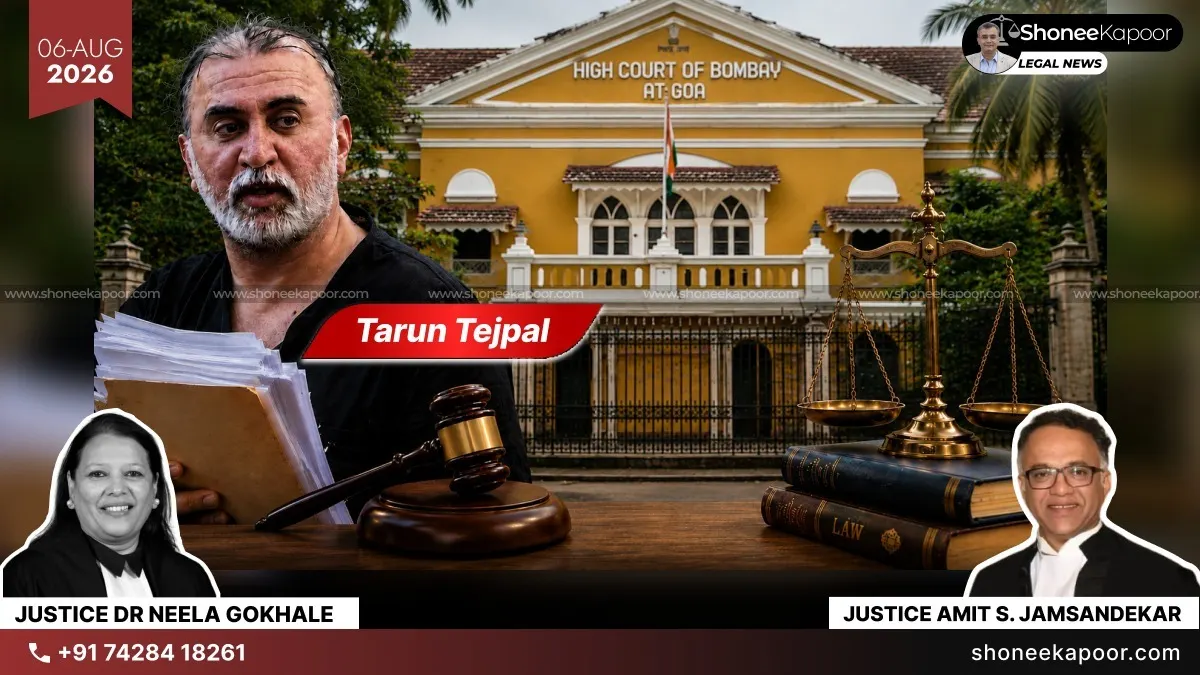
Can any criminal justice system call itself effective when guilt or innocence remains undecided for 13 years? The Bombay High Court reversed Tarun Tejpal’s acquittal, convicted him in the 2013 rape case and sentenced him to 10 years in jail.
PANAJI: Thirteen years. One arrest, nearly six months in custody, a full criminal trial, an acquittal and then a conviction carrying 10 years of imprisonment. The Bombay High Court at Goa sentenced former Tehelka editor Tarun Tejpal to 10 years in jail in the 2013 rape case involving his junior colleague.
A Division Bench of Justice Dr Neela Gokhale and Justice Amit S. Jamsandekar also imposed fines exceeding ₹10 lakh. Tejpal was granted two weeks to surrender before the jail authorities.
While recording the prosecution’s stand on punishment, the Bench noted:
“The court should consider the fact that there was no remorse and the offence was repeated despite a no from the victim,”
The Court also considered the long passage of time and Tejpal’s conduct after the incident.
“The incident took place 13 yrs ago. There is no report of misconduct or allegation. Both parties must have moved on in life,”
The judgment was delivered in an appeal filed by the State of Goa against Tejpal’s acquittal by the trial court. The High Court had earlier set aside that acquittal and convicted him of rape, sexual harassment and other offences under the Indian Penal Code.
Tejpal was sentenced to 10 years’ rigorous imprisonment and fined ₹5 lakh under Section 376(2)(f) IPC. He received another 10-year sentence and a ₹5 lakh fine under Section 376(2)(k) IPC.
The Court also imposed one year’s rigorous imprisonment and a ₹10,000 fine under Section 354 IPC, one year under Section 354A IPC, and three years’ rigorous imprisonment with a ₹10,000 fine under Section 354B IPC.
Fines of ₹500 each were imposed under Sections 341 and 342 IPC. Since all sentences will run concurrently, Tejpal will undergo a total imprisonment of 10 years.
The case began in November 2013, when Tejpal was accused of sexually assaulting a junior colleague inside an elevator at a luxury hotel in Goa. The Goa Police registered an FIR and arrested him later that month. He was released on bail in July 2014.
The trial started in 2017. In May 2021, Additional Sessions Judge Kshama Joshi acquitted Tejpal. The trial court referred to several alleged omissions in the investigation and the prosecution’s failure to produce important evidence, including relevant CCTV footage.
The State of Goa challenged the acquittal before the Bombay High Court. The High Court reassessed the prosecution material, disagreed with the trial court’s conclusions and convicted Tejpal.
Solicitor General Tushar Mehta, representing the State, sought the maximum punishment. He argued that a strong deterrent sentence was required because the case involved a person holding authority over a junior employee.
“Age-wise, Tejpal stood in a parental capacity to the victim, a junior colleague, which ought to be a major consideration in sentencing,”
Mehta argued that the alleged assault was repeated on the following day despite resistance and a clear refusal. He described Tejpal’s conduct as “brazen” and submitted that it showed an absence of remorse.
The prosecution also objected to the manner in which the defence had allegedly portrayed the complainant during the case.
“The court’s views on that would definitely throw light that merely because a woman is understanding, mature and responsible would not mean that the benefit will go to the accused. And the punishment should be commensurate with the relationship which they had,”
Mehta urged the Bench to reinforce that when a woman says “no” to sexual intercourse, it means “no”.
Senior Advocate Aabad Ponda, appearing for Tejpal, sought leniency and requested eight weeks’ protection to approach the Supreme Court of India.
Ponda pointed out that Tejpal had already spent nearly six months in custody following his arrest. He requested that the period be adjusted against the sentence under Section 428 CrPC.
The defence also relied on Tejpal’s age, absence of previous criminal antecedents and the conflicting findings of the trial court and High Court. It argued that the earlier acquittal and the proposed Supreme Court appeal should be considered while granting interim protection.
Tejpal personally addressed the Court and said that he had nothing new to add beyond what had been “put out consistently in the courtrooms” during the previous 13 years.
“Clearly they don’t count for that much. All I can say is I am 62. I believe I am a political victim; I am a father of two daughters. I have a wife. All we can say is we will go up and appeal. My lawyer wants me to request you to be lenient.”
The High Court ultimately imposed the 10-year sentence while allowing Tejpal two weeks to surrender.
EXPLANATORY TABLE OF LAWS AND SECTIONS
| Law / Section | What It Means | Application In This Case |
| Section 376(2)(f), IPC | Punishes rape committed in circumstances involving a person holding trust or authority under the law applicable at the relevant time. | Tejpal received 10 years’ rigorous imprisonment and a ₹5 lakh fine. |
| Section 376(2)(k), IPC | Punished rape by a man exercising control or dominance over a woman. | The Court imposed 10 years’ imprisonment and a ₹5 lakh fine. |
| Section 354, IPC | Punished assault or criminal force intended to outrage a woman’s modesty. | Tejpal received one year’s rigorous imprisonment and a ₹10,000 fine. |
| Section 354A, IPC | Punished sexual harassment, including unwelcome physical advances or demands for sexual favours. | The Court imposed one year’s rigorous imprisonment. |
| Section 354B, IPC | Punished assault or criminal force used against a woman with the intention of disrobing her. | Tejpal received three years’ rigorous imprisonment and a ₹10,000 fine. |
| Section 341, IPC | Punished wrongful restraint. | The Court imposed a ₹500 fine. |
| Section 342, IPC | Punished wrongful confinement. | The Court imposed a ₹500 fine. |
| Section 428, CrPC | Allows earlier custody during investigation or trial to be adjusted against the final prison sentence. | The defence sought adjustment of Tejpal’s nearly six months in custody. |
| Concurrent Sentences | Different sentences run together rather than one after another. | Tejpal will serve a total effective sentence of 10 years. |
| Appeal Against Acquittal | Permits the State to challenge an acquittal before a higher court. | The State of Goa’s appeal resulted in Tejpal’s acquittal being reversed. |
CASE DETAILS
| Case Particular | Details |
| Case Title | The State of Goa v. Tarunjit Tejpal |
| Court | High Court of Bombay at Goa |
| Case Number | Criminal Appeal No. 16 of 2022 |
| Neutral Citation | 2026:BHC-GOA:1562-DB |
| Appellant | The State of Goa, through CID Crime Branch, North Goa, Goa |
| Respondent / Accused | Tarunjit Tejpal, son of Inderjit Tejpal |
| Bench | Justice Dr Neela Gokhale and Justice Amit S. Jamsandekar |
| Judgment Authored By | Justice Dr Neela Gokhale |
| Reserved On | July 30, 2026 |
| Pronounced On | August 6, 2026 |
| Impugned Judgment | Judgment and order dated May 21, 2021, passed by the Additional Sessions Judge at Mapusa |
| Trial Court Case Number | Sessions Case (Ors.) No. 10 of 2014 |
COUNSELS APPEARED
| Party | Counsel Details |
| Appellant, State of Goa | Mr Tushar Mehta, Solicitor General of India; Mr Devidas J. Pangam, Advocate General; Mr S.G. Bhobe and Ms Cyndiana Silva, Public Prosecutors; Mr Pravin Faldessai and Mr Nikhil Vaze, Additional Public Prosecutors; Ms Maria Simone Correia, Mr Shubham Priolkar, Mr Neehal Vernekar, Mr Eshan Jacques and Mr Ajay Borkar, Additional Government Advocates |
| Respondent, Tarunjit Tejpal | Mr Aabad Ponda, Senior Advocate; Mr Subash Jadhav, Mr Raunaq Rao and Ms Tabitha Souto, Advocates |
KEY TAKEAWAYS
- Thirteen years to reach appellate conviction is not timely justice- no criminal case of this seriousness should remain unresolved for more than a decade.
- An acquittal did not bring legal finality-Tejpal was acquitted by the trial court in 2021, but the State’s appeal later resulted in conviction and a 10-year sentence.
- A man’s life remains suspended throughout prolonged prosecution- reputation, career, finances, family life and mental peace cannot be restored merely because a final judgment eventually arrives.
- Men need protection from endless criminal uncertainty, not protection from lawful punishment- the guilty must be punished, but the system must also decide guilt quickly, fairly and conclusively.
- Justice cannot mean accusation first, and finality after 13 years-A civilised legal system must protect the innocent from wrongful prosecution as firmly as it prosecutes those proved guilty.
This Could Change Your Case-Get FREE Legal Advice-Click Here!
Disclaimer: The views and opinions expressed in this article are those of the Indian courts and do not necessarily reflect the official policy or position of “ShoneeKapoor.com” or its affiliates. This article is intended for informational and educational purposes only. The content provided is not legal advice, and viewers should not act upon this information without seeking professional counsel. Viewer discretion is advised.
