
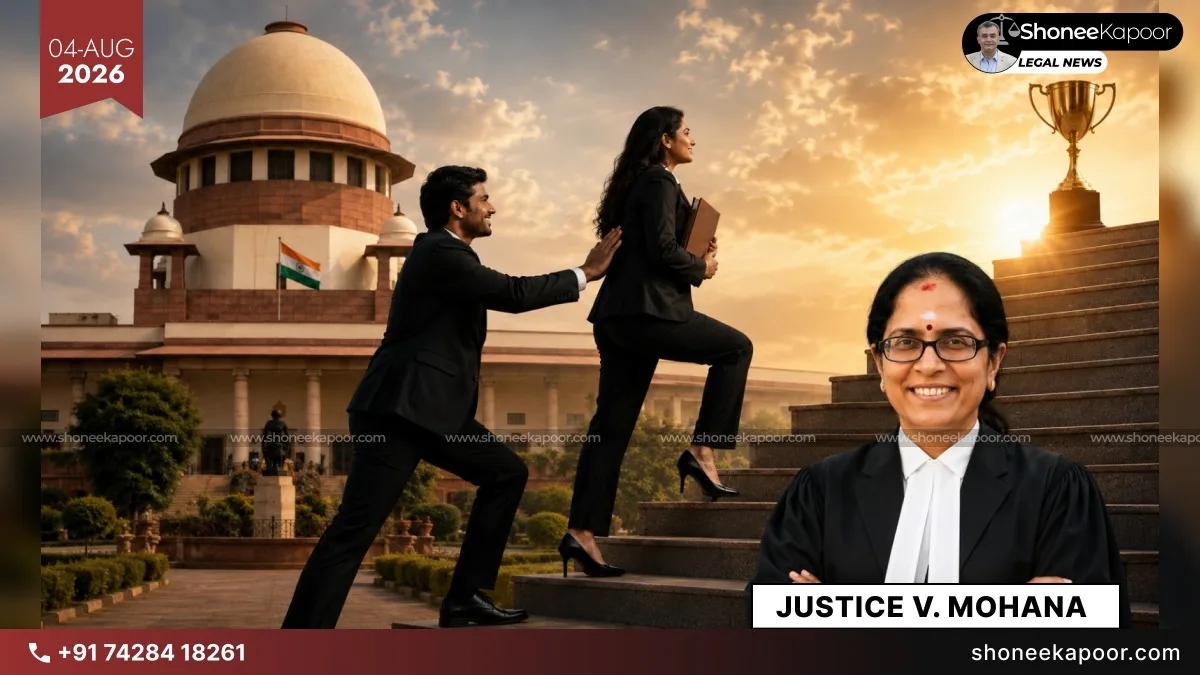
What role did Justice V Mohana’s husband and family play in her rise to the Supreme Court? Her emotional speech revealed the personal sacrifices and support behind her successful legal career.
NEW DELHI: Justice V. Mohana, recently appointed as a judge of the Supreme Court, credited her husband, family, teachers, mentors, juniors and members of the Bar for supporting her long legal journey.
“Behind every successful woman, there is a husband and an entire family,”
-Justice Mohana said while speaking about the people who helped her move from a government school in Tamil Nadu to the Supreme Court of India.
She delivered the speech during a felicitation ceremony organised by the Supreme Court Bar Association for five newly appointed Supreme Court judges. Justice Mohana said her elevation was not an individual achievement but the result of decades of encouragement, professional guidance and support at home.
Referring to her first public appearance after joining the Supreme Court, the event also recalled her earlier address titled:
“Overwhelmed, My First Event Post Becoming Supreme Court Judge”.
The ceremony was held at the Auditorium in the Administrative Building Complex of the Supreme Court. It honoured Justices Sheel Nagu, Shree Chandrashekhar, Sanjeev Sachdeva, Arun Palli and V. Mohana following their appointment to the Supreme Court.
Chief Justice of India Surya Kant, other Supreme Court judges, Attorney General R. Venkataramani, Solicitor General Tushar Mehta, SCBA President Vikas Singh, senior advocates, Bar Association office-bearers and other lawyers attended the function.
Calling the occasion “a very emotional moment“, Justice Mohana said the Supreme Court was also the institution where she had developed her skills and identity as a lawyer.
“This is the place where I grew up, where I honed my skills as a professional, where I got so much love and affection. This is the Bar which has actually promoted, encouraged me, and allowed me to grow my wings,” she said.
Justice Mohana thanked the Chief Justice of India and the members of the Supreme Court Collegium for trusting her and recommending her appointment. She also gave special credit to her parents, particularly her mother, who strongly encouraged her to build a career in law.
“It is my mother’s dream that has brought me here,” she said.
Justice Mohana added that she had never imagined that she would one day address the legal fraternity as a judge of the Supreme Court.
She studied in a government school in Tamil Nadu. According to her, the teachers supported students beyond classroom education and sometimes provided necessary items, including uniforms and geometry boxes.
Justice Mohana later joined Government Law College, Coimbatore. She was part of the first batch of the five-year law course introduced in Tamil Nadu between 1983 and 1988.
She also remembered that Supreme Court judge Justice Kalpathy Venkataraman Vishwanathan was her classmate. She described them as members of that “proud batch“.
Justice Mohana began practising law under experienced civil lawyer M. Panchapakesan in Coimbatore. During this period, she learnt civil trial practice and developed a strong understanding of the Civil Procedure Code.
On her senior’s advice, she shifted to Delhi in 1992. While recalling the early period of her marriage and professional life, she said she and her husband lived in a modest barsati accommodation in Karol Bagh.
During the felicitation ceremony, she was shown her Supreme Court Bar Association membership form from March 1994. The document reminded her of the difficulties, limited resources and professional uncertainty of those early years.
Her statement also highlighted an often-overlooked reality: professional success may depend not only on personal ability but also on the emotional, financial and domestic support provided by a spouse and family. In demanding careers, such contributions frequently remain outside public recognition even though they make professional growth possible.
Justice Mohana worked with several respected members of the Bar and briefed the Attorney General for India in many cases. These professional experiences helped strengthen her legal career.
In 2015, the full court of the Supreme Court designated her as a Senior Advocate.
She also thanked her junior lawyers for carefully preparing cases and supporting her throughout her practice. Addressing young advocates, she encouraged them to set ambitious goals. She said that when a person from Pollachi, Erode and Coimbatore could reach the Supreme Court Bench, the next generation could achieve even more.
Justice Mohana further acknowledged the contribution of her siblings. She said she was the eleventh child among thirteen children.
She also thanked her in-laws, her son and the caregiver who looked after him while she managed the demands of her legal profession. Her account recognised that childcare and family responsibilities do not disappear when a person pursues a serious career. They are often managed through the labour, adjustment and sacrifices of several people, including the spouse and extended family.
At the end of her address, Justice Mohana said she would try to honour the confidence placed in her while performing her judicial duties. She sought the continued cooperation of the Bar and the guidance of her fellow judges.
“I am hopeful that I will be able to do the duty that has been given to me,” she said.
KEY TAKEAWAYS
- Justice V. Mohana clearly acknowledged that her husband and family played a major role in her professional success.
- A man’s emotional, financial and domestic support often remains invisible when a woman’s achievements are celebrated.
- Her statement challenges the one-sided narrative that only women sacrifice for the careers and success of men.
- Husbands who manage responsibilities, support childcare and stand through difficult years also deserve equal public recognition.
- Equality cannot mean praising women’s success while deliberately erasing the men whose sacrifices helped make that success possible.
This Could Change Your Case-Get FREE Legal Advice-Click Here!
Disclaimer: The views and opinions expressed in this article are those of the Indian courts and do not necessarily reflect the official policy or position of “ShoneeKapoor.com” or its affiliates. This article is intended for informational and educational purposes only. The content provided is not legal advice, and viewers should not act upon this information without seeking professional counsel. Viewer discretion is advised.
