
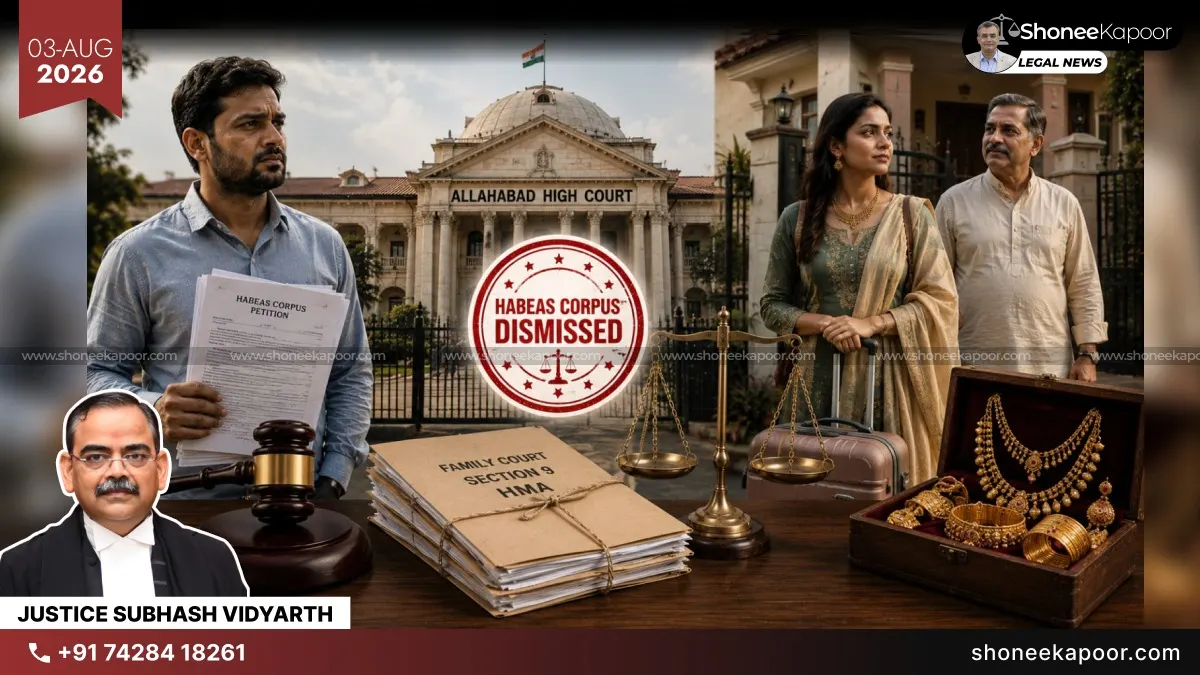
Can a husband use Habeas corpus after his wife leaves with jewellery and blocks all contact? The Allahabad High Court held that concern alone cannot establish illegal detention and directed him towards the remedy under Section 9 of the Hindu Marriage Act.
LUCKNOW: The Allahabad High Court has held that a husband cannot use a habeas corpus petition to secure the production of his wife when his own pleadings indicate that she voluntarily left the matrimonial home and is residing with her father.
Justice Subhash Vidyarthi dismissed the petition after finding that the husband had failed to establish even a prima facie case that his wife had been illegally or forcibly detained.
The petition was filed by the husband, who alleged that his wife was being illegally detained by her father. He also stated that he was not being allowed to meet or communicate with her.
According to the petition, the parties were married on April 28, 2026, at Lucknow. The wife came to the matrimonial home on April 29, and a reception was organised on April 30.
She initially went to her parental home as part of customary rituals. She later returned to the matrimonial home on May 17, 2026.
The husband stated that on May 25, 2026, his wife left the matrimonial home with her brother and another person. He alleged that she took her articles and jewellery worth approximately ₹15 lakh and subsequently blocked all communication with him.
Faced with a complete loss of contact, the husband approached the police on June 13, 2026, and later submitted a complaint through the IGRS portal. Expressing concern regarding his wife’s well-being, he sought a direction for her production before the High Court.
However, the Court noted that the husband’s own pleadings showed that the matrimonial relationship had remained strained almost from the beginning.
The petition stated that the wife had not consented to physical relations during her stay at the matrimonial home. It also stated that while leaving the house, she had taken her belongings and valuable jewellery with her.
The Court found that these facts did not support the allegation of sudden or forcible detention. Instead, they indicated that the wife had consciously left the matrimonial home.
The State also placed before the Court a written application submitted by the wife to the police on June 15, 2026.
In her complaint, the wife alleged that ₹5 lakh in cash, a Venue car worth ₹11.5 lakh, jewellery, clothes, household articles and other gifts had been given during the marriage ceremonies.
She further alleged that her husband and his family demanded additional money and subjected her to physical assault and mental harassment. She stated that she left the matrimonial home because of this alleged treatment.
These allegations were not finally decided or proved by the High Court. The written complaint was considered only for determining whether she was residing at her father’s home voluntarily or was being illegally detained.
The husband relied upon the Supreme Court judgment in Devu G. Nair v. State of Kerala, which issued guidelines for dealing with habeas corpus petitions and police-protection petitions involving allegations that an adult person was being detained by family members.
The High Court, however, found that the Supreme Court decision arose from a different factual background. It emphasised that legal principles cannot be mechanically applied without considering the individual facts of each case.
The Court observed:
“Every case is to be decided keeping in view the peculiar factual background of the case and legal principles and guidelines cannot be applied in abstract”.
The High Court noted that the petition itself disclosed serious matrimonial differences. The wife had allegedly refused physical relations, left with her articles and jewellery, blocked communication and shifted to her father’s house.
The Court held that these circumstances were inconsistent with the husband’s claim that she had been forcibly confined.
It stated that the pleadings themselves:
“prima facie indicate that the wife has willingly left her matrimonial home and has shifted to her father’s home”.
The Court said this prima facie conclusion was further supported by the wife’s written complaint alleging physical and mental cruelty at the matrimonial home.
During the hearing, the Court orally observed that the matter appeared to concern a wife leaving the matrimonial home because of “matrimonial bickerings”.
The Court said that the more appropriate remedy available to the husband was to institute proceedings for restitution of conjugal rights under Section 9 of the Hindu Marriage Act.
Section 9 permits either spouse to approach the Family Court when the other spouse has withdrawn from their society without reasonable excuse.
The husband relied on the Explanation attached to Section 9, which states:
“where a question arises whether there has been reasonable excuse for withdrawal from the society, the burden of proving reasonable excuse shall be on the person who has withdrawn from the society”.
The High Court clarified that this evidentiary burden would arise only after the husband institutes a proper case before the Family Court, summons are issued and the wife appears to contest the proceedings.
The Explanation to Section 9 could not be used to avoid the statutory process and directly seek a writ of habeas corpus.
The Court stressed that habeas corpus is a remedy against illegal detention, not a substitute for matrimonial remedies. A husband’s inability to communicate with his wife, even after she leaves with valuable articles and blocks contact, does not by itself legally prove that she has been unlawfully confined by her parents.
Rejecting the petition, the Court concluded:
“The petitioner has failed to make out that his wife Anamika Yadav has been illegally and forcibly detained by her father and it appears that she has willingly left her matrimonial home and is residing in her father’s home”.
Finding no prima facie evidence of unlawful detention, the Court dismissed the habeas corpus petition of the Husband at the admission stage. The husband was left free to pursue the statutory matrimonial remedy available under Section 9 of the Hindu Marriage Act.
EXPLANATORY TABLE OF LAWS AND SECTIONS
| Law or Provision | What It Means | Application in This Case |
| Article 226 of the Constitution of India | Gives High Courts the power to issue constitutional writs, including habeas corpus, for enforcement of legal and fundamental rights. | The husband invoked the High Court’s writ jurisdiction and sought production of his wife. |
| Writ of Habeas Corpus | A constitutional remedy used to secure the release or production of a person who is allegedly being illegally or forcibly detained. | The husband alleged that his wife was being unlawfully detained by her father. The Court found no prima facie evidence of detention. |
| Section 9, Hindu Marriage Act, 1955 | Allows a spouse to seek restitution of conjugal rights when the other spouse has withdrawn from their society without reasonable excuse. | The High Court said this was the appropriate statutory remedy available to the husband. |
| Explanation to Section 9, Hindu Marriage Act | Places the burden of proving reasonable excuse upon the spouse who has withdrawn from the society of the other spouse, once the issue arises in a properly instituted proceeding. | The husband relied on this Explanation, but the Court said the burden would arise only in proceedings before the Family Court. |
| Family Courts Act, 1984 | Provides specialised Family Courts for deciding matrimonial disputes, including restitution of conjugal rights. | The husband was required to approach the competent Family Court instead of using habeas corpus as a matrimonial remedy. |
| Devu G. Nair v. State of Kerala, 2024 INSC 228 | The Supreme Court issued safeguards and procedural guidelines for habeas corpus and police-protection cases involving allegations that an adult person was being detained by family members. | The husband relied on this judgment, but the High Court distinguished it because the facts showed that the wife had apparently left voluntarily. |
CASE DETAILS
| Particular | Details |
| Case Title | Anupam Yadav v. State of U.P. Through Additional Chief Secretary, Department of Home, Lucknow and 3 Others |
| Court | Allahabad High Court, Lucknow Bench |
| Jurisdiction | Constitutional Writ Jurisdiction |
| Case Number | Habeas Corpus Writ Petition No. 235 of 2026 |
| Bench | Justice Subhash Vidyarthi |
| Petitioner | Anupam Yadav |
| Respondents | State of Uttar Pradesh and three others |
| Neutral Citation | 2026:AHC-LKO:43274 |
| Decision | Habeas corpus petition dismissed at the admission stage |
COUNSELS APPEARED
| Party | Counsel Details |
| For the Petitioner (Husband) | Rakesh Kumar, Ashutosh Singh and Pooshan Upadhyay, Advocates |
| For the Respondents (State) | Ganesh Dutt Bhatt, Additional Government Advocate-I |
KEY TAKEAWAYS
- A husband’s genuine concern is not enough for habeas corpus unless illegal detention is prima facie proved.
- The wife allegedly left with jewellery worth around ₹15 lakh and blocked communication, yet the husband still had to meet a strict legal threshold.
- The Court did not finally decide the wife’s allegations against the husband and his family.
- Habeas corpus cannot be used as a shortcut in a matrimonial dispute when the proper remedy lies under Section 9 of the Hindu Marriage Act.
- A man may lose contact, face allegations and remain deeply concerned, but the law still requires him to prove unlawful confinement before granting constitutional relief.
This Could Change Your Case-Get FREE Legal Advice-Click Here!
Disclaimer: The views and opinions expressed in this article are those of the Indian courts and do not necessarily reflect the official policy or position of “ShoneeKapoor.com” or its affiliates. This article is intended for informational and educational purposes only. The content provided is not legal advice, and viewers should not act upon this information without seeking professional counsel. Viewer discretion is advised.
