
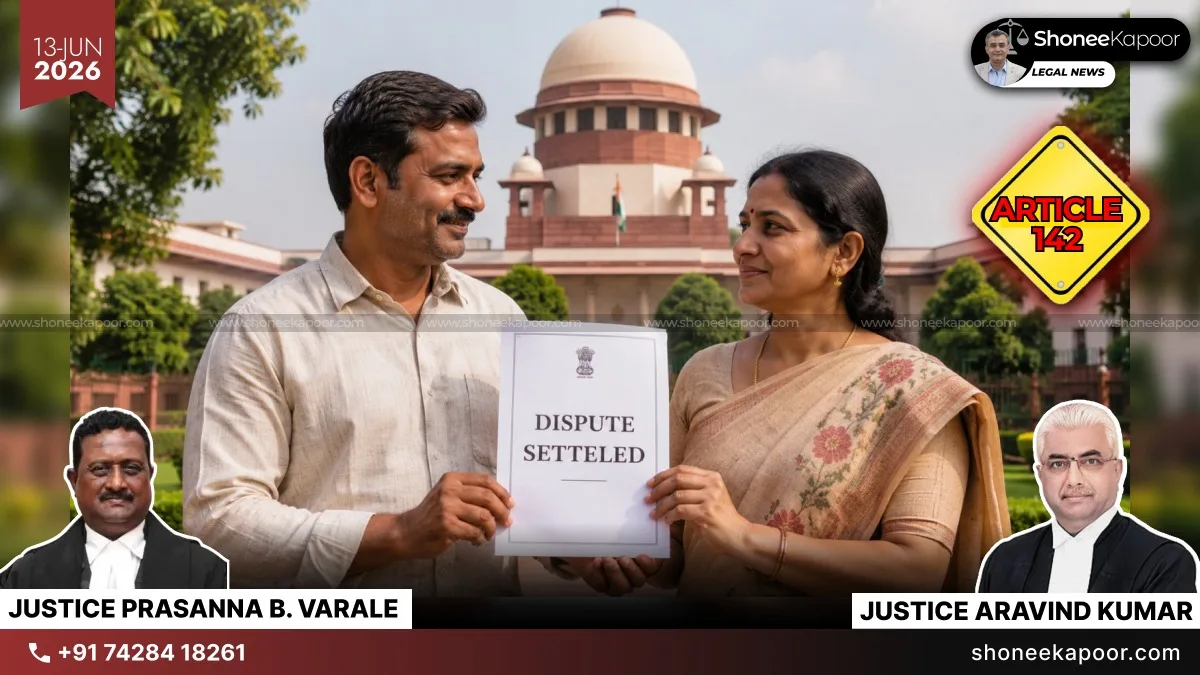
After a 15-year legal battle, the couple informed the Supreme Court that they had resumed living together peacefully. The Court accepted the compromise and closed the criminal proceedings.
NEW DELHI: The Supreme Court of India, through a Bench of Justice Aravind Kumar and Justice Prasanna B. Varale, acquitted a man using article 142 who had earlier been convicted for assaulting his wife after the couple informed the Court that they had reconciled and were now living together peacefully.
The case arose from an incident that took place on July 6, 2011. According to the prosecution, a husband had assaulted his wife with a stick, causing several injuries, including a fracture to her hand. Based on the testimony of the injured wife, other witnesses, and medical evidence such as the wound certificate and X-ray report, the Trial Court convicted him under Sections 324 and 326 of the IPC. He was sentenced to two years’ imprisonment under Section 326 IPC along with fines.
The Karnataka High Court later upheld the conviction. It found that the wife’s testimony was supported by their daughter’s statement and medical records. The High Court observed that the fracture suffered by the complainant clearly attracted the offence under Section 326 IPC and that the sentence imposed was appropriate.
However, while the matter was pending before the Supreme Court, the husband and wife jointly filed an application seeking permission to settle the dispute. They informed the Court that, with the help of elders, relatives and well-wishers, they had resolved their differences and had resumed their married life.
The application stated that the complainant no longer wished to continue the criminal proceedings and had no objection if the conviction and sentence were set aside. The lawyers for both sides submitted that the compromise was genuine and voluntary. The parties also personally affirmed the settlement before the Court.
The Supreme Court noted that it had, in several earlier cases, accepted post-conviction settlements to secure complete justice between parties involved in personal disputes. The Court observed:
“This Court has also consistently held that in exercise of powers under Article 142 of the Constitution of India, this Court can give quietus to criminal proceedings where the dispute is personal in nature and the parties have genuinely settled their disputes.”
The Court further stated:
“While noting the offense under Section 326 IPC is non-compoundable under the provisions of the Criminal Procedure Code, 1973, in the exceptional circumstances of this case prevailing namely appellant and the complainant being husband and wife, including the voluntary settlement between the parties, which would warrant the exercise of this Court’s inherent powers to give effect to the compromise.”
The Bench also recorded the wife’s voluntary statement before the Court. It noted:
“She has stated in categorical terms that she has entered into the settlement without any force, threat or coercion.”
Accepting the settlement, the Supreme Court held:
“In view of the same, we see no impediment to accept the same settlement.”
The Court modified the earlier sentence by treating the period already undergone by the husband as sufficient punishment and directed his immediate release from jail. Finally, bringing the long-running litigation to an end, the Supreme Court acquitted the husband of all charges and discharged his bail bonds.
EXPLANATORY TABLE: LAWS AND SECTIONS INVOLVED
| Law / Section | Purpose | How It Applied In This Case |
| Section 324 IPC | Punishes voluntarily causing hurt by dangerous weapons or means. | The husband was convicted by the Trial Court for causing injuries to his wife. |
| Section 326 IPC | Punishes voluntarily causing grievous hurt by dangerous weapons or means. | The wife’s hand fracture amounted to grievous hurt, leading to conviction under this provision. |
| Section 320 CrPC | Provides for compounding of certain offences. | Section 326 IPC is non-compoundable under this provision. |
| Article 142 of the Constitution of India | Gives the Supreme Court power to do “complete justice” in any matter. | The Supreme Court used this extraordinary power to accept the settlement and acquit the husband. |
| Section 324 IPC (Compounding Principle) | Courts have allowed compromise in appropriate cases. | The Supreme Court relied on earlier precedents permitting post-conviction settlements. |
| Section 326 IPC (Non-Compoundable Nature) | Normally cannot be settled between parties. | Despite this restriction, the Court invoked Article 142 due to exceptional matrimonial circumstances. |
CASE DETAILS
- Case Title: Husband v. The State of Karnataka
- Court: Supreme Court of India
- Case Number: Criminal Appeal arising out of SLP (Crl.) No. 8566 of 2026)
- Date of Judgment: 27 May 2026
- Bench: Hon’ble Mr. Justice Aravind Kumar | Hon’ble Mr. Justice Prasanna B. Varale
- Counsels:
- For Appellant: M/s. Gururaj & Nayak, AOR , Mr. C. B. Gururaj, Advocate, Mr. Hari Abishek P., Advocate, Ms. Pragya Smriti, Advocate, Mr. Dilip Kumar L., Advocate, Mr. Naveen Chandrashekar, Advocate, and Mr. K. P. Singh, Advocate
- For State: Mr. K. V. Muthu Kumar, AOR, and Ms. Gagandeep Chauhan, Advocate
- For Respondent No. 2: Ms. Rooh-e-Hina Dua, AOR, Ms. Shreya Arora, Advocate, and Ms. Shrutika Garg, Advocate
KEY TAKEAWAYS
- The Supreme Court recognised that not every matrimonial dispute should continue endlessly when both spouses have genuinely reconciled and chosen to move forward together.
- Justice should not become mechanical. When the complainant herself voluntarily seeks closure, the legal system must balance punishment with fairness and practicality.
- Men should not carry a lifelong criminal stigma in personal disputes where the parties have resolved their differences without force, threat, or coercion.
- Article 142 serves as an important safeguard to prevent rigid procedures from defeating the larger goal of complete justice in exceptional cases.
- Preserving restored families and bringing genuine disputes to a meaningful end can sometimes serve society better than prolonged litigation.
This Could Change Your Case-Get FREE Legal Advice-Click Here!
Disclaimer: The views and opinions expressed in this article are those of the Indian courts and do not necessarily reflect the official policy or position of “ShoneeKapoor.com” or its affiliates. This article is intended for informational and educational purposes only. The content provided is not legal advice, and viewers should not act upon this information without seeking professional counsel. Viewer discretion is advised.
