
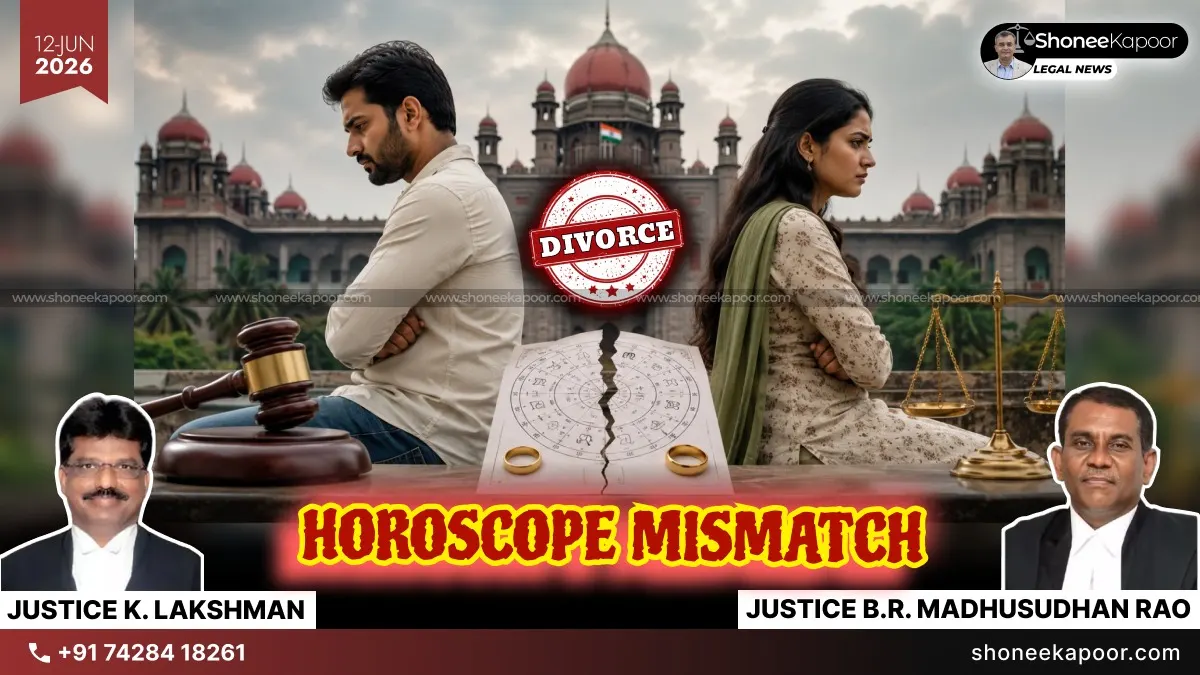
Does a horoscope mismatch automatically make a marriage void? The Telangana High Court refused to declare the marriage null merely on this ground and instead granted divorce after finding that the relationship had irretrievably broken down.
HYDERABAD: In a judgment delivered on May 4, 2026, a Division Bench of Justice K. Lakshman and Justice B.R. Madhusudhan Rao of the Telangana High Court dealt with a matrimonial dispute that began with an alleged false declaration of age on a matrimonial website.
The wife had challenged the Family Court’s decision after her plea seeking annulment of marriage was dismissed. She claimed that her marriage, solemnised on August 24, 2018, was based on fraud because the husband had allegedly shown his date of birth as 09.02.1981 on telugumatrimony.com, while his actual date of birth was 09.02.1974.
According to the wife, she belonged to an orthodox family and strongly believed in horoscope matching before marriage. Since the horoscope was prepared using the date of birth disclosed by the husband, she agreed to the marriage believing that they belonged to the same age group and that their horoscopes were compatible.
The High Court examined whether this allegation amounted to fraud sufficient to annul the marriage under Section 12(1)(c) of the Hindu Marriage Act. The judges noted that both parties were adults at the time of marriage and that the wife’s case was based solely on the allegation that the husband had furnished an incorrect date of birth, resulting in a wrong horoscope match.
The Court also took note of the fact that criminal and domestic violence proceedings initiated by the wife against the husband were pending before the competent courts. However, these proceedings were independent and could not determine the outcome of the matrimonial appeal.
During the hearing, both parties informed the Court that they were no longer interested in continuing their marital relationship. The Bench found that there was no possibility of reconciliation between them.
The Court observed:
“The aforesaid facts would reveal that both the appellant and the respondent are not interested to lead the marital life. Therefore, there is no possibility of reunion.”
The wife stated that she was willing to withdraw the pending proceedings if she received a fair and reasonable settlement and the return of her gold ornaments. The husband, on the other hand, expressed his willingness to consent to the appeal subject to the withdrawal of those cases.
The High Court clarified that these disputed issues regarding settlement, gold and other claims could not be decided in the present appeal and would have to be pursued before the appropriate forum.
The Bench further clarified that permanent alimony cannot be granted automatically and requires a separate application under Section 25 of the Hindu Marriage Act.
Finally, setting aside the Family Court’s order, the High Court dissolved the marriage by granting a decree of divorce.
The Court also granted liberty to the wife to seek appropriate remedies regarding permanent alimony and the return of gold ornaments before the competent forum in accordance with law.
EXPLANATORY TABLE: LAWS AND PROVISIONS INVOLVED
| Law/Provision | Purpose | Relevance in This Case |
| Section 12(1)(c), Hindu Marriage Act, 1955 | Annulment of marriage due to fraud or force. | Wife alleged the husband concealed his true age and obtained her consent through fraud. |
| Section 25, Hindu Marriage Act, 1955 | Permanent alimony and maintenance. | Court held that a separate application is required to claim alimony. |
| Section 7, Family Courts Act, 1984 | Gives Family Courts power over matrimonial disputes. | The original annulment petition was filed before the Family Court under this provision. |
| Section 12, Protection of Women from Domestic Violence Act, 2005 | Provides remedies under the DV Act. | The wife’s DV case against the husband was already pending. |
| Kuldeep Rai v. Smt. Rita, 2024 Supreme (MP) 201 | Separate plea needed for alimony. | Relied upon by the Court to deny alimony in the absence of an application. |
| Child Marriage Restraint (Amendment) Act, 1978 | Mentioned in Section 12(1)(c). | Referred to while interpreting the provision; not directly applicable as both parties were adults. |
CASE DETAILS
- Case Title: XXXXXXXXX v. XXXXXXXXX
- Court: High Court for the State of Telangana at Hyderabad
- Case Number: F.C.A. No. 226 of 2024
- Date of Judgment: 04 May 2026
- Bench: Hon’ble Sri Justice K. Lakshman | Hon’ble Justice B.R. Madhusudhan Rao
- Counsels:
- For Appellant: Mrs. Pushpinder Kaur, representing Mr. G. Durga Charan
- For Respondent: Mr. G. Ramakrishna, representing Mr. Pradeep Kumar Lahot
KEY TAKEAWAYS
- Not every allegation of “fraud” in marriage automatically makes the husband legally wrong or the marriage void.
- Matrimonial disputes often trigger multiple criminal and civil proceedings, but courts must examine each case on evidence and law, not emotions.
- A broken marriage should not be forced to continue when both spouses admit that there is no possibility of reunion.
- Claims relating to alimony, gold, and other financial disputes require proper legal procedures and cannot be granted as a matter of right.
- Family courts must focus on legal standards and fairness rather than assuming guilt based solely on allegations.
This Could Change Your Case-Get FREE Legal Advice-Click Here!
Disclaimer: The views and opinions expressed in this article are those of the Indian courts and do not necessarily reflect the official policy or position of “ShoneeKapoor.com” or its affiliates. This article is intended for informational and educational purposes only. The content provided is not legal advice, and viewers should not act upon this information without seeking professional counsel. Viewer discretion is advised.
